POSTED ON 06/05/2018 BY RATIMA CHANDREMA
Abstract
This paper discusses social networking sites (SNSs), which are used by around 40% of the world’s population daily to create an online world where users can use to present themselves, interact and stay connected with friends or strangers (Brown, 2018). In 2010, a social application named “Instagram” was developed and become the most popular image-based application. By that, many researches relate to social media and mental health issues have looked at the connection between them. In this paper, it will particularly investigate the connection between Instagram and depression. This paper will examine on common motives of using Instagram by young adults such as coolness and surveillance/knowledge about others and factors such as time spending on Instagram, percent of strangers followed, and social comparison which could be a risk to have depressive symptoms and could affect young adult users.
Keywords: Depression, Instagram, Mental Health, Social Media
Social networking sites (SNSs) give a public/private online space for individuals to present themselves and have remarkably changed the way we communicate, express our identity, do business, and live. Some of the most well-known and popular include Facebook, Twitter, and Instagram. These SNS and associated applications are providing a channel for users to stay connected with their friends, communities, and the world (Donnelly, 2017). In these applications, users can share their ideas, personal information, photos and other kinds of media to their friends or even strangers. These abilities encourage users to express things that represent their identity. However, one of the SNS’s essential characteristics is social interaction from both content creator and viewer sides. These mentioned features create an online social world that is fundamentally different than its offline counterpart. To be successful in online social media applications means that the user has a lot of interaction from other users. The way to count those interactions is by looking at the number of their followers, numbers of likes and comment on their posts. It inspires users to present the most positive aspect of their lives in order to gain virtual attentions such as likes, or comments not only from their friends, but strangers around the world (Lup, Trub & Rosenthal, 2015). Most young adult users strive to be recognized in social media which is one of the negative impacts of using social media. This paper will focus on one of the most famous SNS among young adult, aged between 18-29-year-old called Instagram. It will examine on a statement that the usage of Instagram could affect young adult users to develop depressive symptoms.
Instagram and young adults
Instagram is an online photo-sharing application which has 800 Million users from around the world (Wade, 2018). It is one of the most popular SNS applications among young adults. Instagram allows users to post pictures and short videos to their profiles. Text-only contents cannot be created on Instagram unlike other social media such as Facebook or Twitter (Lee, Lee, Moon & Sung, 2015). Users can write a caption or use hashtags to describe the photos. To look at the notable social interaction features, Instagram users can like, comment on posts, send direct messages to other users and they are able to tag other users in their pictures as well. Instagram users can choose to make their profile as a public or private profile but it is common for people to set their profile as public. The primary reasons of using a public profile are that it enables other users to able to view, follow the profile, give likes and comments on public posts. Another reason is the public profile can be searchable via names or hashtags on its posts (Lup, Trub & Rosenthal, 2015). By that, using hashtags can promote your pictures as well as your profile to be followed by other users who could be random strangers and gain popularity.
Motives of Using Instagram
Almost 60% of Instagram users are young adults, aged between 18 and 29-year-old (Wade, 2018). Sheldon & Bryant (2016), analysed Instagram users’ behaviors and studied the motives of using Instagram. The results show there are 4 major purposes of using Instagram which are surveillance/knowledge about others, documentation, coolness, and creativity. Moreover, they also found that users tend to put less significant on connecting or interacting with other people, but they focus more on personal identity and self-promotion. Two motives which are important to this paper are coolness and surveillance/knowledge about others.
People normally join activities because of popularity with their friends (Sheldon & Bryant, 2016). In the case of Instagram, it has features which society considers they are cool such as applying filters for your photos, tagging, following trendy hashtags, convenient ways to explore other users’ photos, and opportunities to follow celebrities’ life. Further than the features, Instagram offers a channel for ordinary people to gain popularity and self-promotion. Most of Instagram users’ goal is to gain a significant number of “likes” on their posts. For instance, Dumas, Maxwell-Smith, Davis & Giulietti (2017) have examined the frequency of doing like-seeking behaviors by almost 500 participants and the result presents that about 90% of participants have at least one like-seeking behavior. The most common behaviors are uploading and taking a picture, using a hashtag and a filter while using software or application to modify one’s physical appearance, and purchasing followers and likes are the least common behaviours (Dumas et al., 2017). They concern about the “likes” because ‘likes” are used to justify their popularity, also the number of followers is used to judge one’s popularity (Sheldon & Bryant, 2016). Greenwood (2013) said that it is human nature to have the need to feel seen, valued, and recognized by other people. Therefore, the “likes”, “comments”, and the number of followers have acted as a kind of social support from others. These can directly affect one’s self-esteem and self-worth. For example, participants in a study describe that they feel like winning, happy and flattered when they receive attentions such as likes or comments, on the other hand, it can lower self-confidence and self-esteem when they do not get many attentions (Chua & Chang, 2016).
Another motive that may cause depressive symptom is surveillance/knowledge about others. One of the main reasons for using Instagram is “surveillance/knowledge about others” (Whiting and Williams, 2013). Users that have this motive want to use Instagram to interact with friends, to see visual posts of others, to follow friends and inspirational accounts, to “like” followers’ photos. To look at the term “knowledge about others”, it means that users like to gather other users’ information ranging from socio-economic status, relationship status, number of friends and more which can be found on the Instagram profiles. These actions and behaviors of browsing other users’ photos on Instagram may trigger the presumption that these photos are demonstrative of how those users actually live. As the research from Lup, Trub & Rosenthal (2015) asserts that the act of conclusive other people life by judging from shown photos on Instagram’s profile makes people more vulnerable because they compare themselves with assumed lives of others. This can lower their self-esteem and trigger the occurrence of depressive symptoms.
Discussion
Depression is a sensitive issue to inspect and it could be different for each individual. However, researches by Lup, Trub & Rosenthal (2015), Hernandez & Smouse (2017), Donnelly (2017), and Uhlir (2016) which all study the connection of social media application usage and depression. By these researches, there are three major factors that can lead users to have depressive signs. The first is the amount of Instagram using time, next is the percent of strangers followed, and lastly social comparison. Those 3 variables are all connected together to make a development of depression of Instagram users.
The study from Lup, Trub & Rosenthal (2015) has focused on the link between frequency of using Instagram and depressive symptoms. He found that other variables such as social comparison and the percent of strangers followed are unavoidable to look at the same time. He purposes the links between those 3 factors with the depressive symptom (See Appendix A). The method that he used to collect data is doing a survey of young adult participants whose age is in the range of 18 to 29 years old. He collected information about the amount of time they use the Instagram daily, a total number of strangers who follow them and strangers that they followed, measured feeling scale 1 out of 10 of 4 items from the Social Comparison Rating Scale. Those 4 items are confident, attractive, desirable and inferior in comparison to other users on Instagram. And last needed info on depressive symptoms which measured by using the Center for Epidemiological Studies Depression scale (CES-D). The results from Lup, Trub & Rosenthal (2015) study indicated that a significant moderator is strangers followed which associate between Instagram use and social comparison, but it has a slight effect on the association between Instagram use and depressive symptoms. Further, the research reveals that the more Instagram use is related to have a greater risk of depression only for users that have high levels of strangers followed. Still, there is a trend which shows that Instagram use and depressive symptoms can be indirectly associated when social comparison was positive at the highest levels of strangers followed. He interprets the results that more frequency of using Instagram had a slightly significant direct association with greater depressive symptoms. Also, more frequent Instagram use was not associated with social comparison, and more positive social comparison was associated with fewer depressive symptoms. About the number of strangers followed, it significantly controls the correlation of Instagram use with social comparison and it indirectly associated between Instagram use and depressive symptoms. His findings highlight the importance of how many strangers follows are, he said that it can lead to have a negative social comparison because users more likely to judge toward those they do not know and places improper attentions on their characteristics to explain behavior. However, seeing friends’ photos or posts might generate positive feelings because the users know how their friends actually live. Therefore, the conclusion from Lup, Trub & Rosenthal (2015) is using Instagram has negative effects with well-being for those who follow a lot of strangers, but for those who follow fewer strangers on Instagram, it reflects positive associations with well-being.
Another research from Hernandez & Smouse (2017) also investigates the relationship of time spent on Instagram and depression symptoms. It explains that spending large amounts of time on Instagram and seeing other people have happier lives make them believe that life is not fair. The author said that the feeling is worsen when they follow strangers and Instagram has offered an opportunity for users to do it. Moreover, when users follow public figures who have privileged lives, it will lead them to make a correspondence bias, and unsettled negative comparison, finally they could develop low self-esteem issues, dissatisfaction, and depression. Next study from Donnelly (2017), it adds another explanation for Instagram use associates with depressive symptoms by using social rank theory. Users are competing against other users to reach online social media fame and a common goal. On Instagram which fame means having lots of followers and likes on photos. Social rank theory verifies that users will feel overcome or upset if they cannot succeed in reaching the goal. Sloman (2003) states that when people fail to compete others in social rank, it considers as a failure and it can cause mechanisms for suffering from defeat. In relation to Instagram users, they could feel vulnerable and depressed because they are not achieving the Instagram platform goal by not receiving considerably likes and other attentions as other users.
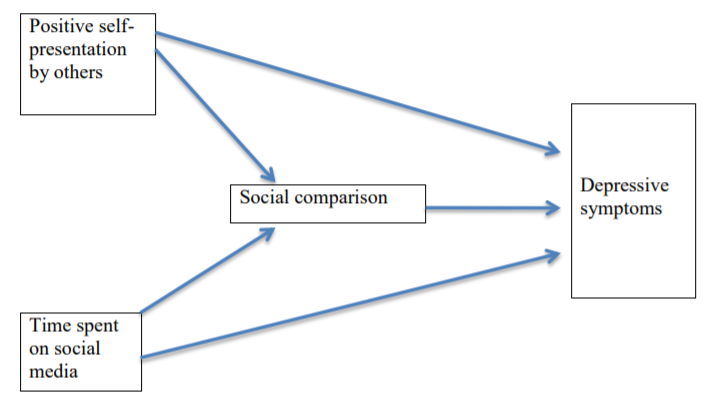
Lastly, one more interesting research which similar to the research by Lup, Trub & Rosenthal (2015). Uhlir (2016) has studied the correlation between social media time and depressive symptoms. His mediation about relationships between variables are some different from Lup, Trub & Rosenthal (2015) by adding Positive self-presentation by others as a variable (See Appendix B). Although, he did not purposeful focus on Instagram the result of his research is interesting. He discusses that spending time on social media has linked to depression which mediated by social comparison. As well as, observing other users’ self-enhancing posts frequently on social media is often to have a social comparison-mediated and positive relationship to depression. Still, levels of favorable self-presentation of users are expected to be indirectly correlated with depression. He concluded that social media still can be good for users who have self-affirming purposes, but it will be unhealthy to use it for social comparison.
Conclusion
Social network applications become a new medium for people in this digital age to communicate and stay connected with other people whether friends or strangers. Most of social applications have offer interactive features such as “like”, “comment” or “follow” which are drawing attention for most teens and young adults. Especially, Instagram which has millions of users around the world and is one of the most popular among other social media apps (Wade, 2018). Instagram is a photo-based app with unique features that provoke users to have some kind of behaviors which may lead to develop depressive symptoms. From many social media or Instagram related studies, it could interpret that there are 3 major factors which are Instagram using time, percent of strangers followed, and social comparison. Those factors are the effects from their motives of using Instagram which 2 directly impacted motives are surveillance/knowledge, and coolness. However, those 3 depression provoked factors are connected together to make users have depression and it might depend on how the users use the Instagram as well. Lup, Trub & Rosenthal (2015) concludes that the users who have a higher risk to develop depression are those who spend a lot of time on Instagram, they follow a lot of stranger accounts to compare themselves with strangers and have a negative feeling toward strangers’ posts. All in all, Instagram is only a tool for online users to be used for earning popularity and connecting with other users. The application itself does not lead users to have depression but the way that the users use the application could contribute depressive symptoms. Still, more studies and research are needed to analyse the link between social media application and depression deeply because depression is a sensitive issue.
References
Brown, J. (2018). Is social media bad for you? The evidence and the unknowns.
Bbc.com. Retrieved 29 March 2018, from
http://www.bbc.com/future/story/20180104-is-social-media-bad-for-you-t he-evidence-and-the-unknowns
Chua, T., & Chang, L. (2016). Follow me and like my beautiful selfies: Singapore teenage girls’ engagement in self-presentation and peer comparison on social media. Computers In Human Behavior, 55, 190-197. http://dx.doi.org/10.1016/j.chb.2015.09.011
Donnelly, E. (2017). Depression among Users of Social Networking Sites (SNSs):
The Role of SNS Addiction and Increased Usage. Journal Of Addiction
And Preventive Medicine, 02(01), 1-6. http://dx.doi.org/10.19104/japm.2016.107
Dumas, T., Maxwell-Smith, M., Davis, J., & Giulietti, P. (2017). Lying or longing for likes? Narcissism, peer belonging, loneliness and normative versus deceptive like-seeking on Instagram in emerging adulthood. Computers In Human Behavior, 71, 1-10. http://dx.doi.org/10.1016/j.chb.2017.01.037
Greenwood, D. (2013). Fame, Facebook, and Twitter: How attitudes about fame
predict frequency and nature of social media use. Psychology Of Popular Media Culture, 2(4), 222-236. http://dx.doi.org/10.1037/ppm0000013
Hernandez, S., & Smouse, A. (2017). Frequency of Instagram Use and the Presence
of Depressive Symptoms in Young Adults. School Of Physician Assistant Studies. Retrieved from https://commons.pacificu.edu/cgi/viewcontent.cgi?article=1611&context=pa
Lee, E., Lee, J., Moon, J., & Sung, Y. (2015). Pictures Speak Louder than Words:
Motivations for Using Instagram. Cyberpsychology, Behavior, And Social
Networking, 18(9), 552-556. http://dx.doi.org/10.1089/cyber.2015.0157
Lup, K., Trub, L., & Rosenthal, L. (2015). Instagram #Instasad?: Exploring
Associations Among Instagram Use, Depressive Symptoms, Negative Social Comparison, and Strangers Followed. Cyberpsychology, Behavior, And Social Networking, 18(5), 247-252. http://dx.doi.org/10.1089/cyber.2014.0560
Sheldon, P., & Bryant, K. (2016). Instagram: Motives for its use and relationship to
narcissism and contextual age. Computers In Human Behavior, 58, 89-97. http://dx.doi.org/10.1016/j.chb.2015.12.059
Sloman, L. (2003). Evolved mechanisms in depression: the role and interaction of attachment and social rank in depression. Journal Of Affective Disorders, 74(2), 107-121. doi: 10.1016/s0165-0327(02)00116-7
Wade, J. (2018). Instagram Statistics 2017 | Smart Insights. Smart Insights.
Retrieved 29 March 2018, from https://www.smartinsights.com/social-media-marketing/instagram-marketing/instagram-statistics/
Whiting, A., & Williams, D. (2013). Why people use social media: A uses and
gratifications approach. Qualitative Market Research: An International Journal, 16, 362–369. https://www.emeraldinsight.com/doi/full/10.1108/QMR-06-2013-0041
Uhlir, J. (2016). Social Comparison and Self-Presentation on Social Media as
Predictors of Depressive Symptoms. Scripps Senior Theses. Retrieved from http://scholarship.claremont.edu/cgi/viewcontent.cgi?article=1801&context=scripps_theses
Appendix A
The diagram shows conditional associations between Instagram use and social comparison at different levels of strangers followed by Lup, Trub & Rosenthal (2015).

Appendix B
The diagram shows associations and relationships between variables by Uhlir (2016).

The work by Ratima Chandrema is under the license of
Creative Commons Attribution-ShareAlike 4.0 International License
Hi Ratima,
Your paper is quite interesting to me as I have not read an article which is based on the analysis of Instagram and depression before. I appreciated that you have given me a chance to know more about the connection between the depression and social media. I agree with the points you have made. Especially the research of 90% of people are having the one-like seeking behavior when they are using the Instagram. People tend to follow or be followed by the unknown people as the number of the “followers” is one of the ways to justify their popularity. Apart from the followers, people also tend to care about their appearance before uploading to Instagram and compare with the other users. These are the new phenomenon which mostly happens amongst the teenagers. I found that sometimes including myself will have the similar behavior. Besides, I found that negative comments will also cause the depression and led to the suicidal thoughts. I saw a news which is about a celebrity who suffering from depression decided to suicide after receiving massive of negative comments on social media. Did you find any similar article regarding to depression and suicide? Thanks.
Looking forward to hearing from you,
Joanne
Thank you for commenting on my paper and interesting in it.
Yes, social media applications including Instagram are becoming a part of our life now. That is why people tend to not acknowledge the connection between depression and social media apps. I noticed myself that I have those behaviors as well. I once deleted a picture on my Instagram because that picture did not receive much attentions (likes and comments) as other pictures of mine. However, those are quite unacceptable behaviors. We shouldn’t let any kind of applications or technologies to affect our mental health. It is an interesting point you suggested about negative comments. I believe negative comments could possibly lead to have depression and It could be involved in cyberbullying issue as well.
Yes, I have read some news and articles about the connection between social media use and suicide. And yes, it is mostly because those victims were receiving negative comments — in other words, they had been cyberbullied.
Ratima
Hi Ratima,
It’s a good chance to know more about the connection between social media and depression. Indeed, I have the same behavior as well. Thus, I wonder why some of the people still choose to upload the photo online even though they receive negative comments in every post. Also, regarding Instagram, I wonder what motivates people to seek attention from the public. I feel like it is unusual that people use social media to reveal themselves as well as their daily life just to gain the attention. I have mentioned some of the points in my paper. Feel free to check it out! Thanks.
https://networkconference.netstudies.org/2018Bentley/2018/05/04/celebrities-online-self-disclosure-of-information-reinforces-the-parasocial-relationship/
Joanne
Hi Joanne,
It a very good question you asked that why do Instagram users choose to seek attention from the public through Instagram. In my knowledge from doing this paper, I have to say that I cannot answer that question now. However, it is no doubt that it is a very interesting point for the further research. Thank you for the comment.
Ratima
Hi Ratima,
Great work! The irreversible nature of social networking sites and the way we interact with them, I believe to be an issue that needs to be discussed more, so that we can learn how to use social media without fierce implications such as depression.
I watched a TED talk for my paper by Sherry Turkle (2012), who said “getting a text is like getting a hug”. I suppose this works in the case of Instagram likes and notifications on things that we post. each time we see someone liked our post, it is like getting a virtual hug, you then know that person likes you and feels you are worthy of double tapping their screen for. On the contrary, the lack of this feels draining, and can make users feel worthless.
Do you think we need to make users more aware of what they are doing online and the implications that a simple like could have on someones mental health? Or do you think we need to be making more resources for those who need the help? As they may not put social media down as the culprit for the way they feel.
I loved reading your paper, particularly because I too focused on the emotional connection we feel when in an online community. If you have time to comment, here is the link to my paper (https://networkconference.netstudies.org/2018Bentley/2018/05/07/emotional-norms-in-online-communities/), I’d love to know your thoughts.
– Abbey
Thank you, Abbey for leaving a comment.
I believe in that too. It is an important issue that we need to be aware of. Social media has been involving in our daily life and everything that make us overlook its possible negative sides.
That must be an interesting TED talk. I completely agree with the quote you brought up. We need and demand that virtual attention too much. I had a post which did not receive many likes or comments on it, so I actually deleted that post. Now I realize how much those virtual attentions could affect my mental health.
Yes, I believe that we need to make an awareness of this issue. We should make all social media users acknowledge those risk behaviors. Also, if they notice themselves that they have one or two of risk behaviors, there should be a channel which offers help and advises a correct way to use the applications.
Thanks again for loving my paper. I will definitely check your paper and leave a comment for sure.
Hi Ratima, just like Joanne noted above I have also never read an article before that discusses the relationship between Instagram and depressive feelings and emotions. It is great to see that you chose to write about a topic and issue that not many people have heard about before and it is great that you are informing people that Instagram can in fact lead to having depressive feelings due to a lack of engagement with your personal Instagram page. I feel that this is such an important issue to note these days, especially amongst younger age groups, considering that social media is becoming more and more popular. There are so many issues in todays society that stem from social media and social networking and although this is a completely different topic to cyber-bullying it is interesting to think that people can feel all of these emotions and feelings because they don’t receive engagement on their Instagram profiles. Do you think that Instagram is often used as a tool to bring people down? Especially amongst younger generations?
I really enjoyed your paper, if you get a chance please check out mine! https://networkconference.netstudies.org/2018Bentley/2018/05/06/social-networking-site-facebooks-negative-impact-on-relationships-through-encouraging-interpersonal-electronic-surveillance/
Lauren
Thank you, Lauren for the comment.
I totally agree with you. This issues that being too obsessive with social media applications and it could lead to develop depression are very important for users especially young adults and teens. I believe we should let them aware of the issues. To answer your question, I think that some people who tend to bully other people and like to bring them down will use Instagram as a handy tool to do cyberbullying. We can see that some of the celebrities now turn off the comment section in their Instagram accounts because it is the right way to avoid being bullied by haters. In the other hand, users who are mentally hurting themselves by using Instagram way too intimate and develop some depressive symptoms would never realize Instagram is the factor or tool that are bringing them down.
Therefore, it is now relevant to make them recognize and acknowledge this issue.
Also, I will definitely check your paper soon. Thanks again Lauren.
Hi Ratima,
I am Evelyn, one of your Instagram followers. I saw the promoting of your paper on your Instagram stories and I found that it is very interesting topic. I agree on the point that users may feel depress when seeing other famous users have a better lifestyle than them. I experienced that as well but now I solved the problem by unfollowing the famous users. Your paper is very good. Hope that the readers now aware of the issue.
Evelyn
Hi Evelyn,
Thank you so much for leaving a comment and interesting in my paper. I am pleased to hear that you can diminish the depression you had and were able to acknowledge your risked behavior. Many young teens or adults might not have an excellent self-awareness as good as you, therefore I picked this topic to promote the issue and hope that readers will be aware of it.
Thank you again.
Ratima
Hi Ratima,
I was scrolling down in networks category and your title immediately catches me. I wanted to read your paper as Instagram is a common app worldwide and obviously, i am one of those using it. It really intrigued me. As i was saying in another comment in another conference paper, the web2.0 is very ‘dangerous’. As we use it in an everyday context, we don’t realize the negative effect that it can cause to people. you talk about young adults, but we should realize that those SNSs are being used more and more at an earlier stage in life in this generation. Parents give their children smartphones, tablets and laptops at a very young age. Children are lying on their age to be able to create an account. This is something that should be controled by parents and this is not being made. Through years, children are put in front of a situation that is not supposed to be for their age. This can be very dangerous with time. As you said, self-esteem can be affected and so many issues also. If this happens to young adults, now imagine children!! Identity is being constructed through online interactions and this has become an everyday interaction for a lot of people.
If you have time, have a look at my paper, i talked a little bit of identity within youth through the web 2.0: https://networkconference.netstudies.org/2018Bentley/2018/05/07/web-2-0-is-having-a-great-impact-on-forging-youth-identity-through-participatory-culture/
Good job, i really enjoyed reading your paper
~Mary~
Hi Mary,
Thank you for the comment. I agree that Instagram would affect younger teens and children as well. As I know that actually, Instagram has an age limit guideline (13 or above year old can create an account), now it is parent responsibility to ban the app for their children if they are younger than the limitation. However, some teens’ identities also still can be manipulated by using social media applications as you said.
Thank you again for the comment
Ratima