Synopsis:
This paper explores the transformation of online connections into a vibrant and active community through DDP Yoga, a fitness program that leverages the power of social media. By examining the strategic use of the DDP Yoga Facebook group, the study highlights how digital interactions are harnessed to cultivate a sense of belonging and active participation among members. The paper delves into the mechanisms of community building, including the integration of user-generated content, shared fitness goals, and real-world meetups. It also discusses how the program’s emphasis on inclusive communication and communal support transcends digital boundaries, fostering not only physical wellness but also social connectivity. Through this case study, the paper contributes to a deeper understanding of how online platforms can effectively translate virtual connections into tangible, real-world community actions, challenging traditional notions of digital versus physical community spaces.
DDP stands for Diamond Dallas Page, or Dallas for short. A former professional wrestler turned fitness guru; Dallas has been able to strategically harness the power of community and through community; develop much more than a fitness empire. DDP Yoga is his brand, and it is marketed has a place for everyone. Being a place for everyone, it has attracted a deep sea of connections; that have gone on to form an extremely diverse and close-knit community. The following essay looks to examine: How have users of the DDP Yoga, Facebook group been able to turn a series of online connections into an active and vibrant community; that relies on genuine user participation and community member contribution to continue expanding its community user base. To do this I will explore how DDP Yoga sets up a strategic approach to turn connections into community, show how members contribute in a meaningful way that adds value to the community, how this online community has extended to the offline world and how members are considered equals.
In a world were there has been disintegration of traditional face to face community, people are often searching for connection. This search for connection can now often be found in the online world and in particular social media. In social media sites like Facebook, users can not only stay connected with their real-world acquaintances but also build connections with users from around the globe (Preece & Maloney-Krichmar, 2005). This ability has been a key feature of fandoms and other interest groups by removing geographical distances it has allowed more people around the globe join the social sphere and enter the conversation (Preece & Maloney-Krichmar, 2005). DDP Yoga is an online fitness program that can be classed has an interest group due to its specific nature; and with that nature it attracts a certain type of user. Though there are several breakaway groups, the official DDP Yoga group can be found on Facebook and at time of writing; has amassed over 70 000 members (DDP Yoga, 2012). What makes this the official Facebook group; is upon sighing up to the DDP Yoga program users are given the direct members only link. Before seeing the link, they are encouraged to join the group, introduce themselves and share updates of their fitness journey (DDP Yoga, n.d.).
This is a community that has been designed to integrate with the DDP Yoga program, yet the community filtration begins a few steps before the connection signs up. The design almost acts like a funnel in finding users that will align with the core values of DDP Yoga. It brings them together and goes on to display Castels theory that; networks are built by the choices and strategies of social actors. (Delanty, 2003, pp. 211). The funnel begins through DDP Yoga’s various social media channels like the main Facebook business page (separate from the community) and its YouTube Channel. On these social channels, many inspirational stories, transformations, and fitness journeys can be found and from here many users are then able to navigate their way to the DDP Yoga website (DDP Yoga, 2012a). These videos not only act in showing casing to the viewer the commitment require in the DDP Yoga program, but also serve in setting the community tone; making the viewer aware that the DP Yoga community is there to support them on their own personal fitness journey (DDP Yoga, 2012a). Any confusion a member might have about the DDP Yoga program is laid out in the List. The list is a ten-step user guide; which according to DDP Yoga “Will help you own your life.” From a community standpoint however, the list is much more important than this. Containing acronyms like S.M.A.C.K. down, lectures, books, and videos etc; the list arms connections with the technical language needed to participate in the public sphere (Wodak & Koller, 2010). This ability to add meaningful engagement to the public sphere, helps members to feel a sense of belonging; and it is this sense of belonging that turns a technologically mediated community into a tangible community for its members (Delanty, 2003, pp. 200–201).
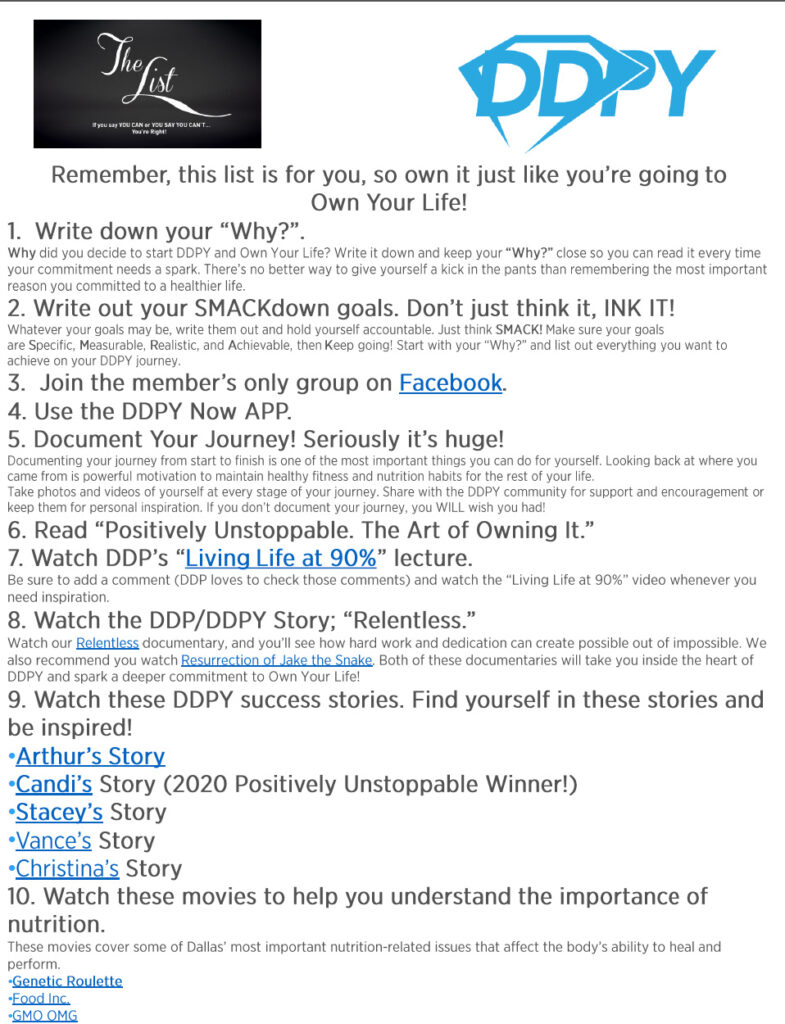
DDP Yoga (nd). The List. [Screen Shot]. https://ddpyoga.com/
Being able to speak a common language is only part of the equation in being able to participate in the public sphere (Wodak & Koller, 2010). A public sphere reflects the main ethos of a community and in the DDP Yoga community, The List also provides a user with the community’s ethos before they decide to enter the conversation. By understanding the community’s ethos, it helps a user to follow the accepted norms and expectations of the community and thus avoid potential conflict. More importantly it helps to strengthen the sentiment of the public sphere by adding more members that align with its core values (Preece & Maloney-Krichmar, 2005). It is important to note that like any other public sphere, members within the DDP Yoga public sphere are still able to have a voice and it is their voice that can lead to change (Birch et al., 2001, pp. 86–91). This draws direct comparison to a public sphere found in broader society where politicians may implement change based on the public sphere’s sentiment. In the case of DDP Yoga these changes are implemented through the group moderators keeping track of the community sentiment (Birch et al., 2001, pp. 86–91). A recent example of this was when a group member posted on the 20th of March 2024 “I wish there were some programs that helped with shoulder flexibility.” This post gained some traction with several members sharing the same sentiment. A moderator replied to this with “We are working on this as we speak; be patient, its coming soon” (DDP Yoga, 2012).
DDP Yoga, engages with their community in several ways that helps to promote an active, participatory culture amongst members; and it is this participatory culture that helps to strengthen the community. By allowing participatory culture to occur, it adds to the overall knowledge pool of the group; and validates participating members, as members that contribute value to the group. (Alessandro Delfanti & Arvidsson, 2019, p. 72). Some of this this engagement includes competitions, encouragement to share progress, recipes, people’s personal struggles and triumphs. Though fitness level and negative body image can often be a barrier for many people considering entering a fitness competition; DDP Yoga appears to have found a solution (Zaccagni & Gualdi-Russo, 2023). There are two main competitions community members can participate in. The first is an ongoing daily competition, where users can trade points, they have earned. Points are earned simply by completing their daily program and can be traded for real world rewards, like t-shirts etc, with the recipient often posting an image with their reward like a badge of honour. The second competition is a yearly competition and caries the highest prestige within the community. It spans for nine months in duration, with eight winners chosen at the end; these eight are declared that year’s champions. Both competitions are free to enter making it accessible to all, but it is the solution in the design that DDP Yoga has found; that breaks the negative body image barriers. Throughout the DDP website and social media channels, the continual theme is about not being the best but being your best; and consistency is the key to positive change. This same sediment echoes throughout the community; and the champions that are chosen are chosen for the positive change they have made to their lives by adopting the DDP Yoga principles. This means that the everyday person, which embodies much of the DDP Yoga community; can compete with and triumphant against personal trainers and professional athletes. This even playing field is extremely important to the DDP Program, which is made for the bed ridden to the professional athlete and everyone in between. The echos of this sediment are entrenched within the community culture such has non scalable victories referred to has NSV’s. NSV’s are personal accomplishments, and NSV’s are embraced and celebrated by the online community no matter how big or small they may appear on the surface. (DDP YOGA, n.d.),
Most online communities either begin in the real world; or start online and have elements transcend to the real world (Preece & Maloney-Krichmar, 2005). With the virtual world becoming so prominent we can no longer judge a community by the proximity of members. Instead, we should judge them by the strength and type of connections they create (Preece & Maloney-Krichmar, 2005). DDP Yoga erases the old notion that that an online community cannot be considered a real community and relationships in virtual communities are often superficial (Delanty, 2003, pp. 2011–2012). Though the DDP Yoga group originated online it has taken on Calhoun’s theory that online communities are a supplement for face-to-face communities (Delanty, 2003, pp. 213). Starting has an online community, DDP Yoga has been able to transcend to the real world. This is done both formally and informally, between group members and even through the company itself. On the informal end of the spectrum, it quite common for community members to friend each other on their social profiles, carry the conversation to private chats and arrange to meet up in real life. There have been a substantial number of community members post which area they live in and make their intention known that they are looking for others to meet up with to exercise or socialise with. The formal end of the spectrum is quite unique and sees community members given the opportunity to meet up at the home of DDP Yoga. The community members that take up this offer, can be immortalized in the app itself by directly taking part in the filming of training videos to be displayed on the app. These member’s also chose to take part in associated social events like organised dinners and social days. For those wanting a fully immersive experience, there is a specialised training house that can be booked for months at a time. Open only to community members, it sees them living together; fully immersed in the DDP culture of training and diet. DDP Yoga is also able to make connections in the real world via its training model. Allowing anyone that has completed 6 months of DDP Yoga to sit the instructors’ course and become teachers within their local communities. This empowers community members by allowing them to make meaningful contributions to community growth in the outside world (DDP YOGA, n.d.).
DDP Yoga, has used strategic design to change connections into an active and vibrant online community, that has been able to transcend into the real world. It has done this by creating a commonality in the language used and ethos shared; making it easily accessible for members to contribute to the public sphere from the onset. It actively encourages user engagement by harnessing the positive effects of participatory culture; leading to more dialogue and activity within the community. It has created a safe place for people to share and engage in community activities like competitions; that help to build community spirit yet in a way that is accessible and avoids negative judgement. DDP Yoga is a good example that under the right circumstances an online community does not necessarily mean superficial relationships. With what appears to be genuine connections and friendships being formed online, the community has been able to extend its reach to the outside world.
References
Alessandro Delfanti, & Arvidsson, A. (2019). Introduction to digital media. Wiley Blackwell.
DDP YOGA. (n.d.). DDP YOGA Official Web Site. DDP Yoga. https://ddpyoga.com/
DDP Yoga. (2012a). DDP YOGA – YouTube. Www.youtube.com.
https://www.youtube.com/channel/UCvmdgf06PhRoQ5VKh0eAzCA
DDP Yoga. (2012b, June 8). Log in or sign up to view. Www.facebook.com. https://www.facebook.com/groups/218632148257795
Delanty, G. (2003). Community. Routledge.
Preece, J., & Maloney-Krichmar, D. (2005). Online Communities: Design, Theory, and Practice. Journal of Computer-Mediated Communication, 10(4). https://doi.org/10.1111/j.1083-6101.2005.tb00264.x
Wodak, R., & Koller, V. (2010). Handbook of communication in the public sphere. Mouton De Gruyter.
Zaccagni, L., & Gualdi-Russo, E. (2023). The Impact of Sports Involvement on Body Image Perception and Ideals: A Systematic Review and Meta-Analysis. International Journal of Environmental Research and Public Health, 20(6), 5228. https://doi.org/10.3390/ijerph20065228


Leave a Reply
You must be logged in to post a comment.