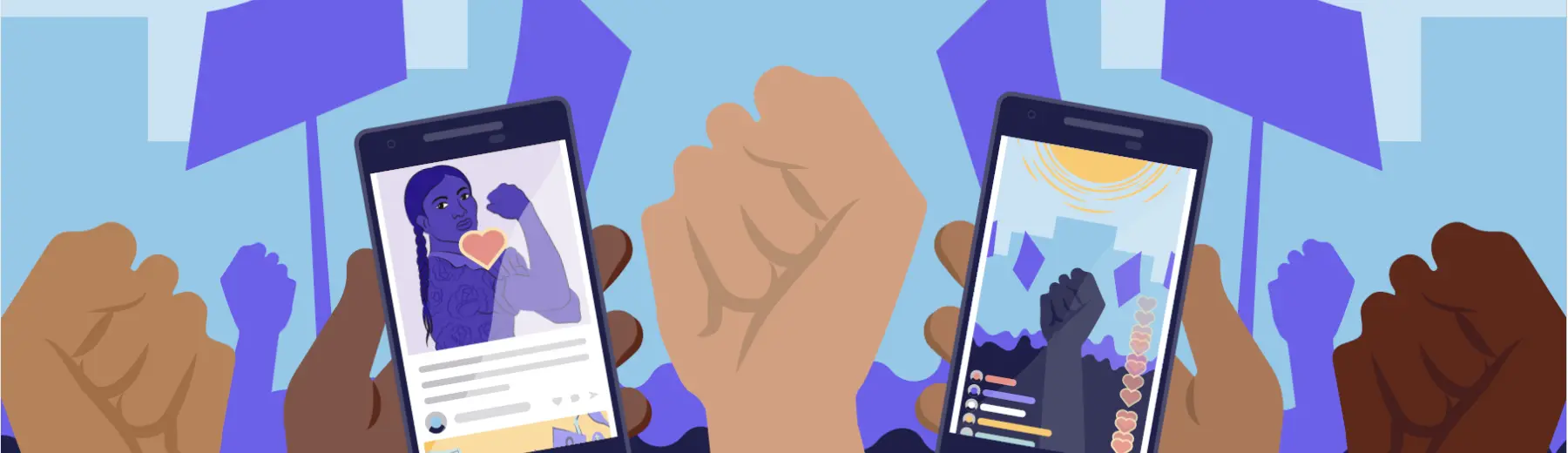
The rise of digital platforms has transformed the landscape of activism by providing a space for underrepresented communities to engage, empower, and amplify their voices in ways that were previously unavailable. With the rise of Web 2.0, the internet has become a space of greater interconnection, facilitating the development of new forms of participation. Online platforms provide accessible, inclusive communities for disadvantaged groups to connect and construct shared identities, enabling a sense of visibility that may be limited in offline environments. Moreover, marginalised groups are able to magnify their voices by creating counter-spaces where their perspectives can be heard and supported, which would otherwise be silenced by traditional media. This shift allows these communities to engage in a process dubbed “restorying” (O’Byrne, 2019), where they can reclaim their narratives, challenging dominant societal norms and creating a more inclusive representation of their experiences. However, despite the potential for this empowerment, online engagement is often criticized as ‘slacktivism,’ a form of activism seen as ineffective due to its low-effort nature – yet, this critique fails to recognize the role it serves in broader participation and mobilising support. This essay will explore how digital platforms have reshaped activism, the changing role of everyday users in political conversations, and the criticism of slacktivism.
Online environments are important places for building communities that empower and support disadvantaged individuals by strengthening shared identity. Internet support groups are places of major influence in bringing visibility to underrepresented communities; their structures are permanently available on the internet and display threads, posts, and dynamic conversations about topics people would struggle to see conversations about elsewhere; those who may feel isolated or silenced in offline settings have the opportunity to participate in these discussions or simply just observe (Dai & Shi, 2022). Tajfel’s (1974) social identity theory implies that similar principles apply to these groups, indicating that even passive social media users can gain from observing positive interactions within communities that share their social identities, building a sense of connection. Particularly, in the realm of mental health, support groups have been shown to encourage self-care and reduce the stigmatization of mental illness (Dai & Shi, 2022). Through Smit et al.’s (2021, para. 4) qualitative study on online peer support group “Depression Connect”, researchers found that participation in the group “contributes to a sense of belonging, emotional growth, self-efficacy, and empowerment.” The digital actions of sharing content, viewing posts, and, crucially, interacting with them, played a key role in instilling a sense of personal empowerment that users had not experienced previously, described as “being of value to others” (Smit et al., 2021, para. 4). Consequently, Depression Connect served as a substitute for offline depression care; likewise, other online communities offer similar benefits, where the accessible and supportive communication structure often alleviates anxiety and depression symptoms amongst young adults (Dai & Shi, 2022).
Furthermore, digital platforms facilitate activism by amplifying the perspectives of marginalised groups into mainstream media. While the real world often silences underrepresented communities, the internet can be a place for these communities to have their opinions heard and even bolstered; O’Byrne (2019, para. 32, 34) refers to this process as “restorying”, where these communities can, and often, use digital spaces to “write themselves into being”. One of the most famous movements of recent years that demonstrates this effect is the #MeToo movement. The movement, coined by Tarana Burke but famously first tweeted by Alyssa Milano, is used to sound attention to the rape culture that is especially prevalent in the workforce, with multiple perspectives aimed to demonstrate the “magnitude of the problem” (Williams et al., 2019, p. 374). The movement originated from the ongoing disregard for women’s experiences with sexual abuse, where many victims felt that their stories would be dismissed, that they were isolated, or that justice was out of reach, all driven by deep-rooted gender inequality (Williams et al., 2019). Shortly after Milano posted the #MeToo tweet on Twitter (X), the hashtag quickly gained traction, with more than a million tweets incorporating it within just 24 hours (Williams et al., 2019). This movement utilised the open and decentralized nature of social media to empower women to share their experiences against the patriarchal hierarchies of the real-world and advocate for real life social change; the #MeToo movement is a stark example of how collective activism has evolved human rights campaigns in the 21st century (Williams et al., 2019), by amplifying voices that are historically underrepresented and continually overlooked by conventional media, such as the news. The term “counter-space” has often been used by academics to refer to a place for activism beyond conventional spheres – “the term counterspace had originally been in reference to university students facing racial discrimination; they created safe spaces for themselves to function without fear and anticipation of stereotypes and racism, in contrast to what they faced in traditional spaces (e.g., classroom, dorms, traditional fraternities/sororities)” (Foster et al. 2019, as cited in Cooper, 2023, p. 11). Yet, the term “counter-space” does not only apply to women’s activism; it applies to all structurally disadvantaged groups, where the internet acts as a platform to promote perspectives that would not be seen elsewhere.
Similarly, the evolution of online networks has significantly reconfigured the mechanics of narrative control and allowed marginalised groups to reclaim dominant narratives. According to O’Byrne (2019, para 35), the retelling of stories, or “restorying”, lays the groundwork for groups to “narrate their story, while also synthesizing, or recontextualizing, dominant narratives to serve as counter-narration, or disruption of inequalities in society” – a concept drawn from earlier work by Haddix, Everson, and Hodge (2015), Olan and Richmon (2017), and Stornaiuolo and Thomas (2017). While media becomes a space for open communication and critique, a shift in narrative power emerges. As Land (2024, p. 205) notes, “we currently have the tools necessary for individuals to engage in advocacy without the need for professional organizations,” highlighting how the media landscape enables groups to express activism independently of institutional support. An increasingly relevant narrative shift is the act of Indigenous Australians reclaiming colonial narratives through online media. Independent podcasters through shows like Black Magic Woman and MedTalk (Kerrigan, 2024, para. 3) offer a more honest review of lived experiences as Indigenous Australians, such as the inherent racism in the medical industry. Culture is shaped through the continuous retelling of stories across generations; over time, the ‘narratives’ that emerge from these stories come to influence and direct societal norms and values – “what we believe, how we interact, what we value and consequently our policies and laws” (Kerrigan, 2024, para. 2). Through the sharing of these personal stories, the hosts enable a critique of institutional issues and defy the dominant racial narratives imposed on them. This retelling exemplifies the way digital platforms have transformed narration into a more democratic process – the narrative power that dominates our society is no longer confined to traditional establishments; instead, it is being actively reshaped through online networks, where minoritised populations use digital apparatuses to collectively redefine cultural narratives and reshape modern activism.
Online activism, often dismissed as “slacktivism,” has faced substantial criticism, particularly regarding its efficacy in creating real societal change. The term “slacktivism” is a blend of “activism” and “slacker,” and it refers to low-effort online actions, such as liking, sharing, or retweeting, as a “token display of support for a social cause, with an accompanying lack of willingness to devote significant effort to enact meaningful change” (Kristofferson et al., 2014, p. 1149). Traditional activism is rooted in direct action—marching, lobbying, and organizing—that brings about concrete change, whereas slacktivism, critics suggest, is only concerned with raising awareness, not solving the underlying issues (Cooper, 2023). Furthermore, the critique of online activism often surrounds its superficial nature. Morozov (2009) heavily critiques slacktivism, attributing that it makes people feel good or gain a sense of heroism, allowing individuals to feel as though they are contributing to a cause without actually making meaningful or perceptible efforts. With minimal involvement required, actions such as sharing a post or changing a profile picture do not require individuals to engage with the complexities of the issues at hand. The ‘Blackout Tuesday’ campaign acts as an example of this, and quickly became a widely criticized instance of slacktivism (Cooper, 2023). While millions posted solid black squares on Instagram to stand with the Black Lives Matter motion, activists quickly marked the trend as being performative and lacking substance (Cooper, 2023). The vast flood of black squares not only failed to offer information but also inadvertently masked posts that did, diminishing the movement’s practical impact (Cooper, 2023). This example underscores a core critique of slacktivism: while visually symbolic, such gestures often lack the depth and resources necessary to drive sustained political change. As Morozov (2009) argues, these low-effort actions are only useful in satisfying an individual’s desire to appear socially engaged. By prioritizing awareness so largely, movements risk becoming misdirected, particularly when participation is not joined with further action. In essence, while online platforms provide a space for global support, they also risk reducing activism to a performative act that lacks concrete effects.
However, this critique of “slacktivism” overlooks both the potential and evolving purpose of online activism for underrepresented groups in the digital era. Freelon et al. (2020, para. 4) argues that “digital political activities—including low-cost ones—are a complement to, not a substitute for, their offline counterparts.” Rather than replacing traditional activism, these online actions function as accessible “entry points” (Cooper, 2023, p. 18) to civic activism, opening up spaces for broader participation. For instance, although widely criticized, initiatives like Blackout Tuesday played a significant role in stimulating global conversation around systemic racism and police brutality, serving as a catalyst for awareness of the Black Lives Matter movement. This early visibility was essential to its eventual integration into mainstream American society by mid-2020 (Cooper, 2023). Additionally, online crowdfunding platforms, such as GoFundMe, further demonstrate the real-world impact of digital engagement. Often dismissed as “clicktivism,” these platforms have raised billions of dollars—with GoFundMe raising $3 billion—for various charities and causes (Akhlaghpour & Vaast, 2018, p. 2). These figures demonstrate the positive outcomes that can emerge from online activism, especially in contexts where traditional fundraising methods may struggle. Moreover, digital activism can encourage political participation among individuals who may otherwise remain politically disengaged (Cooper, 2023). While critics argue that liking or sharing a post is too simple to be meaningful, this accessibility can lower the barrier to entry for many, sparking interest and commitment over time through a reinvigorated sense of political identity (Cooper, 2023). Therefore, due to the seemingly easy nature of online activism, it is frequently misunderstood as lacking genuine impact or influence—overlooking its potential in mobilising support and expanding contribution in political dialogue.
Ultimately, the rise of digital platforms has significantly reshaped activism by creating accessible spaces where underrepresented communities can voice their perspectives and challenge traditional structures. Marginalised groups are provided with opportunities to create inclusive networks, fostering connections that contribute to a strong sense of community and belonging. Moreover, these groups often take part in reclaiming dominant narratives, utilizing digital platforms as tools for self-representation and, at the same time, reshaping discourse about their identities. While online activism is often dismissed as ‘slacktivism,’ this criticism overlooks how digital platforms are instrumental in amplifying conversation and rallying support for significant social causes. As a result, social networks hold significant influence in providing a platform for activism; its power lies in its ability to expand on perspectives that are often overlooked in traditional media, creating a space where individuals can unite together, share experiences, and drive collective action toward social justice.
References
Akhlaghpour, S., & Vaast, E. (2018). Digital Activism for Social Causes: Understanding Clicktivism and Substantive Actions. SSRN Electronic Journal. https://doi.org/10.2139/ssrn.3220833
Cooper, K. (2023). The Effectiveness of Online Activism: Who It Is Effective for, What The Effectiveness of Online Activism: Who It Is Effective for, What Issues It Is Effective for, and What Time Period It Is Effective for Issues It Is Effective for, and What Time Period It Is Effective for Rights Statement License. https://scholarsarchive.library.albany.edu/cgi/viewcontent.cgi?article=1042&context=honorscollege_pos
Dai, Y. (Nancy), & Shi, J. (2022). OUP accepted manuscript. Journal of Computer-Mediated Communication, 27(3). https://doi.org/10.1093/jcmc/zmac006
Freelon, D., Marwick, A., & Kreiss, D. (2020). False equivalencies: Online activism from left to right. Science, 369(6508), 1197–1201. https://doi.org/10.1126/science.abb2428
Kerrigan, V. (2024). Defining narrative change: a case study of the decolonising podcast Ask the Specialist: Larrakia, Tiwi and Yolŋu stories to inspire better healthcare. Media Practice and Education, 26(1), 1–19. https://doi.org/10.1080/25741136.2024.2341526
Kristofferson, K., White, K., & Peloza, J. (2014). The Nature of Slacktivism: How the Social Observability of an Initial Act of Token Support Affects Subsequent Prosocial Action. Journal of Consumer Research, 40(6), 1149–1166. https://doi.org/10.1086/674137
Land, M. B. (2024). Networked Activism. https://journals.law.harvard.edu/hrj/wp-content/uploads/sites/83/2009/09/land.pdf
Morozov, E. (2009, May 19). The brave new world of slacktivism. Foreign Policy. https://foreignpolicy.com/2009/05/19/the-brave-new-world-of-
O’Byrne, W. I. (2019). Educate, Empower, Advocate: Amplifying Marginalised Voices in a Digital Society – CITE Journal. Citejournal.org. https://citejournal.org/volume-19/issue-4-19/english-language-arts/educate-empower-advocate-amplifying-marginalised-voices-in-a-digital-society/
Smit, D., Vrijsen, J., Groeneweg, B., Vellinga-Dings, A., Peelen, J., & Spijker, J. (2020). A qualitative evaluation of a newly developed online peer support community for depression: Depression Connect (Preprint). Journal of Medical Internet Research, 23(7). https://doi.org/10.2196/25917
Williams, J. B., Singh, L., & Mezey, N. (2019). #MeToo as Catalyst: A Glimpse into 21st Century Activism. https://chicagounbound.uchicago.edu/cgi/viewcontent.cgi?article=1658&context=uclf


Hi Shannon Kate, You’re right to ask; it is incredibly difficult to police these issues today. Predatory behaviour isn’t exclusive…