Abstract
The purpose of this article is to address the negative impact pseudonymous individuals have within online communities. Pseudonymous individuals have the ability to share controversial personal opinions with minimal repercussions, which enables them to express negativity and unethical behaviours within online communities. This article first explores how these pseudonymous individuals are able to reside within online communities comfortably, then discusses how the act of expressing personal opinions through an alias is morally wrong, using examples from two perspectives of the act, R.U. Sirius, a popular commentor/writer on Facebook, and Rhegan, a popular TikTok creator with a constant stream of pseudonymous individuals in her comment sections. Through this analysis, I have come to the conclusion that there is more wrong to the actions of pseudonymous individuals than right, and that all pseudonymous individuals should be removed from social media platforms to reduce negativity within online communities.
Introduction
As an addicted fan of the popular app ‘TikTok’, a loyal user (since 2015) of the app ‘Instagram’, and a girl who now and then chimes into Kai Cenat’s ‘Twitch’ streams, I can most confidently say, that online communities have become disgusting. If you are also a user of ‘TikTok’, I’m sure you have seen @user34781…’s comments on almost every single viral post to exist, stating something nasty and opposing to the creator’s purpose. At least @user34781… doesn’t have to see my disgusted face while reading their comments. Pseudonymous individuals could end up ultimately running online platforms. The term pseudonymous can be defined as “bearing a false or fictitious name” (Dictionary.com, n.d.), for example, pseudonymous individuals who are present in online communities have ‘fake profiles’ and their usernames usually have no connection to their true identity. While pseudonyms on social media allow the expression of controversial personal opinions safely with minimal repercussions, the affordance of pseudonymity enables negative expression and unethical behaviours in online communities. They are dangerous, as they have found a home within our online communities that foster their negative expression, they are capable of ‘trolling’, ‘flaming’, and ‘doxxing’ individuals with little to no repercussions, and their extremist opinions could ultimately silence influencers.
The Home to Pseudonymity
Most pseudonymous individuals reside in online platforms such as Twitter, Instagram, TikTok, etc. Now, how did these pseudonymous individuals come to life? I would say the leading reason for most pseudonymous individuals to create their fake usernames would have to be that they are afraid of repercussions, they are afraid of exposure, and finally, they are afraid of being known as a negative individual.
Technology has shaped individuals to adopt a certain identity (Van Der Nagel, 2017). Van Der Nagel (2017) expresses how most online communities are able to foster these individuals by allowing users the right to create their own profile and choose their own username. “The discourse of “platform” deliberately evokes a comforting sense of neutrality, while downplaying the way these social media companies remain profit-driven cultural intermediaries” (Van Der Nagel, 2017, p. 314), in other words, online platforms will aim to give you what you desire to the best of their ability in order to stay relevant and keep receiving revenue from their popularity. Affordances can be described as “the dynamics and conditions enabled by the materiality of a platform” (Van Der Nagel, 2017, p. 314). These platforms are capable of articulating “expectations of names and identities, and therefore content and conversations, through their affordances” (Van Der Nagel, 2017, p. 326). It is clear that pseudonymous expressions, in most online platforms, are seen as a positive addition to social networks and hence are overlooked by money-hungry social media platform regulators. Because of this, controversial or ‘taboo’ topics can be spoken about without real-world consequences, bullying without repercussions is more present, catfishing is enabled (where users who show romantic interest online to another user under a fake identity), and many more issues come to light. Pseudonymous individuals are dangerous as they can display negativity which isn’t generally seen in a face-to-face conversation. Most social media platforms have adopted this negativity, used it to increase platform usage, and ultimately profited from it. I believe this puts the user in a position which is morally wrong as they should be able to own their statements and advocate it through their real identity.
The Affordance of Pseudonymity Enables Negative Expression
So now to address the focal issue of this paper: would it really be okay to hide behind an alias? Is this alias another sense of security on top of being a part of an online community? Do you lack integrity when adopting two different identities (Brusseau, 2019)? Are you still authentic when being recognised for a pseudonym?
R.U. Sirius, a pseudonymous user, was a popular commentator and writer on Facebook (Brusseau, 2019). Brusseau (2019) argued whether this person was “an inauthentic presence on the site” (Brusseau, 2019, para. 10) due to their ‘real’ identity staying hidden. There are two views to anonymity and pseudonymity, one being for privacy and security, the other being a way to share opinions that would usually lead to repercussions if shared under a person’s true identity. So, on the other hand, you could argue that R.U. Sirius was just trying to protect their real identity for personal security reasons. However, he was banned from Facebook for his pseudonymous identity (Brusseau, 2019). This could have been avoided if he grew on the platform through his true identity, this would have also granted him more transparency with his audience.
“Facebook is the largest social network site in the world and by the end of 2013 had 1.23 billion active users” (Van Der Nagel & Frith, 2015, para. 10), currently owned by Mark Zuckerberg. Zuckerberg believes users should be limited to one identity, asserting the idea that “identity can be singular” and “authenticity equals complete openness” (Van Der Nagel & Frith, 2015, para. 11). Although there are many advantages to staying anonymous or pseudonymous in an online setting, the disadvantages will always be significant. Most of the disadvantages relate to some form of cyberbullying or negative online interaction, such as ‘trolling’, ‘flaming’, or ‘doxing’, three popular techniques used by anonymous or pseudonymous users to suppose social good (Van Der Nagel & Frith, 2015).
Practices of ‘flaming’ and ‘trolling’ came about when “the presentation of self was more fluid online because people were freer to switch identities on a whim and construct a new identity through text” (Van Der Nagel & Frith, 2015, para. 17). “Trolling involves posting content designed to incite an emotional reaction in its audience” (Van Der Nagel & Frith, 2015, para. 17), whereas “flaming refers to hostile comments that often involve profanity and personal attacks” (Van Der Nagel & Frith, 2015, para. 17). These methods are used by anonymous and pseudonymous individuals as a way of social justice when disagreeing with other users opinions. For example, users can be unhappy with opinions such as “the lack of social cues of textual media”, “affective provocations that vitalize online participation” (Van Der Nagel & Frith, 2015, para. 18), and many other topics. It could be concluded that anonymity and pseudonymity can be used as a tool for individuals to openly troll or flame other users with little to no repercussions.
The third technique, ‘doxxing’, is one step further for a user to feel as if they had received social justice. It involves meddling in another user’s personal information and ultimately using it against them. Doxxing “involves groups of anonymous or pseudonymous users researching an individual then publishing identifiable facts about that person” (Van Der Nagel & Frith, 2015, para. 20). Zoe Quinn, a well-known female video game developer, had become a victim of this technique. She had allegedly cheated on her boyfriend and held “views of gender that offended some male gamers” (Van Der Nagel & Frith, 2015, para. 20), which had clearly made some of her fans unhappy. They saw an opportunity for an act of revenge, where they believed it was fair to leak her personal information to the public, such as her IP address, etc. (Van Der Nagel & Frith, 2015). “Flaming, trolling, and doxing are all negative consequences related to anonymity and pseudonymity online” (Van Der Nagel & Frith, 2015, para. 21), hence why online platforms need to account for this and ultimately ban anonymous and pseudonymous users.
Now that we can understand Zuckerberg’s reasoning for banning users on Facebook for anonymity or pseudonymity, it is clear that “authenticity dovetails with integrity: you’re meant to be one person on the site” (Brusseau, 2019, para. 9), where “anything goes, as long as it’s authentic, which means the poster employs a real name, and has a single account” (Brusseau, 2019, para. 9). On the contrary, you could argue that authenticity is “connected with identity experimentation” (Brusseau, 2019, para. 12). Users may want to hide, for example, their gender or sexual orientation to avoid inequality or discrimination (Brusseau, 2019). Being pseudonymous could be viewed as “a way of introducing oneself into a community (homosexual, transgender, or something similar)” and can be seen as “an authentic use of the platform, and not an exploitive lie” (Brusseau, 2019, para. 12). Although this could be considered a valid reason to be known as a different identity, you will never know a person’s true intentions. I believe the risks outweigh the benefits, and that it was right that R.U. Sirius was forcefully removed from Facebook. Users should be able to feel safe and secure under their real identity online, and the ones accountable for making this true should be the regulators of social media platforms. Personally, I am a strong user on social media sites, and I do not feel safe online. I believe the social media platform regulators’ focus should be shifted from obtaining a larger audience and maximising revenue, to the safety of many individuals instead, for example, by focusing more on removing online predators and negativity.
The Pseudonymous Army
Now, I want to talk about an army of pseudonymous individuals, and specifically, I’m talking about a large group of users coming together to counter an influencer’s opinion. I would describe a ‘Pseudonymous Army’ as an army of like-minded pseudonymous individuals who band together to form a network where they can freely share opinions on controversial or ‘taboo’ topics. I call this an army because these members ultimately bond through being confident hiding behind their fake names. They feel it’s okay to dominate and overrun comment sections with their ideologies with support from each other.
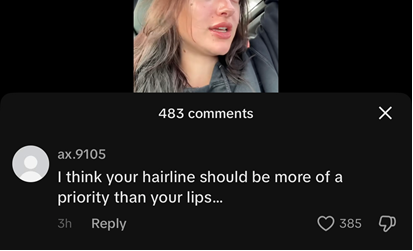
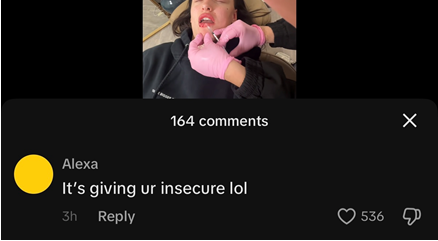
“Social network sites have gained tremendous traction recently as popular online hangout spaces for both youth and adults” (Papacharissi, 2010, p. 39), becoming the centre for all kinds of identities. These social media applications have converged to where profile pages are now not only a place of self-representation, but “a place where people gather to converse and share” (Papacharissi, 2010, p. 43). Although these profiles house fans who express positive or neutral opinions towards posted content, there are those who decide to be negative and spread hostility. One very popular place for users to express their personal opinions and comment on other users’ opinions is through the ‘comment section’ of a post. As shown in Figure 1 and Figure 3, some individuals comment thoughts which, in all honesty, should never have been commented.
Figure 1
Comment on @rhegancoursey’s post on TikTok addressing her desire for more lip filler
Note. From TikTok, by TikTok, 2025 (https://www.tiktok.com/@rhegancoursey/video/7486171108794830123).
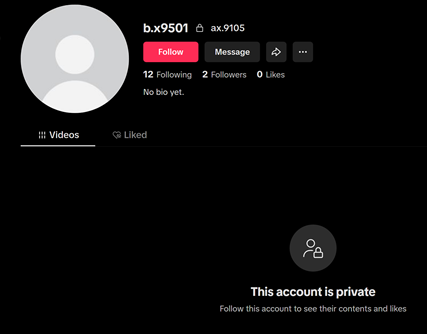
Figure 2
User profile of the pseudonymous user who delivered a comment on @rhegancoursey’s post
Note. From TikTok, by TikTok, 2025 (https://www.tiktok.com/@b.x9501).
Figure 3
Comment on @rhegancoursey’s post on TikTok addressing her action for getting lip filler
Note. From TikTok, by TikTok, 2025 (https://www.tiktok.com/@rhegancoursey/video/7486203680560123179).
Figure 4
User profile of the pseudonymous user who delivered a comment on @rhegancoursey’s post
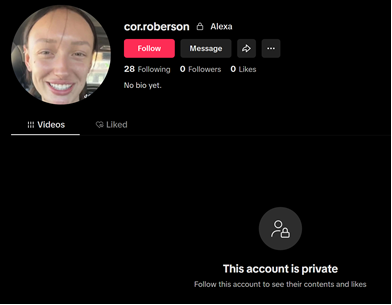
Note. From TikTok, by TikTok, 2025 (https://www.tiktok.com/@cor.roberson).
I have been following one of my favourite influencers, ‘Rhegan777’ (@rhegancoursey on TikTok), for years now and I have watched her grow into a large-scale influencer. I had noticed a trend with her growth, which was that more negative comments started to appear on her posts than usual. Not only were these comments rude and discriminatory, but these comments came from pseudonymous individuals. I had noticed an army of these pseudonymous individuals come onto her page every time she posts and ‘hates on her’, meaning they extremely criticise her in a discriminatory way.
Figure 1 is a screenshot taken from my iPhone of a pseudonymous individual in action, where they criticise Rhegan777’s appearance in her post about her explaining how she wanted lip filler again to feel less insecure. As shown in Figure 2, this user has a cryptic username, a very small following, and a private account, meaning other users can’t see their activity and status.
Figure 3 is another screenshot taken from my iPhone of another pseudonymous individual in action, with a similar comment to that of Figure 1 with the only difference of calling her insecure directly. Figure 4 is the profile page of the user who commented on Rhegan’s post (Figure 3) and this profile contains similarities to Figure 2, where the user has a small following and a private account.
These comments can be seen as forms of cyberbullying. The comment in Figure 1 can be read as an act of ‘flaming’ the creator, whereas the comment in Figure 3 can be read as a way of undermining the creator. I have picked these comments from a pool of many scarily similar comments, and that’s why I call them an army. As a loyal fan of Rhegan, I have witnessed the repercussions, and the repercussions weren’t from the commenters, but rather from the creator herself. I had witnessed her being backed into a corner to the point where she didn’t post videos for some time. The effect of these comments can truly damage an influencer. Users shouldn’t be able to advocate their opinions through a fake name and should express it through their true identity.
Conclusion
If online communities continue to foster pseudonymous individuals, online hate and criticism will continue to break creators, and we could lose them completely if cyberbullying is taken too far. Being pseudonymous is a driving factor for users to state negative opinions on creators’ posts, as they know they are protected from any repercussions. It isn’t morally right to hide behind a screen and bully another individual, and ‘trolling’, ‘flaming’ and ‘doxxing’ other users for a sense of social justice proves how pseudonymous users and accounts should not exist. Online communities are on a path to destruction for fostering these users, and I could only imagine it will grow worse over time.
References
Brusseau, J. 2019. Ethics of identity in the time of big data. First Monday, 24(5). https://doi.org/10.5210/fm.v24i5.9624.
Dictionary.com. (n.d.). pseudonymous. In Dictionary.com. Retrieved April 6, 2025, from https://www.dictionary.com/browse/pseudonymous.
Papacharissi, Z. (2010). A Networked Self : Identity, Community, and Culture on Social Network Sites. Taylor & Francis Group. https://ebookcentral.proquest.com/lib/curtin/detail.action?docID=574608.
TikTok [@b.x9501]. (2025). ax.9105 [TikTok Profile]. TikTok. Retrieved March 27, 2025, from https://www.tiktok.com/@b.x9501.
TikTok [@cor.roberson]. (2025). Alexa [TikTok Profile]. TikTok. Retrieved March 27, 2025, from https://www.tiktok.com/@cor.roberson.
TikTok [@rhegancoursey]. (2025, March 27). A little umph in it ????????? [Video]. TikTok. https://www.tiktok.com/@rhegancoursey/video/7486171108794830123.
TikTok [@rhegancoursey]. (2025, March 27). pain level was a literal 2 [Video]. TikTok. https://www.tiktok.com/@rhegancoursey/video/7486203680560123179.
Van Der Nagel, E. (2017). From usernames to profiles: the development of pseudonymity in Internet communication. Taylor & Francis Online, 1(4), 312-331. https://doi.org/10.1080/24701475.2017.1389548.
Van Der Nagel, E., Frith, J. (2015). Anonymity, pseudonymity, and the agency of online identity: Examining the social practices of r/Gonewild. First Monday, 20(3). https://doi.org/10.5210/fm.v20i3.5615.


Hi Shannon Kate, You’re right to ask; it is incredibly difficult to police these issues today. Predatory behaviour isn’t exclusive…