TikTok is a widely used social media platform that is generally used for creative content, allowing users to create short-form video content that is often used as an expressive means of identity. Over the years, it has become a major cultural phenomenon, particularly among youth, with millions of users creating, viewing and interacting with content each day on a global scale. Unlike social media platforms like Facebook and YouTube, which rely on images and long-form video content, TikTok relies heavily on short-form videos and user-generated virality. That is to say that it facilitates the use of re-usable trending audio clips and has the ability for a user to “duet” or “stitch” another user’s content. These functions serve as a means for the spread of meme content, which can be considered a mechanism for people from like-minded backgrounds or those with similar ideals to come together and create a cultural community. This is particularly true when discussing marginalised communities. In particular, the LGBTQ+ community is one that has embraced TikTok as a tool in which they can express and experiment with their own identity and interact with other queer community members regardless of the geographical boundaries. I argue that TikTok allows for the creation and cultivation of new forms of digital identities, these being performative, community-focused and shaped by the design of the platform. In exploring the fundamentals of performativity and communities, this paper will analyse the roles of trends and memes and how they shape identities by exploring case studies in the queer TikTok space. This paper fits within the Communities and Social Media stream by exploring how TikTok fosters and shapes digital communities within a social media context.
To first argue TikTok’s role in the creation and cultivation of new forms of digital identities and communities, we must first draw on key theories around performativity and how communities are created. In Erving Goffman’s book, The Presentation of Self in Everyday Life, he suggests that individuals perform a curated version of themselves to others daily, always managing how they will be perceived by the ‘audience’, much like a stage actor. (Goffman, 1971). We can see that this type of identity performance is prevalent on social media sites. TikTok is no different, as it allows users to edit their content, enabling them to portray a certain identity to their audience. But I argue that the performative nature of identity on social media sites such as TikTok is not necessarily something that is less genuine; in fact it is allowing communities to shape their identity to create a culture. In Judith Butler’s Gender Trouble: Feminism and the Subversion of Identity, she reaffirms this notion by stating that, “There is no gender identity behind the expressions of gender; that identity is performatively constituted by the very “expressions” that are said to be its results.” (Butler, 1999). This too can be applied to the LGBTQ+ community on TikTok, in that many queer users use this platform and its functions such as audio clips and memes to challenge societal gender and sexuality norms and to foster activism. In a video by TikTok user @ricotaquito, an ongoing skit involves a friend defending the different identifiers about him that are considered ‘gay’, giving alternative reasons as to why he does them.
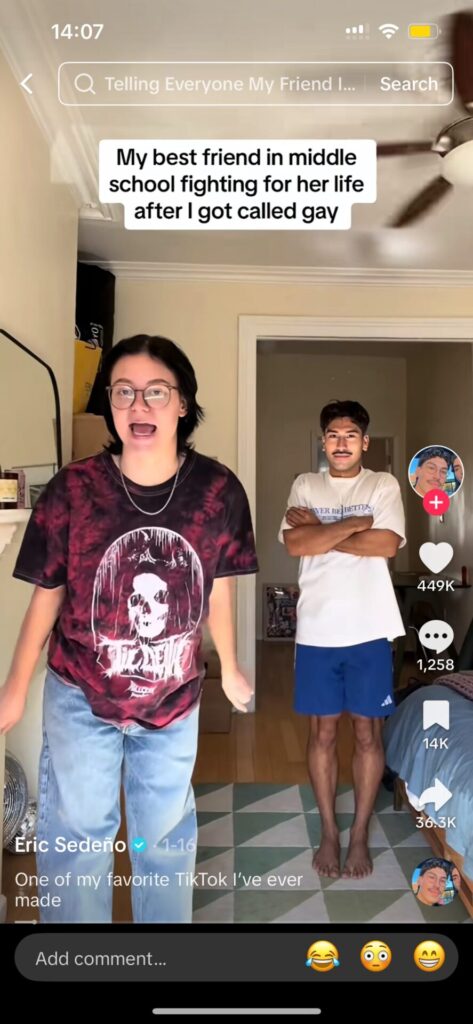
This video is ultimately satirical, playfully highlighting the stereotypical identifiers that many associate with gay men. This kind of content demonstrates how the queer community are using TikTok as a platform to engage in performative displays of identity that challenge societal norms but that also builds a digital community that is continuedly crafted and re-shaped around identity performance. Ultimately, they are performing an identity, but as Butler (1999) states, this performed identity is not false; it exists as it is because it is performed, and this can be true for any identity.
The design of the TikTok platform could also influence the way in which communities are shaped. Zulli and Zulli (2022) argue that TikTok’s digital interface fosters the creation of content that is performative, repetitive and memetic, thus creating digital communities. There are some who argue that social media platforms like TikTok are destroying the concept of community. This can be disputed as Hampton (2016) argues that “New communication technologies make persistent contact and pervasive awareness possible and are especially evident in those technologies described as social media” (Hampton, 2016). This is also true with TikTok, it allows member of the LGBTQ+ community to reshape their community, transforming it into something that isn’t limited to geographical boundaries or even time-based boundaries. “Mobility has liberated people from the dense bonds of traditional community, but they have continued to find companionship and support in sparsely knit networks (Lu and Hampton 2017). (Lu & Hampton, 2017, as cited in Hampton & Wellman, 2018, p. 645). Using TikTok, the LGBTQ+ community is able to create communities that are constant, but ever changing, allowing users to perform their and re-shape their digital identities.
TikTok’s design features, such as its re-sharable audio, memes, stitches, duets and filters are vehicles that allow for communities to perform their identity. The LGBTQ+ community has taken to using these features as a tool to explore and express themselves. For instance, the ‘BlameItOnTheEdit’ trend on TikTok posted by television host and drag queen RuPaul went viral within the queer community on TikTok in 2021. In the original video, RuPaul transitions into drag with the trending audio playing, but the awkward editing of the video sparked the community to poke fun at it. This led to many drag queens duetting videos with RuPaul where they would imitate the original video’s premise.
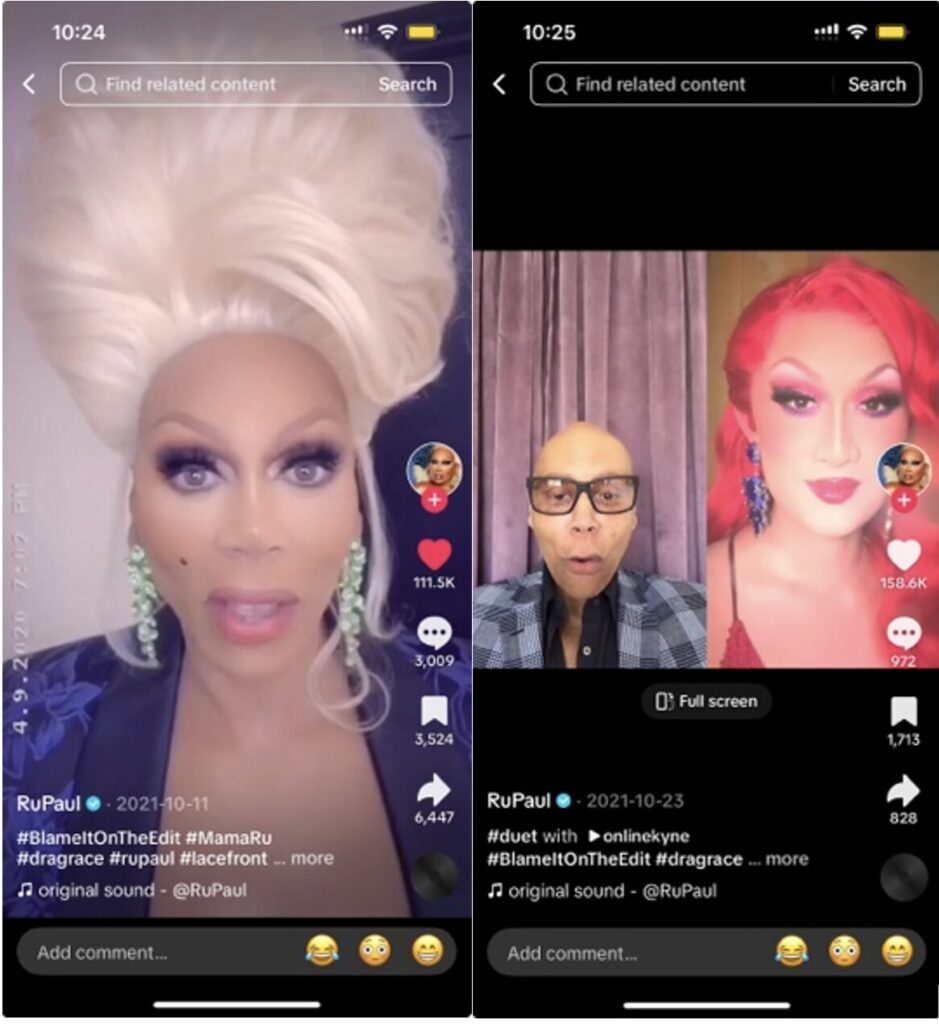
Although this trend was playful and funny, it also served a purpose. Through this trend and other trends within the queer space on TikTok, people are able to bond through their shared interests and through the tools provided to them by the platform, further cultivating their digital community. This aligns with Zulli and Zulli’s (2022) argument that people are able to act as a community on social media platforms when they (1) recognise the content as something they think is relevant, and (2) help spread the content through sharing, interacting or imitation. They also discuss that memes become viral because they rely on people having shared knowledge and ideologies. We can also see other features used on TikTok as tools used for community building. For example, the use of the hashtag has become a tool that is used to create sub spaces within TikTok. For example, many people who post about reading books have labelled their space on TikTok ‘BookTok’ and use that hashtag when posting their videos. This is also the same with the LGBTQ+ community on TikTok. Many users within this community use the hashtag ‘QueerTok’ or ‘QueerTikTok’ as a way of identifying themselves as part of the community and further adding to the library of media that creates a communal space. This notion is supported by Zulli and Zulli’s (2022) research, as they discuss the hashtag as a means for people to come together to coordinate and participate in shared conversations and also as a way to locate each other. The design functions within TikTok have allowed for many communities to flourish. It is something that is beyond memetic content or virality, these communities are creating lasting and meaningful connections with each other despite geographical boundaries. As Hampton and Wellman (2018) argue, digital technologies are not destroying communities, they are reshaping them. Allowing the LGBTQ+ community to escape the societal norms around what constitutes a traditional community that they may be imposed with in their everyday lives. Enabling them the ability to interact with like-minded individuals to create a visible and lasting culture. TikTok fosters these kinds of marginalised communities, allowing for the cultivation of new styles of communities and digital identities shaped by the design of the platform.
While arguing that TikTok allows for the creation and cultivation of new forms of digital communities that allow for users to express their identities and interact with like-minded individuals, we must also discuss the counterarguments that may be made. Social Media platforms like TikTok have long been criticised for their inauthentic performance of identity, particularly in relation to the rise of the influencer and its commercialisation. “Yet the value – financial or otherwise – of the inauthentic and professionalised returns in more recent content production online by influencers, bloggers, Instagrammers, and vloggers who monetise their everyday lives is marked by a knowingly false representation of authenticity, selfbranding and activities to maximise the return on self-commodification.” (Abidin, 2018, as cited in Cover, Haw, & Thompson, 2022, pp. 78, 95–96). While this claim of inauthenticity could be applied to communities on TikTok, it is important to note that this inauthenticity that is apparent with influencing is often related to misleading claims about products and is driven by monetary agendas. The communities on TikTok, like the LGBTQ+ community, cannot be held to the same standards when discussing their expression of identity, and we must come back to Butler’s (1999) argument that identity performance is what creates identity and, in turn, community. Another argument that could be made about the harmful effects that TikTok has on the community could be around things like ‘Shadowbanning’. Shadowbanning is a term that describes the censorship of certain users or hashtags on TikTok primarily due to political reasons. (Risius & Blasiak, 2024). Abidin (2021) draws on quotes to discuss that, “TikTok has had a history of moderating and censoring pro-LGBT content in countries where ‘homosexuality has never been illegal’ (Hern 2019), shadow-banning sexuality hashtags like ‘#gay’ and ‘#transgender’ (Ryan et al. 2020).” (Abidin, 2021). While this is cause for concern, and is an attack on these marginalised communities, these communities persist regardless. Despite attempts at censorship, the LGBTQ+ community still finds ways to utalise TikTok and its functions for identity expression and community building. Thus, TikTok as a space for community building does have its criticisms, but ultimately, it is a space where users can come together to build meaningful and persistent digital communities.
So, while TikTok does have its limitations and concerns around censorship and inauthentic presentation of identity, it remains as a powerful platform for individuals to build communities. The platform’s design and features, like its use of trending audio, memes, stitches, duets and filters, allow for communities like the LGBTQ+ community to utilise them to perform their identities, creating stronger bonds with others in this communal digital space. TikTok allows for LGBTQ+ members to have a space to challenge societal norms and connect with others despite geographical boundaries in a way they wouldn’t have been able to do in the more traditional community sense. As Butler (1999) reminds us, Identity exists because it is performed, and TikTok allows for users a stage to perform and re-shape their identities. TikTok should not just be thought of as a social media app, but a vehicle for the creation of digital identities that in turn foster and shape communities.
References
Abidin, C. (2021). Mapping Internet celebrity on TikTok: Exploring attention economies and visibility labours. Cultural Science, 12(1), 77–103. https://doi.org/10.5334/csci.140
Butler, J. (1999). Gender trouble: Feminism and the subversion of identity (10th anniversary ed.). Routledge. https://doi.org/10.4324/9780203902752
Cover, R., Haw, A., & Thompson, J. D. (2022). Fake news in digital cultures: Technology, populism and digital misinformation (1st ed.). Emerald Publishing Limited.
Goffman, E. (1971). The presentation of self in everyday life. Penguin.
Hampton, K. N. (2016). Persistent and pervasive community: New communication technologies and the future of community. American Behavioral Scientist, 60(1), 101–124. https://doi.org/10.1177/0002764215601714
Hampton, K. N., & Wellman, B. (2018). Lost and saved . . . again: The moral panic about the loss of community takes hold of social media. Contemporary Sociology, 47(6), 643–651. https://doi.org/10.1177/0094306118805415
Risius, M., & Blasiak, K. M. (2024). Shadowbanning. Business & Information Systems Engineering, 66(6), 817–829. https://doi.org/10.1007/s12599-024-00905-3
Zulli, D., & Zulli, D. J. (2022). Extending the Internet meme: Conceptualizing technological mimesis and imitation publics on the TikTok platform. New Media & Society, 24(8), 1872–1890. https://doi.org/10.1177/1461444820983603


Hi Shannon Kate, You’re right to ask; it is incredibly difficult to police these issues today. Predatory behaviour isn’t exclusive…