
Abstract
This paper explores how online communities foster a sense of digital belonging, significantly reshaping the social, emotional, and political identities of young people. As platforms like TikTok, Instagram, and Reddit offer a digital space for self-expression, connection, and validation, Gen Zs are increasingly using these apps to experiment with identity, form their own values, and develop an understanding of being. This paper argues that the desire to belong in digital spaces is not only redefining the self-concept of young people but also influencing the behaviours they portray in the real world, including but not limited to lifestyle and fashion choices, language spoken, world views and political beliefs. Ultimately, this paper highlights how Gen Zs in the ever-evolving world of technology today, are forming identities that blur the lines between digital persona and lived experience in the real world, reshaping the very foundations of identity in the age of social media.
Introduction
In the ever-evolving world of technology today, the digital space undoubtably plays a prominent role in the development of personal identity for Gen Z’s, influencing the perception of self, social interactions, world views, and behaviours of young people online.
Platforms including the likes of Facebook, Instagram, TikTok and WhatsApp, have revolutionised the way in which Gen Zs stay connected, interact and socialise with each other (Wang & Ding 2024). As the innate desire to belong in a digital context increases in significance for young people, many turn to online communities formed on social media platforms to foster a connection.
Defining digital belonging
Defined as the intrinsic desire to feel accepted and connected to a community online, digital belonging is a multifaceted concept increasing in importance amongst the rise of new social media platforms and accessibility of the digital domain (Marlowe, Bartle & Collins 2017). Gen Z’s, a generation of young people born between the years 1997 and 2012, have experienced an upbringing and lived alongside the development of technology for the majority of their lives, which therefore classes them as digital natives (Stewart, 2020).
Comparatively to previous generations, Gen Z’s are very familiar with the use of social media and various technologies and thus, the digital world sets to redefine how they form identity and how this influences their perceptions of the real world (Dalton & Crosby, 2013).
The online activities that Gen Z’s participate in, as suggested by Eric Stoller (2012), and the behaviours they openly express in the digital domain including the content shared and engaged with, how they interact with other users and how they present themselves online, form the basis of one’s digital identity.
Though rather than completely separate constructs of an overarching character profile, one’s digital identity and their distinct identity in real life are entwined through a complex blend of content shared online and the behaviours, values and beliefs that manifest both in real life and in digital spaces (Dalton & Crosby, 2013) (Stoller, 2012).
Maslow’s Need to belong
Understanding Maslow’s hierarchy of needs helps to contextualise and comprehend why the need to belong in a digital context is of such importance to young people and the profound impact it has on the development and formation of identity (Erikson, 1968).
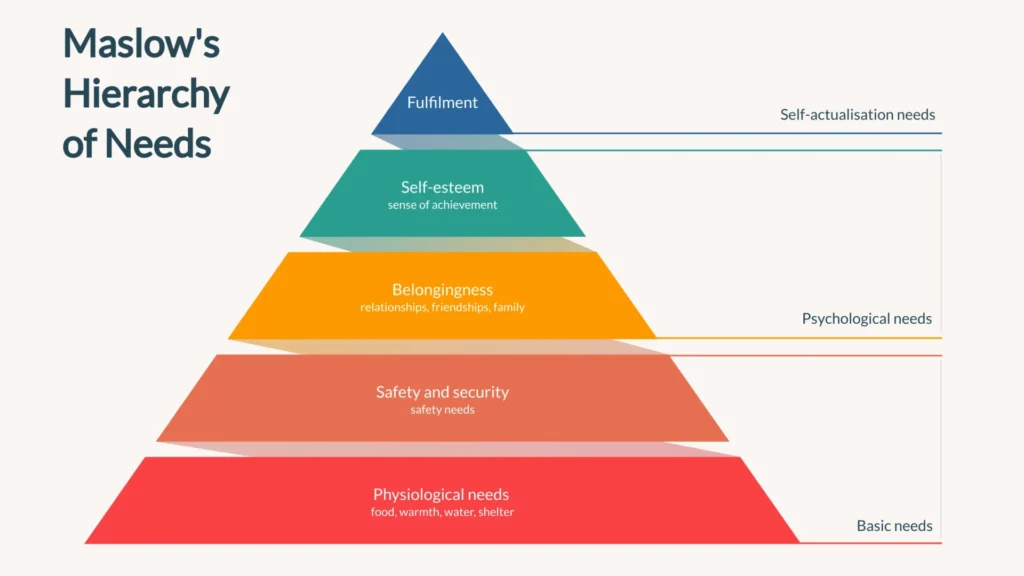
VIZZLO: Maslow’s Hierarchy of Needs
The theory behind Maslow’s hierarchy of needs states that human needs are fundamentally arranged in hierarchal order starting with basic physiological needs and concluding with realisation of full potential (McLeod, 2025). The need for belongingness and love is situated directly in the middle of the hierarchy and is an intricate part of human development characterised by the relationships and sense of connection one shares with friends, family and peers (McLeod, 2025).
As theorised by Maslow (1970), individuals are required to attain belongingness and love to continue to pursue the hierarchy and achieve self-esteem and ultimately self-actualisation. If we apply this theory to the behaviours we see young people portraying online, we can start to understand the profound influence social media has on redefining the basis of their identity.
Connecting in the digital space
Social media platforms including the likes of Tik Tok, Instagram and Reddit, exist to connect people with similar interests, values and beliefs, working to foster a sense of community for young people that perhaps do not feel accepted or as if they belong in the traditional world.
As described by Jacobs and Cooper (2018) digital spaces can be defined as online avenues allowing anyone the opportunity to freely create and explore digital content anywhere and at any time. As young people explore their concept of self and develop an understanding of being, engaging in self-presentation practices including trends, online challenges, and niche communities becomes an important part of the identity formation process (Theodoridis, 2021).
Social media and the integration of technologies into the lives of young people, both academically and personally, constitute a myriad of influential importance on the networks and opportunities they are presented with (Marlowe et al. 2017). Their desire to feel a sense of belonging to community and the ability to explore constructs of their identity in a relatively low risk digital space, has undoubtably changed overtime (Marlowe et al. 2017).
Traditionally, the formation of identity has been achieved through a series of experiences, academic abilities and life achievements. In the context of today, young people search for and find belonging in digital spaces and virtual communities on social media who share in similar interests and values (Preece, 2001).
This opportunity to explore various aspects of their identity and freely express themselves in the digital space, is redefining how Gen Zs develop understanding of their place in the world.
Authenticity vs anonymity
Despite this freedom to express oneself online, the need to belong in a digital context is leading to shifts in identities to fit the expectations of online audiences, influencing the type and extent of content to which Gen Zs are choosing to share online.
Rather than an illusion of reality, the online personas of Gen Z social media users, are perceived as a genuine continuation of oneself (Stoller, 2012). While the increasing desire for authenticity has seen changes in the way in which young people actively use social media and despite this belief that our online personas are an extension of our true selves, Ciarán (2019) states that not everyone wants to be themselves and portray who they really are online.
In exploring differing aspects of oneself, sense of identity and the behaviours portrayed online are significantly influenced by the ability to opt out and avoid challenging exchanges in the digital space through online anonymity (Nitschinsk et al. 2023). While the unique opportunity to remain anonymous online offers young users a degree of protection of personal information and security from harmful online environments, Mr Nitschinsk states anonymity often leaves users unaccountable for their actions which can contribute to an increase in antisocial behaviours portrayed online (eSafety Commissioner, 2025) (Nitschinsk et al. 2023).
The ability for online anonymity and its relationship with identity in the context of social belonging, can lead to a disconnect between one’s online identity and who they are in the real world, creating a fragmented sense of self for young people perhaps portraying an image of themselves on social media that is not truly reflective of their reality (Thomas, 2023).
Additionally, it is in the formation of identity and need for social belonging in a digital space where online anonymity offers the opportunity to avoid confrontations, that young people find themselves altering certain behaviours and aspects of their lives online to create a falsified sense of reality (Thomas, 2023).
Thus, the ability to alter certain parts of our lives as portrayed in the digital world, raises the question; do Gen Zs really present their most authentic selves online or is the liking, commenting and sharing of content only done so to validate the degree of one’s self-esteem. Though many social media platforms have features that allows users to control, to an extent, the type and degree of content shared, individuals in actuality, have limited control over the representation of their identity online (Ciarán, 2019).
While social media arguably presents a range positive outcomes for young people including a sense of community, support and empowerment, such technology challenge the way in which young people view themselves and how they wish to be perceived by audiences online.
Social media in influencing identity
Influenced by the need for belonging and a dependence on social media, young individuals frequently seek alternative ways to develop interpersonal relationships online (Wang and Ding 2024). As Wang and Ding (2024) state, the degree of one’s participation with and use of social media directly links with their social identification to celebrities, social media influencers and content creators of diverse backgrounds, cultures, and values, who allow them to feel a sense of connection in community therefore increasing engagement and use of social media.
While social media influencers across various platforms earn revenue and commissions through the promotion of goods and services, it is their work in building relationships on the basis of trust and authenticity with their audiences that leads them to often be seen as role models or individuals looked up to by their community of followers.
Through the type of content promoted by influencers, followers online will often share similar values, interests and beliefs, and thus, connect over their shared admiration, fulfilling the need to belong to a particular community. Today more than ever before, the role of social media influencers and their views and opinions on various social issues as presented online, play an important role in directing and influencing the views of young people (Albadri, 2023).
The attempt to attain a sense belonging in the digital world has seen an impact on not only the way in which Gen Zs choose to present themselves online but also on their identity offline and the behaviours that translate in the real world. Fashion preferences, the vocabulary and language used, lifestyle choices made, and political views and beliefs of young people are often coherently a result of belonging or the attempt to belong to a particular community online.
Through platform algorithms and the “for you page”, social media inherently depicts the type and extent of content one is exposed to, working to reinforce the interests and identities of young people online. The curated content displayed in one’s feed, based on search history, content previously engaged with and data pulled from a representation of behaviours conducted online, reinforce particular political narratives, driving the direction of self-perception and way that young people identify in the real world relative to their political values and beliefs (Bourland, 2025)
It is perhaps this innate desire to belong that we find the young people of today’s society searching for communities online to identify with on shared causes. While this newfound independence in the digital world has allowed Gen Z’s to explore their concept of self and discover their voice, the profound influence of social media on their beliefs and the way in which one views the world from a political standpoint, has seen a reconstruction in the journey of identity formation for young people.
References
Albadri, H. A. (2023). “The role and impact of social media influencers.” https://www.naturalspublishing.com/files/published/i347j6sr20ft4p.pdf
Bourland, Joel. (2025). “Social Media, Communities and Networks Week 2.” Powerpoint slides.
Dalton, J. C., & Crosby, P. C. (2013). “Digital Identity: How Social Media Are Influencing Student Learning and Development in College.” https://doi.org/10.1515/jcc-2013-0001
Duffy, B. E. (2020). “Social media influencers.” The international encyclopedia of gender, media, and communication. https://osf.io/gcj3r/download
Erikson, E. H. (1968). “Identity: youth and crisis.” WW Norton & company. https://onlinelibrary.wiley.com/doi/abs/10.1002/bs.3830140209
eSafety Commissioner. 2025. Anonymity and identity shielding. Australian Government. https://www.esafety.gov.au/industry/tech-trends-and-challenges/anonymity
Marlowe, J. M., Bartley, A., & Collins, F. (2017). “Digital belongings: The intersections of social cohesion, connectivity and digital media.” https://doi.org/10.1177/1468796816654174
Mc, Mahon, Ciarán. The Psychology of Social Media, Taylor & Francis Group, 2019. ProQuest Ebook Central, https://ebookcentral.proquest.com/lib/curtin/detail.action?docID=5741692.
Nitschinsk, L., Tobin, S. J., Varley, D., & Vanman, E. J. (2023). Why Do People Sometimes Wear an Anonymous Mask? Motivations for Seeking Anonymity Online. Personality and Social Psychology Bulletin, 0(0). https://doi.org/10.1177/01461672231210465
Stewart, A. J. (2020). “Sense of Belonging in Digital Spaces.” ProQuest Dissertations & Theses. https://www.proquest.com/docview/2439649849?pq-origsite=gscholar&fromopenview=true&sourcetype=Dissertations%20&%20Theses
Theodoridis, K. (2021). “Digital Identities: Social Media, Youth and Sense of Belonging.” Social Cohesion and Development. https://ejournals.epublishing.ekt.gr/index.php/SCAD/article/download/32203/28121
Thomas, Sherry. 2016. “A Virtual Life: How Social Media Changes Our Perceptions.” The Chicago School, October 7, 2016. https://www.thechicagoschool.edu/insight/from-the-magazine/a-virtual-life/
VIZZLO. 2025. Maslow’s Hierarchy of Needs. [Diagram]. https://vizzlo.com/gallery/pyramid-chart/example/maslow-s-hierarchy-of-needs
Wang, X., & Ding, Y. (2024). “Does Social Identification with Influencers Impact Social Media Fatigue Among University Students? The Role of Algorithm Awareness and Information Overload.” https://doi.org/10.51668/bp.8324309n


Hi Shannon Kate, You’re right to ask; it is incredibly difficult to police these issues today. Predatory behaviour isn’t exclusive…