Authored by Savannah-Leigh Horner
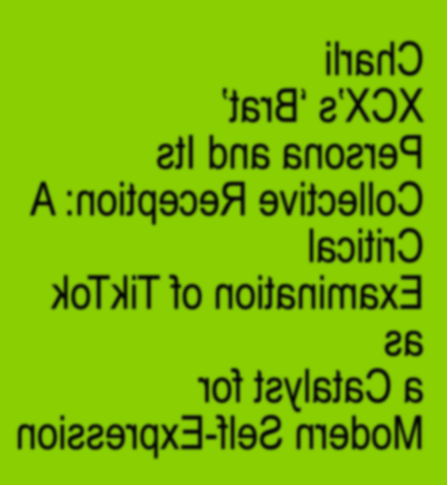
(Source: https://www.bratgenerator.com/)
INTRODUCING The ‘Brat’ Identity
Charlotte Emma Aitchison, publicly known as Charli XCX, is a British experimental electro-pop singer and songwriter. (Brodsky, I. 2024) Despite being active in the music industry for over a decade and playing a key role in some of the most iconic pop hits of the 2010s—such as Icona Pop’s “I Love It,” her own “Boom Clap” in 2014, and Iggy Azalea’s “Fancy”, Charli XCX was still not widely recognized by her name alone (Bai, A. 2024). Her societal impact was amplified in the summer of 2024 following the release of her sixth album, ‘brat’, a Grammy-winning LP filled with hyperpop synths and club-inspired tracks which gave rise to the viral ‘bratty’ persona (Hammond, J. 2024).
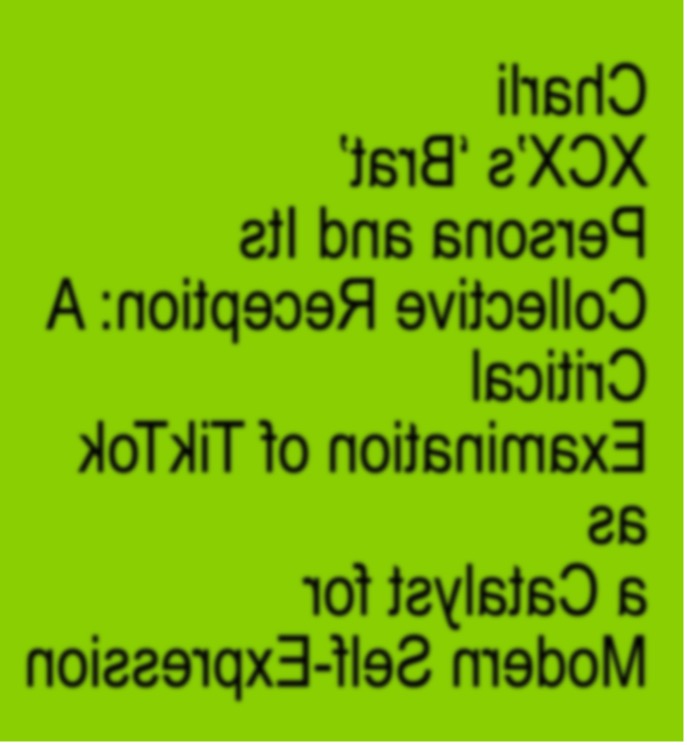
The “Brat” trend has made a profound impact on social media, evolving into a viral phenomenon defined by its distinctive aesthetic. Characterized by a bright lime green colour palette and low-resolution, blurred distortions of custom Arial font letters, the entire anti-design concept was ingeniously created by Brent David Freany for New York-based Special Offer Inc., with the concept originally envisioned by Charli XCX (Poe, J. 2024). The highly replicable nature of this brand image has fuelled the widespread production of user-generated content across platforms like TikTok, while also influencing fashion and brand marketing strategies. The hashtag “#bratsummer” has emerged as a key cultural identifier, with TikTok’s accessibility serving as a powerful catalyst for self-expression, further cementing the movement’s cultural significance.
The Message Behind Charli XCX’s ‘Brat‘
The identity of the ‘Brat’ trend essentially boils down to being unapologetically yourself and not caring about external judgements or opinions. Charli articulates being a brat as “being messy and making mistakes. As well as being honest, authentic and partying through it all.” (Hammond, J. 2024). ‘Brat’ depicts how the majority of young women yearn to live – “dirty, hedonistic, happy, and bra-less” (Williams, Z. 2024).
The emergence of this persona was neither coincidental nor random; it was a carefully curated tracklist drawn from the deeply ingrained societal issues and challenges that women in the music industry often face. Sexism runs rampant within the music industry, with women being berated more than male artists. Bold Women Blogging delve into the multiple factors contributing to this societal issue and outline them as double standards, media influence, and sexualisation (Bold Women Blogging, 2024). There is an aggressive expectation for female artists to continuously evolve with fresh sounds or new looks prior to each new release, to secure relevancy within the music industry and society (Bold Women Blogging, 2024).
This reality is diametrically opposed for male artists, who are praised for serving a consistent style and sound for it presents authenticity. These contrasting gender expectations highlight the unmistakable double standards that prevail in the music industry. When crafting new music, “creatives frequently draw inspiration from their personal experiences to express themselves in their art” (Bold Women Blogging, 2024).
This typically is displayed via reflecting on past relationships and themes of love and sexuality. However, for male artists, explicit expressions of love and admiration for a partner are widely accepted, and sexually charged lyrics, often containing derogatory language, face minimal backlash (Bold Women Blogging, 2024). Charli XCX birthed the ‘brat’ persona to challenge these discriminatory expectations of women in the music industry and ignite the ultimate self-empowerment movement of Gen Z.
Despite the marketing of ‘brat’ projecting an unhinged image, the album delves into the complexity of womanhood accentuated by Charli’s vulnerability. I must confess that upon my initial listen to the trending album, I failed to recognize the complex layers embedded within its track list. At first glance, ‘Brat’ appears to be the ideal playlist for pre-drinks, a soundtrack to accompany the process of getting ready for a night out, evoking that familiar sense of anticipation and euphoria. However, after multiple listens and a more thoughtful examination of the individual tracks during my leisure time, I came to realize that Charli XCX has shared her innermost personal thoughts in a raw and unapologetic manner.
An example of this sensitivity is prominent in the track that has the entire Internet in its palm, “Apple”. An upbeat track that exudes playfulness, discreetly manipulates the use of clever apple metaphors to communicate themes of generational trauma (Bai, A. 2024). During “Everything is Romantic” after describing idyllic Italian summers, Charli sings, “Four generations make up a family”, representing a subtle nod to the strong bond that’s typical of Italian families (Bai, A. 2024).
Another depiction of Charli’s vulnerable side is “I think about it all the time”, this quirky offbeat tune accurately translates Charli’s feelings of uncertainty and doubt through self-reflection after spending time with friends who have recently entered parenthood. With a flat, detached tone, she asks a question many have pondered: “Should I stop my birth control? / ’Cause my career seems so small in the existential scheme of it all.” (Bai, A. 2024).
How TikTok Fuelled the Rise of Charli XCX’s ‘Brat’ Movement
Social media played a pivotal role in promoting the empowerment of modern self-expression that Charli cultivated through the ‘brat’ persona. It is evident that TikTok was the most effective social media platform for the creation and distribution of content that contributed to the formation of identity, culture, trends and individuality. TikTok, the widely popular short-form video sharing app, has captivated millions around the world and become a global cultural sensation. First launched in China in 2016 under the name Douyin, it was later rebranded internationally as TikTok (Sahijwani, C. 2024).
TikTok now boasts over 2 million downloads, with Gen Z accounting for 60% of its user base (Hajiyeva, K. 2022). The core mechanism of TikTok is its advanced recommendation system, driven by artificial intelligence, which effectively analyses user behaviour to promote content that aligns with their preferences. The ‘For You’ page is responsible for delivering personalised content, curated from both established and new users, creating an endless stream of tailored recommendations (Sahijwani, C. 2024). The digital landscape has been transformed by TikTok’s ability to democratise content creation, embracing a new wave of influencers and creators.
The platform hosts a broad spectrum of content, ranging from ‘GRWM’s’ (get-ready-with-me videos) and dance routines to lip-sync performances and educational material. Its viral challenges and trends have imposed a significant impact on pop culture, influencing everything from music charts to fashion trends. However, the release of “Brat” has revealed a concerning shift in both pop culture and societal norms. Charli’s engagement with TikTok has sparked dance trends, lip-sync audios, and fashion movements that are uniquely associated with the ‘brat’ persona.
By now, the ‘Apple’ dance trend is likely etched in everyone’s mind, whether or not you took part. Cemented into the minds of users, this viral trend was propelled by user-generated content with Charli XCX teaming up with fellow LGBTQIA+ icon Troye Sivan to participate in the dance (Atlantic Records, 2024). This collaboration highlights Charli’s strategic ‘brat’ marketing, utilising the partnership to amplify the inclusivity of the ‘brat’ persona. The trend embraced diverse communities across sexualities, genders, and races, reinforcing its universal appeal. TikTok known for fostering creativity and community, has provided a platform where users from all background can express themselves freely (Sahijwani, C. 2024).
A key element of the ‘brat’ aesthetic is its lack of official merchandise, instead encouraging fans to create their own interpretations. Charli herself was featured in a street interview by Offtrend (Offtrend, 2024), where she revealed her fondness of sunglasses due to their ability to embody the essence of ‘brat’ energy. This iconic accessory has become a staple of her signature style, whether on stage or out for the night. Charli isn’t alone in embracing this trend; TikTok users are actively participating by curating their own outfits, creating lip-sync videos to various “Brat” tracks, and showcasing products that embody the ‘brat’ aesthetic, with brands also leveraging the trend in their promotions.
I came across a standout TikTok featuring an outfit recreation, in light of Halloween, of iconic duo Charli and Billie Eilish, seamlessly paired with a trending audio from their song ‘Guess’ (Sena, 2024). Marketing experts have praised this authenticity of the “DIY vibe” acknowledging that the individuality of ‘brat’ cannot be manufactured or commodified (Williams, Z. 2024), this is seen by Sadé’s TikTok of various brands that incorporated the bold, unmistakable green ‘brat’ aesthetic into their promotional TikTok content (Sadé, 2024).
These campaigns, combined with the availability of the ‘Brat Generator’ – a website created by Charli’s marketing team to allow users to generate their own ‘brat’ memes – are a testament to the trend’s brilliance. They exemplify how the ‘brat’ phenomenon achieved such widespread success through its accessible and participatory nature.
‘Brat’ vs. ‘Clean Girl’: Gen Z’s Embrace of Modern Self Expression
When analysing the collective reception of the ‘brat’ influence with Charli’s predominantly Gen Z audience, it is critical to note that ‘brat’ summer was fostered after the short-lived ‘clean-girl era’ trend. A TikTok aesthetic that promoted the expensive appearance of slick-back buns, extensive self-care routines, obsession with pink, overconsumption of activewear, and the routine of journaling after morning pilates class with the girls.
Essentially, ‘brat’ is a retaliation against not only the ‘clean-girl’ but also the societal pressure that demands all young women to conform to the same standards (Williams, Z. 2024). ‘Brat’ comforts Gen Z that it’s acceptable to wear the same outfit repeatedly, embracing the messy-girl aesthetic with week-old unwashed hair. This relates back to the sexism that runs rampant within not only the music industry, but society as a whole. Men unitedly idolise a perfectly traditional submissive version of womanhood, where women are required to be neat, feminine creatures (Williams, Z. 2024).
In Charli’s music video for hit-single “360” she is pictured leisurely drinking red wine whilst on a treadmill, resulting in pouring it all over herself whilst clearly avoiding engaging in any exercise. This serves as one of Charli’s most explicit visual expressions of her opposition to the ‘clean girl’ trend (Williams, Z. 2024). Charli’s influence on TikTok led to her predominantly Gen Z audience quickly embracing ‘brat’ as part of their colloquial speech. Bryan Robinson, recognised Forbes author, has publicly defined how Gen Z uses the term, describing it as a “compliment towards a person or action emulating confident rebellion, playful defiance and boldness” (Robinson, B. 2024).
Gen Z is currently navigating a cost-of-living crisis, grappling with the extreme unaffordability of the housing market, and facing negative judgement from older generations (Haider, A. 2024). The ‘brat’ aesthetic clearly offers this generation a sense of relief, providing an outlet to embrace the chaotic aspects of the ‘brat’ lifestyle in a society that seeks to criticise and control this so-called “lazy, and unmotivated” demographic (Haider, A. 2024). This positive perception is evident in the trending #brat on TikTok, where the majority of user-generated content is produced by Gen Z users. Some even express their disappointment over the conclusion of the beloved ‘brat’ summer.
Summary
In essence, the ‘brat’ trend is about unapologetic self-expression, embracing individuality without fears of external judgement. Far from being a random phenomenon, this persona was a deliberate response to the systemic challenges women face in the music industry. Female artists are often pressured to constantly reinvent themselves to maintain relevance, whereas male artists are praised for their consistency as it is seen as a sign of authenticity. Charli XCX created the ‘brat’ persona as a direct challenge to these double standards, igniting a movement of self-empowerment particularly amongst Gen Z.
This movement encourages the rejection of traditional expectations and embraces raw, unfiltered self-expression. Though the marketing of ‘brat’ may exude an unhinged, rebellious energy, the album itself dives deeply into the complexities of womanhood, deeply intwined with Charli’s open vulnerability and personal narrative. Social media, particularly TikTok, played a pivotal role in amplifying this message and fostering a space where users could engage with, reinterpret, and contribute to the ‘brat’ aesthetic. More than just a promotional tool, TikTok became a catalyst for modern self-expression, shaping identity, culture, and trends in ways that resonated far beyond the album’s release. This level of user participation transformed ‘brat’ into a collective experience that reflected the evolving social landscape of modern self-expression.

Atlantic Records – TikTok. Charli XCX, Troye Sivan, Terrencefoconnor Apple Dance. (2024). TikTok.com. https://vt.tiktok.com/ZSrkf1QVp/
Bai, A. (2024). BRAT: the (r)evolution of Charli XCX. The Emery. https://thehuronemery.com/11244/zine/brat-the-revolution-of-charli-xcx/
Brodsky, I. (2024, November 13). Charli XCX | Biography, Music, Albums, Brat, & Facts. Encyclopedia Britannica.. https://www.britannica.com/biography/Charli-XCX
Bold Women Blogging, (2024, June 27). Gender Inequality in Pop Music. Womens Resource and Development Agency. https://www.wrda.net/blog/gender-inequality-in-pop-music
Hammond, J. G. (2024, July 31). How does Charli XCX’s “brat” summer prove the power of authentic social media? | Creativebrief. Creativebrief. https://www.creativebrief.com/bite/thought-leadership/how-does-charli-xcxs-brat-summer-prove-power-authentic-social-media
Haider, A. Brat summer proves once again that it’s all about the aesthetic for Gen Z.(2024). Wearepion.com. https://www.wearepion.com/blog-posts/brat-summer-proves-once-again-that-its-all-about-the-aesthetic-for-gen-z
Hajiyeva, K. (2022 September 8). What the data says about Gen Z TikTok usage?. Planly. https://planly.com/gen-z-tiktok-use/
Poe, J. (2024, August 16). The spectacular rise and depressing demise of Charli XCX’s Brat Summer. Under the Paving Stones; Under the Paving Stones. https://underthepavingstones.com/2024/08/16/the-spectacular-rise-and-depressing-demise-of-charli-xcxs-brat-summer/
Robinson, B. (2024, August 27). The New 2024 “Brat” Trend In The Workplace And What It Means. Forbes. https://www.forbes.com/sites/bryanrobinson/2024/08/26/the-new-2024-brat-trend-in-the-workplace-and-what-it-means/
Sadé – TikTok. Companies that are having a brat summer. (2024). TikTok.com. https://vt.tiktok.com/ZSrBCqwMC/
Sahijwani, C. (2023, November 2). TikTok: The Rise, Impact, and Cultural Influence of a Global Phenomenon. Medium. https://medium.com/@chandan.sahijwani/tiktok-the-rise-impact-and-cultural-influence-of-a-global-phenomenon-9a9430aea91f
Sena – TikTok. Guess????. (2024).TikTok.com. https://vt.tiktok.com/ZSrBQcDw6/
Offtrend – TikTok. Interview with Charli XCX: What clothing item do you think gives ‘brat’ energy? (2024). TikTok.com https://vt.tiktok.com/ZSrBQvkaD/
Williams, Z. (2024, July 16). Brat summer: is the long era of clean living finally over? The Guardian. https://www.theguardian.com/lifeandstyle/article/2024/jul/16/brat-summer-is-the-long-era-of-clean-living-finally-over


Hi Shannon Kate, You’re right to ask; it is incredibly difficult to police these issues today. Predatory behaviour isn’t exclusive…