Abstract
With the rise of user-generated content through social media, the sharing of diverse interests has led to various online communities that different users resonate with. Among these interests are blind boxes, which refer to toy collectibles sold in sealed packaging that conceal the specific item or design the consumer will receive. Blind boxes have become an online phenomenon with users publishing their own unboxing and collection videos. This paper examines ways in which blind box toys have transitioned from simple collectibles into instruments of self-expression within toy-centred online communities. It argues that the affordances of digital platforms and the culture of collecting within online communities have transformed the blind box collecting hobby as a method of affirming psychological identity and performing personality and social class. The essay examines how information exchange regarding blind box toys contributes to the development of self-importance and confidence in one’s own abilities, and how preferences in blind box toys that are associated with distinct themes signal personality. Finally, it investigates different collecting habits exhibited online, primarily on TikTok, demonstrating how collectors implicitly and explicitly express their social class and financial abilities. Through investigating the various collecting activities involving social media, the paper concludes that blind box collectibles, through the facilitation of online platforms, have become a mechanism to present and express self-identity.
Introduction
In a digital age where content creation has been democratised, even a tiny figure pulled from a mystery box can imply who we are or want to be. A blind box toy refers to toy collectibles sold in sealed packaging that conceal the specific item or design the consumer receives (Xiao, 2022). Blind boxes are often classified by series, with the box demonstrating what potential toy can be obtained (Xiao, 2022). Consumers, therefore, purchase the product blindly without a guarantee of which variation they will receive, only revealing its content once they finalise the purchase and conduct an unboxing (Xiao, 2022).
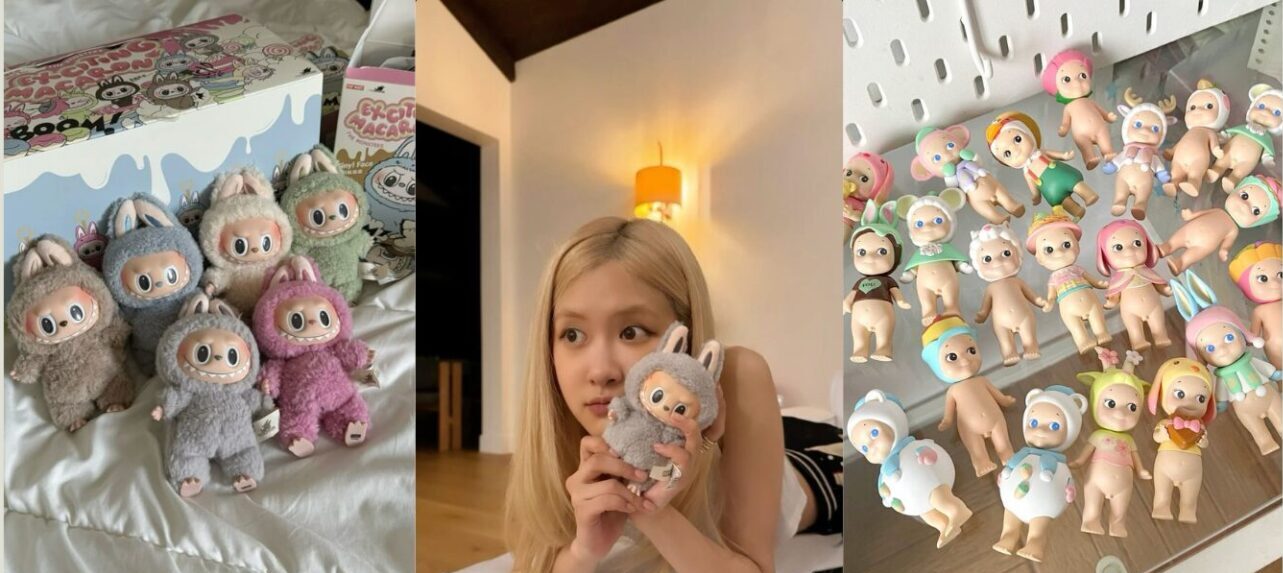
Pop Mart has popularised the contemporary concept of blind boxes globally, making it a prominent company in the industry (Li, 2025). It began in 2015 with the release of its first-ever blind box series featuring its original character, Molly, whom customers admired and loved (Li, 2025). At the same time, numerous companies have released their own versions of blind boxes, significantly boosting the blind box market and offering various choices for consumers (Li, 2025). Some well-loved blind boxes include characters such as Sonny Angels, Smiskis, and Pop Mart’s Labubu or those based on popular intellectual properties such as Pokémon and Hello Kitty (Ryan, 2024).
Online platforms like TikTok have played a pivotal role in boosting the mainstream popularity of blind boxes, giving rise to a wave of blind box influencers. Within a platform’s content format, everyday users feature their unboxings and, as a result, showcase their reactions as they unbox and reveal what figure they obtain. This suspenseful and curiosity-piquing experience has established a vibrant community centred around these surprise toys. In platforms like TikTok, repeated interaction with these types of content alerts the algorithm, which improves its suggestions based on user engagement habits, resulting in increased recommendations for such content, further amplifying blind box culture (Zulli & Zulli, 2022).
This essay will argue that blind box toys have evolved from simple collectibles into a self-expression tool within toy-centred online communities, enabling users to affirm their psychological identity and perform personality and social class.
Establishing the Value of Self through Blind Boxes
Participation in blind box communities enables users to boost their sense of self-worth and accomplishment through information exchange and communication within online platforms. Within a blind box series, a certain style can be classified as ordinary or rare, with the rare ones, referred to as secret or hidden, being most sought after by collectors (Xiao, 2022). However, the probability of getting the secret item is lower than ordinary variations, typically 1/144 boxes (Ziwei, 2021). Therefore, when blind box collectors share their experiences on online platforms, including completing a particular series, they often garner admiration and respect from other collectors (Li, 2025; Qi et al., 2024). With the affirmation gained from fellow collectors through proudly showcasing accomplished blind box sets on online platforms, individual collectors can better ascertain personal value through a sense of achievement within the blind box community. Collectors can develop a greater sense of self-appreciation as their confidence in their knowledge, dedication and expertise in the realm of collecting increases based on the recognition from the online community.
Furthermore, senior collectors who are well-versed in predicting which figures are contained in each box often preach their strategy to new collectors. These strategies include differentiating blind boxes based on the sound or weight of the boxes when shaken (Ziwei, 2021). Information can be relayed online, either through video tutorials or detailed posts. The guiding and expert roles collectors assume within online blind box communities like TikTok “fulfil a psychological desire for self-importance” (Qi et al., 2024, p. 34). Through informative exchanges and inputs regarding what may seem like a trivial hobby, individuals perceive themselves as a core member of the group, thereby elevating their sense of purpose and contribution. When other collectors successfully secure their desired figures based on the advice of these expert collectors, advisers may discern themselves as pivotal influencers of a thriving community, further uplifting self-perception and psychological identity. Ultimately, the online blind box community have expanded beyond a place for merely showcasing toy collections. It has now evolved into a space where collectors can reinforce their sense of personal significance and shape their self-perception. The transformation of blind boxes from simple collectibles into something more meaningful and complex can be further understood by assessing how individuals engage in blind box communities on social platforms as a marker and reflection of their personality.
Blind Box Preferences as an Indicator of Identity
Collectors’ deliberate sharing of their personal preferences for blind boxes and collection journeys on online platforms transforms the art of collecting into a marker of identity, often tied to aesthetic expression and taste. According to Marwick (2013), Identity is dynamic, with individuals varying their self-presentation in accordance with specific circumstances. The rise of social networking sites has provided more avenues for individuals to facilitate self-expression through “text, photographs, and other multimedia capabilities” (Papacharissi, 2010, p. 304). This results in a more intentional, consistent, creative presentation of self (Papacharissi, 2010). This concept correlates to how blind box collectors conduct themselves online. On social platforms like Instagram, TikTok, or YouTube, individuals share their toy collections, preferences, and unboxing experiences in a curated way, implying their sense of self. Blind box series are meticulously constructed by designers, thus resulting in highly distinct appearances and design themes (Dai, 2024; Zhan, 2024). Collectors give each character particular connotations, converting them into symbols that resonate with an individual identity (Zhan, 2024). For example, the Pop Mart character, Hirono, is suited for individuals with mischievous traits who unapologetically express their emotions (Rosario, 2024). Meanwhile, the character Molly leans toward a playful and quirky persona (POP MART AUSTRALIA, n.d.). As a result, collectors’ mere selection of a specific blind box series to showcase on their online platforms becomes a method of self-expression wherein taste and aesthetics are determined. Through the consistent feature of specific blind boxes on a collector’s platform, whether it favours a specific brand, showcases a themed display or follows a certain colour palette, blind box collectors signal aspects of their personality, preferences, and identity that align with the characteristics of the toys themselves.
Furthermore, a specific blind box series can have a prominent endorser, or a public figure associated with it. For example, Lisa, a member of the well-known Korean girl group BLACKPINK, shared her love for Pop Mart’s character, LABUBU (Wu, 2024). Considering this, individuals may intentionally align their collecting preferences with those of influential figures as a form of social signalling on social media. Collections that resemble those of a famous figure can communicate an aspiration towards a particular lifestyle and personality. This can also exemplify possessing similar immaculate tastes and ideals as the widely idolised persona. Thus, blind box toys, by extension, become a mechanism for expressing identity and values online, intentionally or subconsciously.
In addition to the unique figures, how the blind box experience is showcased speaks volumes about the collector’s identity. The aesthetic choices in collection presentation result from the user-friendly affordances of social platforms like TikTok, which provides a wide gallery of music, filters and editing tools to supplement content creation (Vaterlaus & and Winter, 2021). An unboxing with a mellow sound and soft filter of one collector may signal a calm and collected character. In contrast, others may utilise humorous music and be hyper and loud with their toy unboxing, reflecting a more extroverted and spontaneous personality. This demonstrates that the presentation of the blind box experience online, with varying aesthetic choices, dictates the perception regarding the collector. This further exemplifies that the blind box community on social media tends to become an extension or performance of the personal identity of collectors beyond the main subject of toys. Ultimately, blind boxes have become a self-expression tool and a concrete portrayal of a collector’s ideals, aspirations, and traits in the digital age. The affordances of social platforms enable individuals to communicate their varied collecting experiences in ways that align with their identity. This trend exemplifies how blind boxes, beyond their inherent value as collectibles, function as markers of social identity in the digital age.
Collecting Habits Indicating Social Class and Spending Power
Another way individuals project their identity in online communities, utilising blind box toys, revolves around the signalling of social class and discretionary spending power. According to Shin et al. (2021), Gen Z -Pop Mart’s main target market- often consumes premium-priced items and famous brands for self-expression on social media. Participation in online blind box communities can be a method to perform wealth, as blind box toys employ a rarity system and limited edition drops that are positioned at a high value (Xiao, 2022). As previously mentioned, ‘secret’ toys within a blind box series appear less frequently; thus, these items have a higher value in the resale market, which can be six times the retail price of the blind box, amplifying the toys’ perceived value (Xiao, 2022; Zhan, 2024). Thus, in social media, when collectors flaunt their hard-to-get figures, emphasising their rarity through dialogues and narratives about the struggles of obtaining the toy within their unboxing or collection content, blind boxes, by extension, become a tool to signal spending ability and financial status, whether it truly reflects individuals’ circumstances or merely a performance. Additionally, the capability to pay exorbitant resale prices for a non-necessity item further signals wealth.
Moreover, some blind box enthusiasts would go to great lengths, such as travelling to overseas flagship stores like Thailand and queueing for hours to obtain their desired toy (Hardianti & Oktalisa, 2024). Others may employ intermediary services, who earn commission by sourcing and selling blind boxes at an additional cost (Hardianti & Oktalisa, 2024). These practices are heavily documented online through ‘POV’- style content. For instance, one collector documents travelling to two countries – Hong Kong and Macau, to visit Pop Mart stores. Thus, the nature of blind box collecting paired with democratised social media transforms toy collecting into a form of conspicuous consumption where spending power that fuels extreme collecting behaviour and access to rare goods are used to subtly signal elevated social status and financial freedom to an online audience. Additionally, blind box toys are not confined to shelf displays but have transcended as fashion and lifestyle accessories. Pop Mart’s Labubu has emerged as a trendy bag charm, often spotted with celebrities and royals (Zhang, 2025). Due to the surrounding scarcity and high demand for these toys, flaunting these items as a part of their everyday fashion on personal socials, e.g. casually wearing them as a keychain, implies a level of affluence and nonchalance toward goods deemed as priced possessions. Using these high-value items with no reservations serves as a performance of wealth. In this way, blind box collecting becomes a form of lifestyle branding where taste and wealth are communicated through digital platforms. In essence, participation in the online blind box culture can involve a performance of wealth, thereby projecting a particular facet of an individual’s identity.
Conclusion
Blind box toys transcended their role as collectibles, now serving as a meaningful vehicle for self-identity on social platforms. Through the communities and engagement these toys foster, individuals navigate self-image and exemplify personal traits and social status to others. Firstly, collecting achievements such as the completion of a blind box set leads to the identification of personal worth because of the affirmation obtained from other collectors. Individuals who facilitate information regarding toy collecting assume an expert role, instilling a sense of purpose and contribution. Furthermore, as each blind box character bears different connotations, a collector’s preferences in the categories of toys they highlight on social platforms extend as a form of self-presentation. A similar idea of identity signalling in online toy-collecting communities can be concluded when an individual’s collection resembles that of a famous personality, and through the deliberate use of platform tools to document their collecting experiences. Lastly, social class can be ascertained by an individual’s collecting habits shared online, further reinforcing blind box collecting as an avenue for displaying personal attributes, whether explicitly or implicitly. Given these insights, future studies may examine how long-term participation in online blind box communities impacts self-perception, particularly when trends shift and the popularity of blind box toys decreases. This may include investigating whether its power as a self-representation tool diminishes or persists despite decreasing mainstream relevance. It also invites the question of whether reduced public attention to blind box collecting leads to a more authentic pool of collectors, making identities expressed through collections more genuine.
References
Dai, T. (2024). Analysis of Product Characteristics and Marketing Strategies of Blind Box Based on the Study of Consumer Propensity—Take Pop Mart as an Example. Lecture Notes in Education Psychology and Public Media, 54, 106-111.
Hardianti, F., & Oktalisa, N. E. (2024). The FoMO Labubu in AISAS Approach Digital Communication Study of Instagram User Behavior on Labubu Dolls. International Conference on Communication and Media Digital,
Li, S. (2025). Research on marketing strategies of trendy toy brands under the “blind box economy”: A case study based on POP MART. In (1 ed.). CRC Press. https://doi.org/10.1201/9781003564966-87
Marwick, A. E. (2013). Online identity. A companion to new media dynamics, 355-364.
Papacharissi, Z. (2010). A Networked Self : Identity, Community, and Culture on Social Network Sites. Taylor & Francis Group.http://ebookcentral.proquest.com/lib/curtin/detail.action?docID=574608
POP MART AUSTRALIA. (n.d.). OUR IP & Designers. https://au.popmart.com/pages/our-designers?srsltid=AfmBOoohI2wJZRMW24-rCP0Lgz4IrUp5jKTdiVDlO9sj1wvRBzqCj9D8
Qi, A., Sudtasan, T., Kewprasopsak, T., & Suriya, K. (2024). The Impact of online community on blind box repurchase intentionChiang Mai: Graduate School, Chiang Mai University].
Rosario, M. D. (2024, November 8). The MEGAStyle Gift Guide: The Perfect Pop Mart Figure for Every Personality. MEGA. https://mega-asia.com/lifestyle/culture/the-megastyle-gift-guide-the-perfect-pop-mart-figure-for-every-personality/
Ryan, M. (2024, December 24). What are blind boxes? The latest Asian retail craze to hit Minnesota. The Minnesota Star Tribune.https://www.startribune.com/pop-mart-miniso-blind-box-ebisu-barnes-noble-toy-art-collectible-figurine/601198734
Shin, S.-A., Jang, J.-O., Kim, J.-K., & Cho, E.-H. (2021). Relations of Conspicuous Consumption Tendency, Self-Expression Satisfaction, and SNS Use Satisfaction of Gen Z through SNS Activities. International Journal of Environmental Research and Public Health, 18(22), 11979. https://www.mdpi.com/1660-4601/18/22/11979
Vaterlaus, J. M., & and Winter, M. (2021). TikTok: an exploratory study of young adults’ uses and gratifications. The Social Science Journal, 1-20. https://doi.org/10.1080/03623319.2021.1969882
Wu, S. (2024). The Rise of Blind Boxes: Cultural, Marketing, and Consumer Trends Behind Bubble Mart’s Global Success. 1(10), 1-5. https://doi.org/ https://doi.org/10.61173/nn89jm39
Xiao, L. Y. (2022). BLIND BOXES: OPENING OUR EYES TO THE CHALLENGING REGULATION OF GAMBLING-LIKE PRODUCTS AND GAMBLIFICATION AND UNEXPLAINED REGULATORY INACTION. Gaming Law Review, 26(5), 255-268. https://doi.org/10.1089/glr2.2022.0012
Zhan, H. (2024). Research on the Impact of Blind Box on Consumers and Marketing Strategies. SHS Web of Conferences,
Zhang, T. (2025, February 20). How the Fluffy Figurine Labubu Is Catching Fire as the ‘It’ Bag Charm for Royals, Socialites and Lisa. Women’s Wear Daily. https://wwd.com/fashion-news/fashion-features/labubu-bag-charm-royals-celebrities-fashion-1236847325/
Ziwei, Z. (2021, 2021/07/12). Research on Blind Box and its Marketing Strategy. Proceedings of the 2021 International Conference on Economic Development and Business Culture (ICEDBC 2021),
Zulli, D., & Zulli, D. J. (2022). Extending the Internet meme: Conceptualizing technological mimesis and imitation publics on the TikTok platform. New Media & Society, 24(8), 1872-1890. https://doi.org/10.1177/1461444820983603


Hi Shannon Kate, You’re right to ask; it is incredibly difficult to police these issues today. Predatory behaviour isn’t exclusive…