1. Introduction & Importance of the Study
A. Introduction to the Topic
TikTok with more than one billion active users today is now a phenomenon that is much more than entertaining. It thereby created a rapport for young people to perform their identity as they create content. Through trends, challenges and discussion users express various segments of their personality and interact with like-minded users. This becomes an open stage where youths can test different personas and get either approval or rejection from others in society. Therefore, through self-identity in the various creatively produced scenarios that its users post, TikTok affects how the consumers and their targeted audience perceive themselves and the world.
B. Relevance and Importance of the Study
Identity Formation in the Digital Age:
According to Erik Erikson’s psychosocial theory of development, both adolescence and young adulthood are important for the development of identity. The platforms like TikTok enable youngsters to play with different avatars and also get the response from their followers (Okunev, 2023). In creating, sharing and collaborating on content, individuals undergo a transformative journey of self-realization in which peer approval determines the nature of one’s online and offline persona.

Figure 1: Erikson’s stages of development
(Source: https://www.verywellmind.com )
Impact of Algorithm-Driven Content:
The TikTok app provides users with content recommendations based on their interactions and content viewing history. On one hand it reifies some of these identities and beliefs and on the other, it curtails the pursuit of a variety of opinions and thoughts since it creates echo chambers. First of all, the reflection of beautiful and ideal body images encourage young people to aspire for slim figures and change their values unconsciously (Ionescu and Licu, 2023). This algorithmic reinforcement could lead to perceived perfection, which can harm individuals’ well-being and mental health.
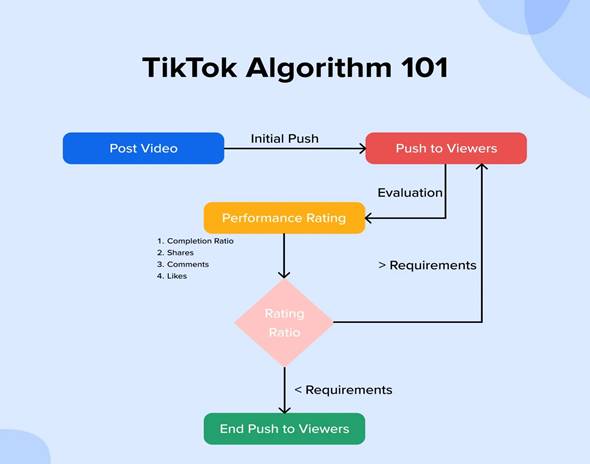
Figure 2: The tiktok algorithm
(Source: https://www.socialpilot.c )
Role of Peer Validation:
Likes, comments, and shares act as the validation from peers and determine the perception that young people have about themselves. Positive feedback increases confidence and makes people feel valued while negative or lack of feedback leaves them feeling incompetent. This search for appreciation results in the filtering of content that is supposedly liked by the followers, thus the distinction between peoples’ actual selves and the personas they create to attract attention.
C. Why This Topic is Appropriate
Relevance in Modern Society:
With the increasing overlap between online and offline identities, understanding TikTok’s impact on young people’s self-concept is essential. Positive engagement with such content can boost self-esteem but negative effects such as anxiety and body dissatisfaction may also be expected when individuals are exposed to such content. Researching these effects can be beneficial to understand the dynamic between social media platforms and identity construction.
Impact on Psychological and Emotional Development:
Based on the nature and the frequency of the interaction with the content, it is necessary to understand the impact of TikTok on psychological and emotional well-being. Although ‘likes’ from peers could boost self-confidence, appearing on the curated platform results in negative body image, increased depression, and anxiety levels.
Bridging the Research Gap:
Although the existing literature features increased inquiry into the role of social media in identity construction, the manner in which TikTok operates with distinctive features such as the algorithm it uses, fast content sharing, and its participatory format has remained uncharted. Thus, the investigation of young people’s self-identity shaped by TikTok will give more significant information about the growing role of digital media technologies in individual identity construction (Lee et al. 2022). This study was designed to address this gap in the literature by examining how TikTok influences the identity constructions of young people while elucidating the positive and negative impacts of this platform.
2. Review of Literature & Analysis of Other Researchers’ Views
Cedrún and Civila (2024), discuss how TikTok impacts individual representation and virtual socialization among the youth population. It reveals how TikTok is a form of self-creation as well as the construction of self by peers and the algorithm. The analysis based on the concept of digital interaction leaves no doubt that youth turn to TikTok to negotiate their identities, but on the other side, they go through the process of identity formation as they receive interaction metrics. The authors also describe the positive impact of TikTok as an empowering tool for creativity and personal growth, untwisted by the negative pull of the algorithms Standardization. It discusses the positive and negative implications of this digital involvement with regard to self-image and feelings, and stresses the necessity for more complex understanding of effects that virtual environments have on young users’ identities.
Chen (2023), discusses the benefits and drawbacks of social media usage with specific reference to TikTok and Instagram in the formation of youthful self-identity. This paper examines how such a type of virtual socialization could contribute to identity crises, with a focus on over-reliance and misuse of social websites. In the study Chen recruited 30 students from Ankara University, who filled a number of questionnaires to prove the role of TikTok in the formation of identity and impression of popularity as well as the impact it has on one’s interactions. This paper discovers that TikTok acts as a platform for pop-culture expression and online interaction but also brings problems like identity crisis and influence by trends. The study offers possible interventions and suggestions on how to avoid the possible harms of social media through proper and safe use. Chen’s work focuses on dynamics between the digital spaces and identity transformation of youth.
Argumentative Discussion on Researchers’ Viewpoints
While both Cedrún and Civila (2024) and Chen (2023) offer valuable insights into the influence of TikTok on young people’s identity, their analyses exhibit certain gaps. While Cedrún and Civila explore the subject heavily as it relates to the algorithm and its influence on identity formation, socio-cultural factors shaping identity in diverse contexts are not given their due consideration. However, Chen’s study shows the negative impacts of social networking sites in that students are likely to develop an identity crisis when they spend too much time on SNS but it lacks generalizability because it is based on a sample size of 30 students only. Additionally, both studies fail to explore the possible future consequences of the development of the digital identity and the relationship between race, gender, and class (Felaco, 2025). To bridge these gaps, longitudinal research and cross-cultural comparison are essential to gain better insight in the future. It is essential to explore these areas as TikTok impacts the self-perception and mental health of young people and the role of social media in today’s society.
3. Detailed Discussion on the Influence of TikTok on Young People’s Identity
A. Understanding Identity Development in Adolescence
Personal identity development is a process of understanding who a person is within themselves through key experiences and learned factors within a society. Erik Erikson in his Social Development theory categorizes the adolescent stage as the identity versus role confusion stage, in which boys and girls engage in the exploration of roles they should play (Soh et al. 2024). This period is important because adolescents experiment with various aspects of self-identity and try to fit into a certain group. TikTok as one of the most used SNSs enables young people to stage such explorations online and develop new, partly more acceptable selves based on the interactions with the users.
B. TikTok as a Space for Identity Exploration
The content of TikTok is unique as it is created by the generation which uses it as the playground for multiple sides of their personality. By such videos, challenges, and trends, people try on different roles and topics of attention. Specific Hashtags like #AltTikTok and #BookTok allows users to find individuals similar to them and provide a sense of belonging to the specific group, thus, the enforcement of the specific identity. However, TikTok offers the potential for genuine expression and genuinity, but it is a performance all the same. Some users share their feelings and opinions, while others share content due to its adherence to specific standards to get approval and sympathy, so sometimes, there is an intricate balance between what is the true self and what is the performed self for the audience (Jerasa, 2025).
C. Algorithmic Influence on Identity Perception
TikTok is one of the world’s most popular social media platforms in terms of engagement as it provides customized content that matches users’ interests and views. This algorithmic reinforcement leads to confirmation bias, rediscovering, and self-reinforcing prejudice and thus isolating individuals from the exposure to divergent opinions. In addition, TikTok has a trend culture where specific trends such as dance challenges and beauty standards require youngsters to conform to particular behaviors for them to fit in (Ionescu and Licu, 2023). This focus on trend adoption may have detrimental effects such as creating a monoculture of users that conform to trends rather than post to be their true selves online. Thus, the youngsters can face an internal conflict between their internal and external selves in social networks.
D. Impact on Self-Esteem and Mental Health
TikTok affects young people’s confidence in many ways since it has a feature of likes, comments, and views, therefore reflects young people’s self-images. Receiving positive attention makes people feel wanted and valued, negativity on the other hand, makes people feel unwelcome and unaccepted (McCashin and Murphy, 2023). This leads to a situation whereby young users feel the need to constantly wait for approval from the rest of the community online. Moreover, advertising, fashion, television, movies, and magazines all entice women to compare themselves with supermodels and other thin celebrities thereby causing anxiety, depression and body dissatisfaction. These factors make a bridge between mental health and social media, as these help in making their identities in social media.
E. Positive Outcomes: Empowerment and Advocacy
It is necessary to understand that TikTok, social networks and such platforms in general can and should be used to raise awareness of young people about the problems that occur and inequality. Speaking through trending hashtags and creating viral challenges, the people empower various causes that include a change in climate, racial abuses, and rights of women. In addition, content creation allows the young users to gain confidence, improve creativity, and increase digital literacy. Thus, playing an active role and sharing opinions also develops the young people’s skills while enhancing their possible impact on the society.
F. Negative Consequences: Identity Crisis and Homogenization
It can negatively impact its users, as they emulate other more popular creators and lose their individuality through identity ideology. Societal expectations of youths influence these viral aesthetics and challenges to the extent that the youths aim at impressing other people by promoting beauty (Chen, 2023). Thus, exposure to multiple, sometimes contrasting, digital images and representations can lead to identity crisis. These multiple roles in various virtual environments complicate the relationships between users’ avatars and their offline selves and can cause anxiety in youth. This paradox raises the issue of possible psychological costs of performing digital selves and conformity.
G. Influence of Cultural Norms and Diversity on Identity
TikTok thus offers a platform where young people of different cultures can present themselves and find like-minded groups. However, gender roles and societal expectations are critical influences in how individuals express and how other users perceive their identities. Certainly, TikTok serves as an outlet for several minorities and buoys the spirits of the minority; however, algorithms are prejudiced against those minorities. This can lead to either underrepresentation or stereotyped portrayal of characters, which in turn affects how young people of diverse backgrounds engage in the process of coming into their own. Overcoming these biases remains important to promote a better digital representation of people and their identities.
H. Long-Term Effects of Digital Identity Formation
TikTok determines how young individuals phrase themselves and express themselves as the identity transformation occurs virtually. However, the continuous maintenance of such subject performances erases itself from countless curated digital identities. On the positive note, digital identities increase levels of confidence and creativity, on the negative side, the existence of digital identities promotes an ugly reality where people live two different lives (Hein, 2022). Moreover, young users’ data stays out there with them endlessly, it can affect education and career, and other facets of life. Developing critical digital literacy is necessary for youth to effectively navigate their digital selves and personally significant accounts and to ensure that their online representation is consistent with their offline identity.
4. Conclusion
A social media platform like TikTok has a crucial role of defining youth’s identity and providing creative expression and recognition. By creating content, viewing content and participating in online communities, youth identity emerges and develops. Nonetheless, it should be noted that TikTok has a positive and negative influence on its users in a similar manner as it promotes self- expression, advocacy, identity, and sharing on one hand while on the other hand has negative impacts like identity crisis, conformity, and adverse mental health on the same. Further research should be conducted to determine the long term effect of TikTok on identity. Moreover, exploring how race, gender, and economic status play into the impact of TikTok on identities can be a useful future research direction.
Reference list
Journals
Cedrún, L.C. and Civila, S., 2024. The influence of TikTok use on young people’s identity formation and virtual socialisation. MLS Communication Journal, 2(1).
Chen, S., 2023. The influence of social media platforms on Self-Identity in the new media environment: the case of TikTok and Instagram. In SHS web of conferences (Vol. 165, p. 01020). EDP Sciences.
Chen, S., 2023. The influence of social media platforms on Self-Identity in the new media environment: the case of TikTok and Instagram. In SHS web of conferences (Vol. 165, p. 01020). EDP Sciences.
Felaco, C., 2025. Making Sense of Algorithm: Exploring TikTok Users’ Awareness of Content Recommendation and Moderation Algorithms. International Journal of Communication, 19, p.22.
Hein, M., 2022. Social influencers: FOMO and identity crisis. Character and, pp.63-80.
Ionescu, C.G. and Licu, M., 2023. Are TikTok algorithms influencing users’ self-perceived identities and personal values? A mini review. Social Sciences, 12(8), p.465.
Ionescu, C.G. and Licu, M., 2023. Are TikTok algorithms influencing users’ self-perceived identities and personal values? A mini review. Social Sciences, 12(8), p.465.
Jerasa, S.E., 2025. The# BookTok Connection: Examining Cultural and Linguistic Identity Expression in Online Reading Communities. Education Sciences, 15(2), p.234.
Lee, A.Y., Mieczkowski, H., Ellison, N.B. and Hancock, J.T., 2022. The algorithmic crystal: Conceptualizing the self through algorithmic personalization on TikTok. Proceedings of the ACM on Human-computer Interaction, 6(CSCW2), pp.1-22.
McCashin, D. and Murphy, C.M., 2023. Using TikTok for public and youth mental health–A systematic review and content analysis. Clinical child psychology and psychiatry, 28(1), pp.279-306.
Okunev, R., 2023. The psychology of evolving technology. Apress. https://doi. org/10.1007/978-1-4842-8686-9_3.
Soh, S., Talaifar, S. and Harari, G.M., 2024. Identity development in the digital context. Social and Personality Psychology Compass, 18(2), p.e12940.


:max_bytes(150000):strip_icc()/2795740-article-erik-eriksons-stages-of-psychosocial-development-5ac3df9e875db90037ffa803.png)

Hi Shannon Kate, You’re right to ask; it is incredibly difficult to police these issues today. Predatory behaviour isn’t exclusive…