
Abstract
During the era when social media has become an important part of people’s everyday lives, it has also changed how some industries operate. Social media has sped up the fashion trend cycle in the fashion industry. Consumers are trying to keep up with the newest and most fashionable quickly, leading to the rise of fast fashion. Fast fashion provides the most up-to-date products with some of the cheapest prices, which many young people have favoured. People on social media are very trend-driven; therefore, they like the newest and interesting things to keep up in the digital landscape. This is the ultimate lead to social media being one of the most important marketing tools in the fashion industry, as it allows for a quick introduction of new trends, and overall, there has been an increase in the relevance of fashion brands to market on social media.
Besides influencing fashion trends, social media has also increased awareness of the importance of sustainability and eco-friendliness, partially due to concerns about the environmental damage caused during the consumption and production of fast fashion products. More and more people are now hoping for sustainable products. Many brands have seen this change and begun to take suitable and eco-friendly measures in their business; however, many use the word ‘sustainable’ but are taking action in greenwashing. Many companies in the fashion industry’s overall goal is to increase their consumption, which does not change the current situation.
Introduction
The evolution of social media has made it an important marketing tool for many industries. This is particularly the case in the fashion industry, where many companies have begun to see the power of social media in speeding the fashion trend cycle and influencing consumer behaviour (Mahskey, Mariyappanavar, and Kumar, 2024). This drives the rise of investment in social media marketing as it has become a critical element for various types of fashion influence, increasing companies’ heavy reliance on social media advertisements and influencer promotion. This influence was a key catalyst of what we today call “fast fashion” in the industry (Chowdhury et al., 2024). However, another perspective has arisen on social media that increases the consideration of the environmental impact of the fast fashion industry. The rapid increase in customer awareness has raised the sustainability expectations for the products they purchase, pushing fast fashion brands to adopt sustainable and eco-friendly measures within the company. Although on the one hand, the awareness of the need for sustainability has increased, social media still tends to encourage short-lived fashion trends, which directly lead to overproduction and consumption that run counter to the sustainability goal in the industry.
How Social Media Drives Fast Fashion and Brand Social Media Advertisements
The rise of social media has contributed to the construction of the fast fashion industry and people’s everyday lives. It has become a source of inspiration, enabling people to discover products and brands they favour. Research in 2023 shows that six out of ten social media users find social media such as TikTok and Instagram helpful in finding brands and products they are interested in (Statistics, 2024). This demonstrates how social media has changed how customers engage with fashion and caused a shift from traditional media advertising to social media advertising in the fashion industry (Tran, 2020). Brands like Zara, H&M, Mango, and Uniqlo use platforms like Facebook, Instagram, and Twitter to engage with their customers actively (Koivulehto, 2017). Promoting or advertising products on social media helps businesses to attract the right customers as it has been shown that 84% of them are more likely to purchase brands that they follow and know at the same time, 78% of the followers of a brand are more likely to step into a brand’s store (Tran, 2020). This transformation has led to decreased investment in traditional advertisement, as media advertising can better understand customer needs in this rapidly changing fashion trend cycle. As a result, the fashion industry has become increasingly reliant on social media, as the network is so powerful that it has shaped customer trends by emphasising instant gratification, trend-led consumption, and community engagement (Chowdhury et al., 2024). Stepping up the cycle of fashion and how trends are introduced. However, this has led to a problem with the increasing need for ‘fast fashion’ (Chowdhury et al, 2024) with the rise of awareness of the impact of fast fashion on sustainability, especially with the fast, fast-paced, changing trend that raises overconsumption by social media. This has become a challenge for fast fashion brands as this industry’s model contradicts sustainability values. However, at the same time, because of the attention drawn to sustainability, many brands are truly adapting to sustainable measures.
How Influencers Shape Shopping Habits and Local Market Reach
Influencer promotions are also important for fast fashion companies’ social media advertisements as they are an important strategy that can connect consumers with the brand and promote its sustainable value. The main reason for using influencers in the fast fashion industry is the industry model, which quickly produces and introduces new staples. At the same time, influencers quickly promote the most current trend (Léa et al., 2018). Many fashion brands have adopted social media influencers because of their natural and more direct connection with consumers, especially with micro-influencers. For example, Shein is a fast fashion brand that is more interested in having micro-influencers promote their products than having larger influencers because of the increased closeness and communication that micro-influencers (individuals with 10,000 to 100,000 followers) have between the influencer and the customers (Nie, 2025). The adoption of social media advertising has made influencer promotions an essential advertising strategy in the fast fashion industry. Social media influencers have enabled brands to have more direct and engaging communication with consumers, building trust between brands and influencing purchasing behaviour. The use of influencers goes beyond just promoting a product to their customers. It also presents the sustainable effort of brand construction, like Shein and many other brands. The fast fashion industry is one of the fastest-developing industries in the world. Still, at the same time, it is also one of the most polluting in the world, bringing concerns about its environmental impacts to social media users (Kong et al., 2021). At the same time, this has increased the awareness of sustainability and the desire to purchase sustainable products (Kong et al., 2021). Consumers are aware of the environmental impact of buying fast fashion products. Many companies have begun to use sustainability as a marketing tool, with an estimated 70 per cent of customers preferring to buy products from a more sustainable brand (Kong et al., 2021).
The Adaptation of Sustainability and how some are Considered as Greenwashing
Many companies have begun to realise the rising desire to consume sustainable products; however, many have adopted greenwashing instead of working towards more sustainable measures. Many companies have used advertisements to present their care and adopt the corporation’s social responsibility to protect their reputation (Lagun, 2022). Due to the rise of awareness of the environment, many companies use this as a marketing strategy. However, there are claims that companies use greenwashing to gain a competitive advantage. At the same time, social media is one of the most useful tools in advertising their actions towards sustainability (Lagun, 2022). An example is the campaign “Conscious”, which also used media as an advertising tool. It was launched in 2010 by H&M and aimed to promote sustainability; however, it was pointed out for greenwashing (Lagun, 2022). Originally, this campaign promoted long-term clothing usage but continued the fast-fashion cycle (Lagun, 2022). It demonstrates how fast fashion companies use sustainability to promote product sales. This demonstrates how the fast fashion system is not compatible with true sustainability.
The Double-Edged Role of Social Media in Sustainable Fashion
Consumers’ wishes for sustainable products have led to a rise in the consumption of sustainable fashion brands. Regardless of whether the brand is fast or sustainable, they have all adopted social media as a platform to promote their products. Well-known sustainable brands like Patagonia and Everlane have all used social media to advertise their brand. The sustainable brand Everlance uses social media to embolden its reach and customer communication. It has sought feedback through platforms like Instagram on product launches, packaging design, and sustainable efforts to create a transparent and trust-based relationship with its customers (Zhao et al., 2022). This shift highlights the empowerment of social media on consumers in the demand for ethical products and how sustainability has been pushed into the fast fashion market. At the same time, it shows the ongoing change in the fashion industry that is influenced by social media and demonstrates how fashion trends influence consumers (Zhao et al., 2022). Social media has influenced consumers to demand ethical and sustainable fashion choices. However, we need to understand that the overall goal of using social media advertising for sustainable brands is also to promote consumption. What is, then, the difference between fast fashion and sustainable fashion? Consumers are trend followers; when the current fashion trend is sustainability, customers will purchase sustainable products; however, this still leads to the unsustainable practice of overconsumption. The problem of overconsumption in the fashion industry still exists. Although many brands try to promote sustainable practices in their business, their model and goal are still based on large amounts of consumption. Although social media has enabled awareness of sustainability, it has also promoted the problem of overconsumption.
Sustainability vs. Consumer Desire in the Digital Age
Social media is a useful tool to prompt the purchase of fashion products, but this leads to the ultimate problem of overconsumption, which directly leads to unsustainable effects in the fast fashion industry. There is a positive relationship between the desire to gain new products and making a demand for people that are using social media (Frick et al., 2020). The nature of social media has led to higher consumer habits, contributing to unsustainable behaviour. This demonstrates that sustainability is not just a problem related to the industry. It is also related to the manipulated purchasing behaviour of consumers in the social media age. Social media has a great influence on what products consumers buy when they see content that encourages purchasing more; they tend to diverse to more purchase; however, on the other hand, when they see promotions for sustainability, they tend to develop a value to consume, fewer products (Frick et al., 2020). However, although sustainable value has been promoted on the internet, consumers’ overall desire for sustainability is still driven by the constant exposure to new trends and fast fashion advertisements, making it hard for them to commit to sustainable consumption habits. Over time, we can see the contradicting values that have grown on social media between the awareness of sustainability and the action of overconsumption driven by social media.
Sustainable Fashion as a Social Media Fashion Trend
Even though what we see in terms of sustainability practices in the fashion industry is negative, it does not mean sustainable fashion does not exist. Social media is a very important tool in influencing customer fashion trends. Second-hand clothing has become a new fashion trend in popular culture, partly among Gen Z (born between 1995-2012), the people born in the digital age (Oscario, 2023). Second-hand clothing has become a popular fashion trend in this generation; almost 40 per cent of Gen Z will buy second-hand clothing (Oscario, 2023). The market sales will increase from $36 billion in 2021 to $77 billion in 2025 (Oscario, 2023). This demonstrates the motivation of people to move into a new sustainable lifestyle and shows how influential social media is in shaping consumer buying behaviour. Sustainable consumption is a very important practice that leads to a lower environmental impact, and it reduces the use of resources and waste generated as fewer clothes need to be produced (Persson & Hinton, 2023). In the second-hand market, it reduces the need for products in clothing and shifts the consumer towards a healthier consumption lifestyle (Persson & Hinton, 2023). Consumers are very trend-influenced, and although production and consumption behaviour may still contribute to environmental challenges, it does not mean that sustainable fashion can not exist. The rise in popularity of second-hand clothing is an example that demonstrates the change in consumer behaviour that is influenced by social media, enabling a better practice for the environment. Social media has promoted sustainable products, which are not only a desire but also a fashion trend that fashion customers want to follow.
Summary
Social media has fundamentally changed the fast fashion industry. Not only is it changing how brands promote their products to their customers, but it is also changing how consumers think, shop and react to fashion trends. The new social atmosphere has encouraged over-consumption as the pace of fashion is generally faster and driven by people’s likes and shares. But while this new social space has encouraged fast fashion, it has also raised awareness of the environmental concerns of the fast fashion industry. As sustainability has become more visible online, consumers have raised their ethical alternatives when demanding products, forcing brands to move towards sustainability and ethical policies. However, many of the actions companies have taken are seen as a way of greenwashing their brand and are seen as using sustainability as a marketing tool rather than making meaningful changes. However, this doesn’t mean that sustainable fashion isn’t a thing. The rise of secondhand fashion among Gen Z has shown how changing consumer behaviour and values have become the new trends. As this paper suggests, social media is more than a marketing tool. The power of social media lies in how it changes and manipulates consumer shopping behaviour in the long term. As consumers, the question should never be whether we should adapt to sustainable fashion products, but rather how we can change our shopping habits to avoid over-consumption and trend-driven consumption to contribute to sustainability in the long term, because buying one or two pieces of sustainable clothing will not make a difference.
Reference
Photo
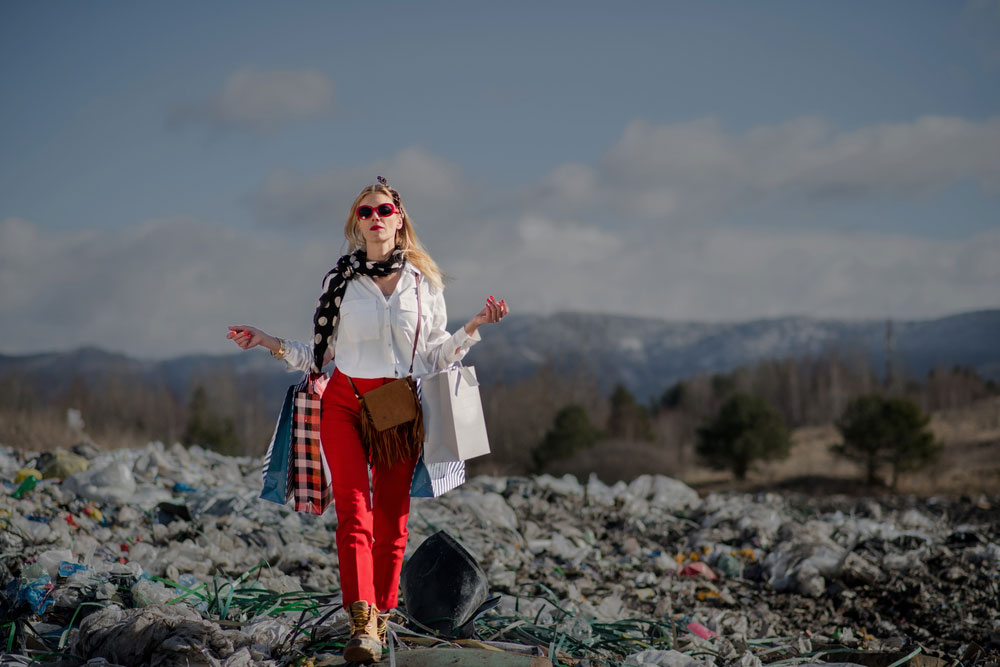
Plastic Pollution Blogger (2024). How Fast Fashion is Bad for the Environment. Plastic Collective. Available at: https://www.plasticcollective.co/wp-content/uploads/fast-fashion.jpg.
Text
- Chowdhury, S. N., Faruque, M. O., Sharmin, S., Talukder, T., Mahmud, A., Dastagir, G., & Akter, S. (2024). The Impact of Social Media Marketing on Consumer behavior: a Study of the Fashion Retail Industry. Open Journal of Business and Management, 12(03), 1666–1699. https://www.scirp.org/journal/paperinformation?paperid=133258
- Frick, V., Matthies, E., Thøgersen, J., & Santarius, T. (2020). Do online environments promote sufficiency or overconsumption? Online advertisement and social media effects on clothing, digital devices, and air travel consumption. Journal of Consumer Behaviour, 20(2), 288–308. https://doi.org/10.1002/cb.1855
- Koivulehto, E. I. (2017). DO SOCIAL MEDIA MARKETING ACTIVITIES ENHANCE CUSTOMER EQUITY? https://aaltodoc.aalto.fi/server/api/core/bitstreams/4b37684f-6238-4418-a14b-29006e9c819c/content
- Kong, H. M., Witmaier, A., & Ko, E. (2021). Sustainability and Social Media communication: How Consumers Respond to Marketing Efforts of Luxury and non-luxury Fashion Brands. Journal of Business Research, 131(0148-2963). https://doi.org/10.1016/j.jbusres.2020.08.021
- Lagun, C. S. (2022). Sustainable or greenwash? An analysis of how fast fashion brands use Social Media Marketing. Sustainable or Greenwash? An Analysis of How Fast Fashion Brands Use Social Media Marketing.
- Léa, C., Malek, P., Jönköping, L., Malek, C., Runnvall, P., & Tutor, L. (2018). Influencers impact on decision- making among generation Y and Z Swedish females when purchasing fast fashion. Bachelor’s Degree Project in Business Administration Title: Influencers impact on decision-making among generation Y and Z Swedish females when purchasing fast fashion. https://www.diva-portal.org/smash/get/diva2:1214227/FULLTEXT01.pdf
- Mahskey, P., Mariyappanavar, S., & Kumar, A. (2024). Influence Of Social Media On The Fashion Industry. Influence of Social Media on the Fashion Industry, 12(9), 2320–2882. https://ijcrt.org/papers/IJCRT2409065.pdf?utm_source=chatgpt.com
- Nie, Y. (2025). The Role of User-Generated Content and Micro-Influencers in Shaping the Global Image of Fast Fashion Brands: A Case Study of SHEINs Marketing Strategies in North America and Europe. Advances in Economics Management and Political Sciences, 160(1), 171–176. https://doi.org/10.54254/2754-1169/2025.19802
- Oscario, A. (2023). The Transformation of Second-Hand Clothes Shopping as Popular Sustainable Lifestyle in Social Media Era. E3S Web of Conferences, 388, 04020–04020. https://doi.org/10.1051/e3sconf/202338804020
- Persson, O., & Hinton, J. B. (2023). Second-hand clothing markets and a just circular economy? Exploring the role of business forms and profit. Journal of Cleaner Production, 390, 136139. https://doi.org/10.1016/j.jclepro.2023.136139
- Statistics. (10 January 2024). Topic: Social commerce. Statista. https://www.statista.com/topics/8757/social-commerce/#topicOverview
- Tran, H. T. (2020). The Influence of Digital Marketing on Consumer Purchase Decisions toward Fast Fashion Products. The Influence of Digital Marketing on Consumer Purchase Decisions toward Fast Fashion Products.
- Zhao, L., Lee, S. H., Li, M., & Sun, P. (2022). The Use of Social Media to Promote Sustainable Fashion and Benefit Communications: A Data-Mining Approach. Sustainability, 14(3), 1178. mdpi. https://doi.org/10.3390/su14031178


Hi Shannon Kate, You’re right to ask; it is incredibly difficult to police these issues today. Predatory behaviour isn’t exclusive…