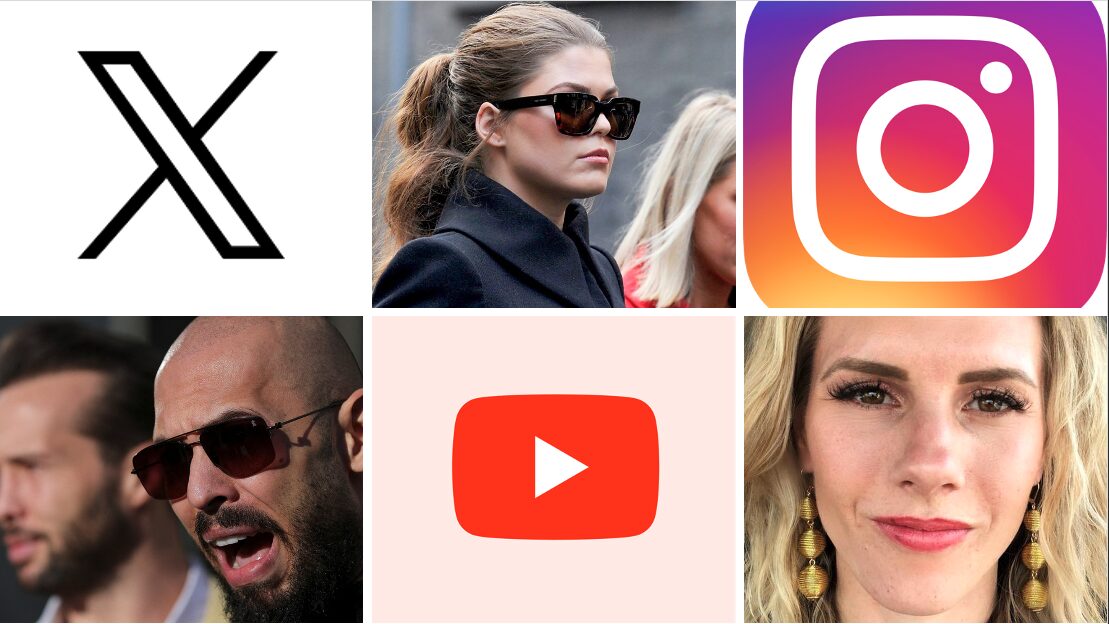
Abstract
This paper argues that social media influences negatively impact their followers, blurring the lines between reality and media illusion by social networks. Some of these negative social media influencers that I write on include Belle Gibson, Andrew Tate, and Ruby Franke. The social media networks that these influencers operated on include Instagram, YouTube, and Twitter X. This paper outlines how these social media influencers manipulated and deceived their viewers into following their content. With media constantly evolving in today’s society, it goes to show how careful we must be when following online users.
Introduction
Popular social media users can manipulate and deceive online users into making wrong and immoral decisions in their day to day lives. Media technologies have been at the heart of history between social transformations and political struggle within civilization (Meikle 2018). An influencer is described as a person who has the power to change decisions of others due to his or her authority, knowledge, position, or relationship with his or her audience (Geyser, W, 2024). Throughout society there have been many negative online influencers that have worsen and altered people’s perception about life. These types of people include Belle Gibson, Andrew Tate, and Ruby Franke. In 2013, Belle Gibson first grew popular after blogging about her ‘battle with cancer’ and launching an Instagram account that gained over 200,000 followers (BBC Bitesize, 2025). Gibson released a wellness and lifestyle app known as ‘The Whole Pantry which eventually turned into a book to help people with their diets. Gibson was eventually uncovered by journalists after lying about the amount of money she had raised for charities and was also caught lying about her diagnosis. Gibson is a classic example of a social media influencer who falsely manipulates her viewers to believer her way is the only way. Andrew Tate is a four-time kickboxing world champion and online based influencer. Through Tate’s’ online platforms such as Twitter X, he boasts about his large amount luxurious cars and promotes toxic masculinity content. With hashtags on Twitter X and Tik Tok, Tate created a large following and appealed to young boys in a negative manner across the world. Tate is another example of a negative online influencer who encourages corrupt opinions and behaviors that can impact young people in society. Ruby Franke created an online YouTube channel called ‘8 Passengers’ which documented their controversy parenting techniques and advice. After one of her children eventually escaping their home and reporting the abuse he had encountered, Franke was arrested with her former business partner Jodi Hildebrandt and were both jailed for four terms of one to 15 years each. Whilst Franke appeared to create a friendly family YouTube channel, there was a hidden influence on her viewers to discipline children in an abusive manner. Social media can be used as a platform for online influencers to create an undesirable atmosphere for their viewers, however it can be used to communicate emergency information and urgent requests between emergency agencies just like in Ruby Franke’s case. (Kim, J et al 2018). Social media influences negatively impact their followers, blurring the lines between reality and media illusion by social networks such as Instagram, YouTube, and Twitter X.
Influence of Belle Gibson through Instagram
Belle Gibson was once seen as a wellness and health-based influencer who assist her viewers with gut sickness and diseases on Instagram, although this was far from the truth. At the height of Gibsons social media presence before she was cancelled, she established a popular following with charities and people affected by cancer. Gibson was exposed in April 2015 after having her medical records uncovered revealing she never had cancer and that money that was supposed to be donated to charities was kept to herself. She was fined $410,000 in 2017 for misleading her readers into thinking she knew how to cure cancer. Gibsons online story was a massive wakeup call in the way online users should be cautious about reading into information about health. In 2021 Instagram reported that over 400 million users posted food content with the ‘#food’ comment (Pancer, E, et al 2021). This just illustrates the impact of food and healthy content on Instagram which can make people fully swap diets because one might appear popular. “The social media landscape has fundamentally altered how consumers are exposed to food” (Pancer, E, et al 2021). Gibson is a direct example of a social media influencers who promotes false and deceiving content, making viewers feel illuded compared to real life reality. Considering the popularity of Instagram at the time of Gibson’s height, online viewers were susceptible and not familiar with scamming content. Behaviours in people have been constrained and reshaped due to newer technologies embedded into communities (Hampton, K. N, et al 2018). The way Instagram can be used to manipulate and promote online influencers negative content is a gentle reminder don’t believe something if it sounds too good to be true. In Gibsons case she utilised the idea of ‘curing cancer’ with her own apparently tested techniques and methods that were not effective at all. At the time of Gibsons rise to fame, there were several followers that would ignore public health advice and scientific knowledge about cancer to follow Gibsons own theories which ultimately ended many lives. In retrospect, Gibson utilised Instagram as a platform to manipulate her users and gain personal affection through lies, which reminds society to be more careful when interacting with other social media influencers such as Andrew Tate.
Influence of Andrew Tate through Twitter X
Through the social media platform Twitter X, influencer Andrew Tate was able to deceive his viewers and promote negative behaviour especially towards young women. Tate has reached more than 10 million Twitter X followers based off promoting these controversial right-wing views (Franks, J, 2023). Some of the content Tate has posted on his Twitter X account includes instructional videos about how young boys should treat women and describes women as inferior and morally deficient beings. With the recent news about the Hamas attacks, Tate has also gone onto Twitter X about it and posted antisemitic, racist, and pro-terror content. The impact of Tate’s negative online content has caused young boys to believe his ideas and theories about how to treat women. “Technology has always played a major role in the shaping of human societies” (Delanty, G, 2018). This illustrates the power of social media influencers and social media platforms such as Twitter X which can ultimately change our future children for the worse. Many allegations have been made about Tate which has led to his arrest in December 2022 and was charged in June 2023. His charges included tricking seven women into sexual exploitation on fake promises of a marriage or relationship (Franks, J, 2023). Over the years, there have been several attempts to ban Tate from social media however many platforms still fail to limit his activity. Tate was banned on Twitter X in 2017 for his misogynistic views and hate speech however his account was reactivated in November 2022 after Elon Musk’s takeover of the platform (Franks, J, 2023). Social media consultant Matt Navarra told Sky News that “social media is the new battleground, and influencers are the new generals, and Tate is perfectly aligned to Trump’s mission” (Franks, J, 2023). This exemplifies the influence that negative online influencers have on followers and just how quickly people can get blindsided from reality and caught up in chaos. Tate was banned though from Instagram and Facebook in August 2022 which he had 4.7 million followers before it was deleted (Franks, J, 2023). Tik Tok and YouTube have also striped Tate of having any accounts on those platforms however many online fans have created their own channels to support his beliefs and content. In essence, the negative influence that Tate had on younger people in particular boys, demonstrations just how powerful influencers are and platforms like Twitter X. It also goes to show that some content creators can appear normal but be just as manipulative and devious similar to Ruby Franke.
Influence of Ruby Franke through YouTube
Ruby Franke a mother of six, launched a YouTube channel in 2015 called ‘8 Passengers’ to showcase her family and the techniques she used to discipline her children. At the height of the channel, it reached nearly 3 million subscribers and brought in over $100,000 per month (Mercuri, M, 2025). Family vlogging channels became very popular in 2015 with content like cooking, sport activities, eating, and family home-schooling being the main themes (Bubalo, M, 2023). Ruby linked her YouTube channel with Jodi Hildebrandt who operated a counselling business. Hildebrandt would use unethical counselling techniques and teach them to Ruby, showcasing them in her YouTube channel. Ruby was able to use YouTube as a social media platform to manipulate her viewers into thinking her parenting style was the way, but it was just abuse in disguise. Ruby and Hildebrandt were arrested in 2023 after Ruby’s 12-year-old son escaped their house and ran to a neighbour’s house pleading for food and water. Ruby Franke was married to her husband Kevin Franke however once she was arrested, Kevin filed a petition for divorce in Utah. At the time of her arrest both Kevin and Ruby were living in separate homes. Most of this information was hidden from her followers until authorities found out about the abuse. Ruby appeared to be pleasant and look like a nice mother when on camera which was deceiving to viewers and made them not think otherwise. Once the truth came out, many online users went to Tik Tok and YouTube spreading the word of the abuse and how the family manipulated not only the children but viewers too. “Community is something experienced as belonging and it follows that if people experience belonging in virtual forms” (Delanty, G, 2018). This proves that getting connected with an online community such as a family channel through YouTube, you can feel part and belong to it. The reality of the ‘8 Passengers’ YouTube channel is that there was abuse that was hidden by Ruby, however most viewers could not see past it as they were caught up and illuded by it. Overall, the negative influence that Ruby had on her viewers could have caused many families to implement her own abusive techniques and methods, which would result in an unsafe environment for future children to come.
Conclusion
The social media influencers Belle Gibson, Andrew Tate, and Ruby Franke all manipulated and impacted their followers, blurring the lines between reality and media illusion. Gibson was able to appeal to her viewers through health and food which was a popular topic at the time on Instagram. In hindsight she was just lying and scamming many people into thinking her diet approaches would cure cancer. Andrew Tate promoted and continues to promote negative behaviour towards women through Twitter X, which young boys who are online would see and get immediately attached. Similar with Ruby Franke who disguised her abusive techniques towards children in her apparently ‘family friendly’ channel which was far from the truth. Social media is an ever-changing way we communicate with each other however, in most times than not, more and more online users and influencers are consuming other people to make them believe their way. Together all these social media influencers share the same idea of manipulating and lying to their followers so that they may get a good reaction or support from them. Without acknowledging and recognising these negative influencers in society, our future generations will be unsure what to believe online and prepared for the worse.
References
Andrew Tate: Five Things to Know. (2024, January 3). Adl.org. https://www.adl.org/resources/article/andrew-tate-five-things-know
Baker, S. A., & Rojek, C. (2020). The Belle Gibson scandal: The rise of lifestyle gurus as micro-celebrities in low-trust societies. Journal of Sociology, 56(3), [388]-404. https://search.informit.org/doi/10.3316/informit.387304959199397
BBC Bitesize. (2025, February 21). Who is Belle Gibson and why is she trending? – BBC Bitesize. BBC Bitesize. https://www.bbc.co.uk/bitesize/articles/zwkx46f
Bubalo, M. (2023, September 9). Ruby Franke and 8 passengers: The rise and fall of a parenting influencer. BBC News. https://www.bbc.com/news/world-us-canada-66719859
Delanty,G.(2018).VirtualCommunity. VirtualCommunity,200–224. https://doi.org/10.4324/9781315158259-10
Franks, J. (2023, September 26). Who is Andrew Tate, the self-styled “king of toxic masculinity” arrested in Romania? Sky News. https://news.sky.com/story/who-is-andrew-tate-the-self-styled-king-of-toxic-masculinity-arrested-in-romania-12776832
Geyser, W. (2024, August 30). What is an influencer? – factors that define a social media influencer. Influencer Marketing Hub. https://influencermarketinghub.com/what-is-an-influencer/
Hampton, K. N., & Wellman, B. (2018). Lost and Saved . . . Again: The Moral Panic about the Loss of Community Takes Hold of Social Media. Contemporary Sociology, 47(6), 643–651. https://www.jstor.org/stable/26585966
Kearney, M. S., & Levine, P. B. (2015). Media Influences on Social Outcomes: The Impact of MTV’s “16 and Pregnant” on Teen Childbearing. The American Economic Review, 105(12), 3597–3632. http://www.jstor.org/stable/43821387
Kim, J., & Hastak, M. (2018). Social network analysis: Characteristics of online social networks after a disaster. International Journal of Information Management, 38(1), 86–96. https://doi.org/10.1016/j.ijinfomgt.2017.08.003
Meikle, G. (Ed.). (2018). The Routledge Companion to Media and Activism (1st ed.). Routledge. https://doi.org/10.4324/9781315475059
Mercuri, M. (2025, February 27). What Did Ruby Franke Do? The Crazy True Story Behind Hulu’s “Devil In The Family.”Forbes. https://www.forbes.com/sites/monicamercuri/2025/02/27/the-crazy-true-story-behind-hulus-devil-in-the-family-the-fall-of-ruby-franke/
Pancer, E., Philp, M., Poole, M., & Noseworthy, T. J. (2021). Content Hungry: How the Nutrition of Food Media Influences Social Media Engagement. Journal of Consumer Psychology, 32(2). https://doi.org/10.1002/jcpy.1246
Radford, A. (2022, December 30). Andrew Tate: The self-proclaimed misogynist influencer. BBC News. https://www.bbc.com/news/uk-64125045


Hi Shannon Kate, You’re right to ask; it is incredibly difficult to police these issues today. Predatory behaviour isn’t exclusive…