The Power of Social Networking Platforms and Hashtags: During the #FreeBritney Movement

Posted on

by


PDF: The Power of Social Networking Platforms and Hashtags – During the #FreeBritney Movement

Abstract:

This paper will examine how social networking platforms and hashtags help like-minded individuals to connect and opt for social change. Using the #FreeBritney movement, the paper will discuss how hashtags and social networking platforms like Twitter/X can work successfully as tools for social change. Sociological and political theoretical contexts have been used and studied to form the basis of this paper’s perspective. Tracking the #FreeBritney movement using X’s advanced search engine, I analysed tweets/posts that correlated to Billboard magazine’s detailed timeline of Britney Spears’ conservatorship and used the hashtag #FreeBritney. Through analysing tweets/posts with #FreeBritney by @BritneyHiatus, @Taci00x, and @BritneyTheStan, I discovered how the Britney Army became citizen journalists and collectively advocated for the end of Britney’s conservatorship. My findings concluded that the hashtag and Twitter/X helped the Britney Army connect, share their concerns, and spread awareness collectively about Britney’s situation in the conservatorship.

_________


On 23 November 2021, fans of pop star Britney Spears were overjoyed when it was announced that the thirteen-year conservatorship battle that the singer had been quietly suffering in ended. Following this news and overcome with emotion and the affective bond they had for Britney, fans known collectively as the Britney Army took to the social networking platform X, then Twitter to spread the news that the #FreeBritney movement they had started three years earlier had worked. In 2008, Britney was placed under the care of her father, Jamie Spears, in a conservatorship after suffering a mental breakdown. Despite her illness, she continued to perform, which some Britney Army members found concerning but did not address. That was until April 2019, when they noticed an Instagram post on Britney’s Instagram notifying her followers that she was taking some ‘me time’ and ‘voluntarily’ checked herself into a mental facility. Driven by their concerns about whether or not this was Britney’s choice, the Britney Army became citizen journalists and took to Twitter/X. To actively collaborate and participate in reporting and broadcasting the facts about Britney’s conservatorship case, hoping to sway public opinion and release her from her father’s control. The #FreeBritney movement on Twitter/X allowed Britney Army members to become citizen journalists and advocate collectively to end Britney Spears’ conservatorship by sharing their affective concerns, spreading collective awareness, and organising their persuasive narrative.


Through the #FreeBritney movement on Twitter/X, individuals of the Britney Army shared their affective concerns about Britney’s well-being, which led to connective action. (Hopkins, 2022; Smith et al., 2023) In April 2019, individual members of the Britney Army began using Twitter/X and the hashtag #FreeBritney to voice their concerns about Britney voluntarily checking herself into the mental facility. However, their fears were not yet strengthened until an anonymous source close to the conservatorship case came forward on a podcast with news that Britney was placed into the mental facility against her will (Hopkins, 2022; Smith et al., 2023). Upon hearing this news on the podcast and driven by their emotional investment and affective bond for the pop star, individual members of the Britney Army urgently took to Twitter/X in the hopes of releasing Britney from her conservatorship (Hinck, 2020; Papacharissi, 2015; Papacharissi & Trevey, 2018; Reddick, 2022). Although at first their concerns came across as conspiracy theories due to the mainstream media manipulating people’s perceptions, Britney Army members felt it was their duty to inform others on the platform about what they felt was going on. Individual Britney Army members informed others by writing short blog posts using the microblogging platform’s networked infrastructure and technical affordances such as hashtags (Ojala & Ripatti-Torniainen, 2023; Smith et al., 2023).


@BritneyHiatus was one of many fans who took to Twitter to inform people about the #FreeBritney movement and “how Britney Spears went from being the most photographed person in the world to being locked away in a mental health facility against her will” and used the hashtag #FreeBritney in their tweet/post (BritneyHiatus, 2019) (see figure 1). (Delanty, 2018; Hinck, 2020Ojala & Ripatti-Torniainen, 2023; Papacharissi, 2015; Papacharissi & Trevey, 2018) Using #FreeBritney in their post, @BritneyHiatus connected with other fans on Twitter/X who shared the same sentiments about Britney and the conservatorship due to their affective ties for her. @BritneyHiatus connected with other like-minded fans of Britney’s on the platform because hashtags and Twitter/X are information and communication technologies that open up new digital spaces. Where like-minded individuals can communicate and bond over their shared concerns and interests about a specific topic, therefore creating a sense of belonging in a virtual community (Delanty, 2018; Hinck, 2020; Ojala & Ripatti-Torniainen, 2023; Papacharissi, 2015; Papacharissi & Trevey, 2018). According to Smith, et al. (2023), the same month that @BritneyHiatus took to Twitter/X to voice her concern about Britney’s welfare in the conservatorship #FreeBritney was shared a further 88,303 times (Smith, et al. 2023). Confirming that many fans were conversing in a crowd-like behaviour around the common goal of wanting to see Britney be freed from the conservatorship (Ojala & Ripatti-Torniainen, 2023; Smith, et al., 2023). Participating in sharing their concerns over  Britney strengthened the #FreeBritney movement and built the formation the Britney Army needed to spread their collective action.


Figure 1.
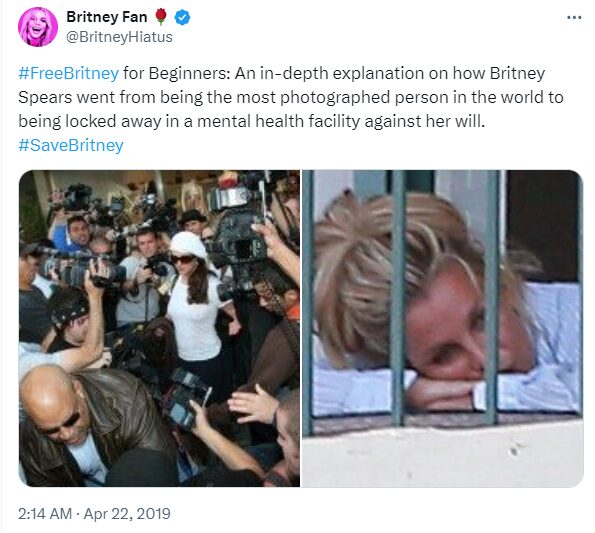
Screenshot of @BritneyHiatus’ tweet/post from April, 2019


@Taci00x took to the platform to inform others about how much control the conservatorship had over Britney. The tweet/post attained 121 comments, 10,000 likes and 5,700 reshares/retweets. @Taci00x’s use of #FreeBritney helped raise awareness of the Britney Army’s concerns on the platform due to the engagement they received on their post. When a user engages with a tweet/post on the platform, the information spreads to their followers, making them aware of it (Hampton, 2016). A user’s followers become aware of the information through the user’s engagement with a post/tweet on the platform due to the speed at which information flows throughout the platform, transcending the limits of time and space (Dalenty, 2018; Hampton, 2016).


In cases like #FreeBritney, increased awareness and engagement can make information go viral and trend on Twitter/X. (boyd et al., 2010; Marwich and boyd, 2011; Reddick, 2022; Smith et al., 2023) Going viral and trending on Twitter/X increased the public knowledge of what was happening to Britney and the discussion surrounding the #FreeBritney movement. Conversations about the conservatorship and how Britney was being treated were escalated online and offline and even to those that were not directly involved in the conversations being had (boyd et al., 2010; Marwich and boyd, 2011; Reddick, 2022; Smith et al., 2023). The virality and impact of these conversations surrounding #FreeBritney that members of the Britney Army started on Twitter/X even reached the mainstream media and Britney herself. In September 2020, after hearing of the support from the Britney Army and how they spread information about how Britney was being treated in the conservatorship, Britney argued for her conservatorship case to go public and won (Mamo, 2021) (see figure 2).


Figure 2.
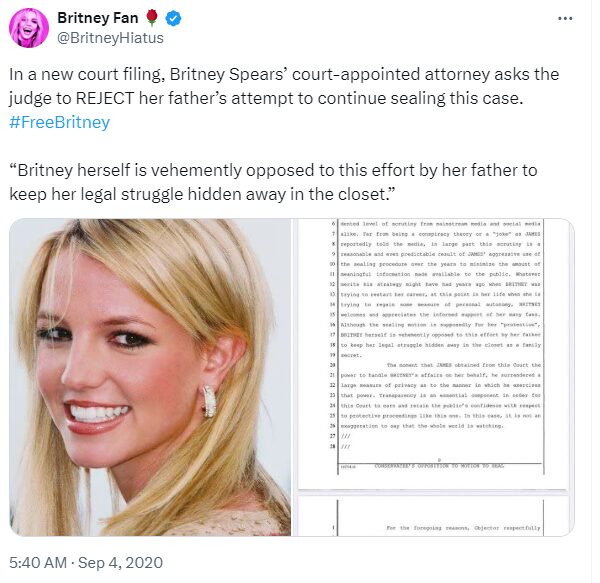
Screenshot of @BritneyHiatus’ tweet/post from September 2020 notifying the public that Britney’s conservatorship had gone public


Making the conservatorship go public meant that several of the case’s court papers were open to the public. However, this did not stop the Britney Army from advocating and spreading awareness that Britney needed to be freed from her conservatorship. When the court documents leaked to the public on 3rd September 2020, @BritneyHiatus took to Twitter to spread some shocking news found in one of the court documents. They wrote, “Court documents reveal Britney Spears DOES NOT have a developmental disability as would usually be the case for probate conservatorships” (BritneyHiatus, 2020) (see figure 3). Utilising Twitter/X as a news source and the platform’s digital affordances allowed Britney Army members like @BritneyHiatus and @Taci00x to participate in citizen journalism (Alfonzo, 2021; Papacharissi, 2015; Papacharissi & Trevey, 2018; Reddick, 2022).


Figure 3.
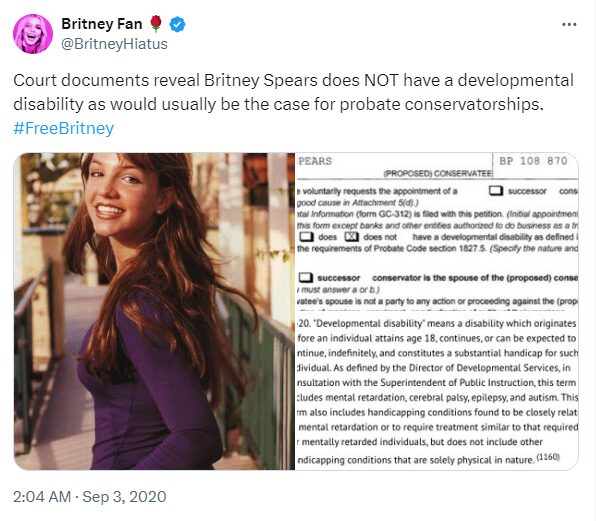
Screenshot of @BritneyHiatus’ tweet/post from September 2020 notifying the public that Britney’s court documents state that she DOES NOT have a disability


When participating in citizen journalism and using the affordances of Twitter/X, the Britney Army gained viral attention and raised awareness about the issues surrounding #FreeBritney collectively. (Alfonzo, 2021; Papacharissi, 2015; Papacharissi & Trevey, 2018; Reddick, 2022) By gaining attention and raising awareness, the Britney Army persuaded the public’s perception of the #FreeBritney movement and got them to realise that the movement was more a human rights issue than just an issue about Britney Spears. The impact the Britney Army had on the public regarding the #FreeBritney movement, windows of opportunity opened up, and change began to occur (Alfonzo, 2021; Papacharissi, 2015; Papacharissi & Trevey, 2018; Reddick, 2022). For example, in June 2021, Britney made her first public appearance at the courthouse, and the world was able to find out how she was being treated in the conservatorship (Mamo, 2021). By using the hashtag, the information about how Britney was being treated in the conservatorship went viral, and the Britney Army was able to influence others with their collective awareness.


Adding #FreeBritney to their tweets/posts on Twitter/X, the Britney Army became trusted citizen journalists, as the hashtag helped organise their content into a structured journalistic narrative that played out in real time. As evidenced throughout this paper, Twitter/X and its affordances aided the Britney Army in providing them the ability to consistently spread their subversive narrative and share important information about the conservatorship during the #FreeBritney movement (Alfonzo, 2021; Smith, et al., 2023). Making it easier for the Britney Army to communicate their political messages because of the platform’s ‘always on’ nature which helped circulate the movement throughout the platform and broadened the support for Britney (Hinck, 2020; Papacharissi, 2015; Reddick, 2022). The immediate nature of the platform makes it a powerful tool during news-breaking events or events that are happening in real-time such as #FreeBritney and making it possible for people to become instant citizen journalists reporting on events as they happen from the ground (Alfonzo, 2021; Papacharissi, 2015; Reddick, 2022). It is because of Twitter’ s/X’s immediate nature that Britney Army members could live-tweet/post from outside the Los Angeles courthouse during the case court hearings, therefore breaking important news about the case as it happened and participating in the movement as citizen journalists.


For example, on 29 September 2021, when Britney’s attorney, Matthew Rosengart, held a press conference outside the courthouse and announced that Jamie Spears was no longer Britney’s conservator. Overcome with excitement and driven by the same emotional investment and affective bond they had for Britney when starting the #FreeBritney movement the Britney Army took to their Twitter accounts to announce the news. Such as @BritneyTheStan, who wrote, “Britney Spears’ attorney Mat Rosengart announces that her father has been suspended today #FreeBritney” (BritneyTheStan, 2021) (see figure 4). (Alfonzo, 2021; Papacharissi, 2015) By adding the hashtag to their tweet/post, @BritneyTheStan attached their commentary to the growing collaborative pool of information within the #FreeBritney movement on Twitter/X. Therefore, they helped create a well-organized narrative structure that reads as a corresponding story of the #FreeBritney movement as it played out in real time when the hashtag is searched on the platform. The well-organised structure and affective tone behind their collaborative storytelling made the Britney Army feel connected and seem like citizen journalists to others on the platform (Alfonzo, 2021; Papacharissi, 2015). Twitter/X and its affordances helped the Britney Army become trusted citizen journalists as they collectively advocated to end Britney’s conservatorship by reporting on the happenings of the case in real time.


Figure 4.
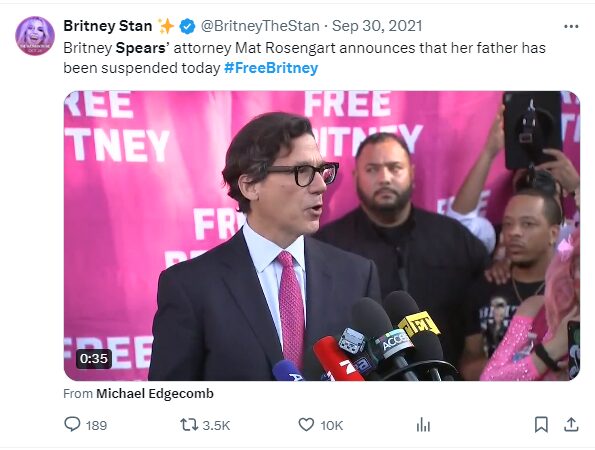
Screenshot of @BritneyTheStan’s tweet/post from September 2021 notifying the public that Britney’s father is no longer her conservator


Social networking platforms like Twitter/X and their affordances supply the foundation and tools to share, spread, and organise important information collectively. If it were not for Twitter/X and using the hashtag #FreeBritney on the platform, @BritneyHiatus, @Taci00x, @BritneyTheStan, and other members of the Britney Army would not have been able to become citizen journalists, find one another, and collectively advocate to end Britney’s conservatorship. Using Twitter/X and the hashtag #FreeBritney, the information reaches others on and off the platform, making them aware of what is happening through collective awareness. By making others aware of why Britney needed to be freed from her conservatorship the Britney Army was successfully able to convince them of their structured persuasive narrative. Therefore, the hashtag #FreeBritney and Twitter/X gave the Britney Army the power they needed to achieve their goal of releasing Britney from her conservatorship. Britney echoed this in her 2023 memoir The Women in Me when she thanked the Britney Army for all the work they did during the #FreeBritney movement because, without their help, she would not have won her freedom back.


References

Alfonzo, P. (2021). A Topology of Twitter Tactics: Tracing the Rhetorical Dimensions and Digital Labor of Networked Publics. Social Media + Society7(2). https://doi.org/10.1177/20563051211025514


boyd, D. Golder, S. & Lotan, G. (2010). Tweet, Tweet, Retweet: Conversational Aspects of Retweeting on Twitter. Hawaii International Conference on System Sciences, 43, 1-10. https://espace.curtin.edu.au/bitstream/handle/20.500.11937/93780/93585.pdf?sequence=2


@BritneyHiatus. (2019, April 22). #FreeBritney for Beginners: An in-depth explanation on how Britney Spears went from being the most photographed person in the world [Description]. X. https://twitter.com/BritneyHiatus/status/1119997970169180161


@BritneyHiatus. (2020, September 3). Court documents reveal Britney Spears does NOT have a developmental disability as would usually be the case for probate conservatorships [Description]. X. https://twitter.com/BritneyHiatus/status/1301189388445966336


@BritneyTheStan. (2021, September 30). Britney Spears’ attorney Mat Rosengart announces that her father has been suspended today #FreeBritney [Description]. X. https://twitter.com/BritneyTheStan/status/1443364614398517249


Delanty, G. (2018). Virtual Community: Belonging as communication. In G. Delanty (Ed.), Community (3rd ed., pp. 200-224). Routledge. https://www.taylorfrancis.com/chapters/mono/10.4324/9781315158259-10/virtual-community-gerard-delanty


Hampton, K. N. (2016). Persistent and Pervasive Community: New Communication Technologies and the Future of Community. American Behavioral Scientist60(1), 101-124. https://doi.org/10.1177/0002764215601714


Hinck, A. (2020). Fan-Based Social Movements: The Harry Potter Alliance and the Future of Online Activism . In N. Crick (Ed.) The Rhetoric of Social Movements: Networks, Power, and New Media (pp. 191-206). Routledge. https://www.taylorfrancis.com/chapters/edit/10.4324/9780429436291-14/fan-based-social-movements-ashley-hinck


Hopkins, S. (2022). Free Britney, b**ch!: femininity, fandom and #FreeBritney activism. Celebrity Studies13(3), 475–478. https://doi.org/10.1080/19392397.2022.2037354


Kim, J. & Hastak, M. (2018). Social Network Analysis: Characteristics of online Social Networks After a Disaster. International Journal of Information Management. 38, 86-96. https://linkinghub.elsevier.com/retrieve/pii/S026840121730525X


Mamo, H. (2021, December 11). A Timeline of Britney Spears’ Conservatorship. Billboard.  https://www.billboard.com/music/music-news/britney-spears-conservatorship-timeline-2-10139930/


Marwick, A. E., & boyd, d. (2011). I Tweet Honestly, I Tweet Passionately: Twitter Users, Context Collapse, and the Imagined Audience. New Media & Society13(1), 114-133. https://doi.org/10.1177/1461444810365313


Ojala, M., & Ripatti-Torniainen, L. (2023). Where is the public of ‘networked publics’? A critical analysis of the theoretical limitations of online publics research. European Journal of Communication0(0). https://doi.org/10.1177/02673231231210207


Papacharissi, Z. (2015). Affective Publics and Structures of Storytelling: Sentiment, Events and Mediality. Information, Communication & Society, 19(3), 307–324. https://doi.org/10.1080/1369118X.2015.1109697


Papacharissi, Z., & Trevey, M. T. (2018). Affective Publics and Windows of Opportunity: Social media and the potential for social change. In M. Graham (ed) The Routledge Companion to Media and Activism. Routledge. https://www.taylorfrancis.com/books/edit/10.4324/9781315475059/routledge-companion-media-activism-graham-meikle


Reddick, S. (2022). Points of Contact Between Activism, Populism, and Fandom on Social Media. Media and Communication, 10(4), 191-201. https://www.cogitatiopress.com/mediaandcommunication/article/view/5738/2970


Smith, A. H., Gitomer, A. & Welles, B. F. (2023). You Want a Piece of Me: Britney Spears as a Case Study on the Prominence of Hegemonic Tales and Subversive Stories in Online Media. First Monday. https://firstmonday.org/ojs/index.php/fm/article/view/13314/11378


Vaidya, A. R. (2022, June 23). #FreeBritney: Strategies of Counternarratives and Self-Regulation in Digital Fan Activism [Video]. Console-ing Passions. https://stars.library.ucf.edu/cp2022/program/pink/4/


List of Figures

Figure 1. Wilson, Jessica. 2024. “Screenshot of @BritneyHiatus’ tweet/post from April 2019”. Screenshot. Accessed from. @BritneyHiatus “#FreeBritney for Beginners: An in-depth explanation on how Britney Spears went from being the most photographed person in the world”. X post. https://twitter.com/BritneyHiatus/status/1119997970169180161


Figure 2. Wilson, Jessica. 2024. “Screenshot of @BritneyHiatus’ tweet/post from September 2020 notifying the public that Britney’s conservatorship had gone public”. Accessed from. @BritneyHiatus “In a new court filing, Britney Spears’ court-appointed attorney asks the judge to REJECT her father’s attempt to continue sealing…”. X post. https://twitter.com/BritneyHiatus


Figure 3. Wilson, Jessica. 2024. “Screenshot of @BritneyHiatus’ tweet/post from September 2020 notifying the public that Britney’s court documents state that she DOES NOT have a disability”. Accessed from. @BritneyHiatus “Court documents reveal Britney Spears does NOT have a developmental disability as would usually be the case for probate conservatorships”. X post. https://twitter.com/BritneyHiatus/status/1301189388445966336


Figure 4. Wilson, Jessica. 2024. “Screenshot of @BritneyTheStan’s tweet/post from September 2021 notifying the public that Britney’s father is no longer her conservator”. Accessed from @BritneyTheStan “Britney Spears’ attorney Mat Rosengart announces that her father has been suspended today #FreeBritney”. X post. https://twitter.com/BritneyTheStan/status/1443364614398517249


Figure 5. (Featured Image). Wilson, Jessica. 2024. Screenshot #FreeBritney. Accessed from @BritneyHiatus. X account. https://twitter.com/BritneyHiatus


Search Site

Your Experience

We would love to hear about your experience at our conference this year via our DCN XV Feedback Form.

Comments

20 responses to “The Power of Social Networking Platforms and Hashtags: During the #FreeBritney Movement”

  1. oohsam Avatar
    oohsam

    Hey there !
    I just finished reading your paper on the #FreeBritney movement and how social media platforms and hashtags can spearhead social change. It’s really compelling how you’ve used this particular movement to show the power of digital communities in real-world activism.

    I loved the detailed look at how fans became citizen journalists through their tweets and posts—it’s a fascinating angle on how ordinary people are shaping public narratives and having a huge impact on media and public opinion. The way you connected these actions back to key events in Britney Spears’ conservatorship battle was also super clear and engaging, making it easy to see the big picture.

    It’s great how you’ve nailed the #FreeBritney movement, I wonder how maybe comparing it to other social media movements like #MeToo or #BlackLivesMatter could highlight some universal strategies or unique challenges. Plus, it could give a fuller picture of social media activism in general.

    Also, while it’s clear the movement had a lot of positives, maybe peeking into some potential downsides of social media activism—like the risks of misinformation or how it can affect participants’ mental health—could balance things out a bit. It’s always good to consider the other side of the coin, right?

    Overall, your paper is a great read, really engaging and well-researched. It made me think differently about the power of hashtags and how we use social media. Great job!

    My article is here if you get a chance : https://networkconference.netstudies.org/2024/csm/3874/social-growth-in-the-social-media-age-influencers-and-their-impact-on-adolescents/#comment-3247

  2. Jess Wilson Avatar
    Jess Wilson

    Hi,

    Firstly, thank you so much for the feedback on my paper; it is very much appreciated. Secondly, I agree with you. While my paper focuses solely on the #FreeBritney movement and the positives of social media during social movements such as #FreeBritney, it would be interesting to go back and research other movements such as #MeToo and #BlackLivesMatter just to compare them. Also, yes! You are correct it is always good to see both sides of an argument. Since writing my paper, I have thought that it would be good if I had added some not-so-good things about the movement and social media during social movements. Especially since lately, in the media, there has been backlash about the #FreeBritney movement and whether or not the end result was good for Britney. Once again, thank you for your feedback, and I’ll be sure to check out your article.

    Jess

  3. El Ashcroft Avatar
    El Ashcroft

    Interesting read. The #FreeBritney is a great example of how people across the world can come together across social media to call out issues that others try to hide.
    Besides being instrumental in Britney asking for the conservatorship case to go public do you think #FreeBritney and the Britney Army influenced the instigation of the case?

    I enjoyed your discussion about citizen journalists. Given that many of the Britney Army were camped outside the courthouse do you think that they possibly reported quicker than the media? I’d also be interested to know if people such as @BritneyHiatus were more trusted and viewed than the media. Did you come across any research around that?

    Although Britney is free from the conservatorship, I have noticed that #FreeBritney is still being used to raise concerns about her not really being free and her mental health. What are your thoughts on this? Do you think #FreeBritney is now heading down the path of having a negative effect on Britney?

    If you wouldn’t mind could you take a look at my paper? https://networkconference.netstudies.org/2024/onsc/3578/how-yes-and-no-supporters-used-social-media-to-influence-the-indigenous-voice-to-parliament-vote/

    1. Jessica Wilson Avatar
      Jessica Wilson

      Hi El,

      Firstly, thank you so much for the feedback on my paper; it is very much appreciated. The Britney Army’s influence on the case was significant due to social media’s ability to transcend time and space and the wide spread of information through hashtags. I found no research on whether individuals like @BritneyHiatus were trusted more than the media. However, I believe being fans and being present at the courthouse during the case might have made them more trustworthy. This observation of mine is also from experience. As a fan of celebrity and entertainment culture, I’ve seen firsthand that there are outlets out there that are more trusted than others. Also, I believe fans are becoming more trusted than media outlets. As technology, such as mobile phones and social media platforms, has made it easier for fans to report on their favourite celebrities/idols.

      I have mixed feelings regarding the movement’s impact on Britney’s well-being. As a fan of Britney’s, I’m glad she’s free from her father’s control. However, if she’s still not well, I think further action is necessary, but not with her father as conservator.

      Once again, thank you for your feedback, and I’ll be sure to check out your article.

      Jess

  4. Mohamed Ali Avatar
    Mohamed Ali

    Hi Jessica,

    Excellent read! My thoughts: although the #FreeBritney initiative might have made social media activism intense, it does not make it an actual organised activity; instead, it can only be used as a testimony to the commonality of the movement. Evidently, sharing hashtags, posts, and comments is not activism, as it had almost no impact on Britney Spears’ conservatorship case. That is, although several millions continued to repost #FreeBritney daily for the past ten years, nowhere near this many have signed a petition, let alone participated in the street protesting. Therefore, this indirect impact may have hardly mattered in terms of how the activity affected the judicial process.

  5. katelyn.rolfe Avatar
    katelyn.rolfe

    Hi Jess,

    The #FreeBritney movement is a great example of how powerful digital activism and collective action can be to promote social change. Thanks for your research into the matter!

    Do you think any other platform could have facilitated the #FreeBritney movement as well as X/Twitter did? If the users @BritneyHiatus, @Taci00x, @BritneyTheStan, etc., had started the movement on Instagram, for example, would you say the movement would have gained as much attention as it did and had success in freeing Britney?

    Katelyn

    P.S. I would love it if you had time to comment on my paper ‘The Negatives of Social Media Communities: How the Pro-Ana Community Circumvents TikTok’s Algorithm with Refracted Publics’ at: https://networkconference.netstudies.org/2024/csm/3609/the-negatives-of-social-media-communities-how-the-pro-ana-community-circumvents-tiktoks-algorithm-with-refracted-publics/

    1. Jessica Wilson Avatar
      Jessica Wilson

      Hi Katelyn,

      Thank you for the feedback on my paper; it is very much appreciated. 

      Regarding whether or not I believe the movement would have gained as much attention on other social media platforms like Instagram as it did on Twitter/X. Although hashtags have a consistent functionality across platforms, the movement may not have resonated as strongly on Instagram. I say this because of Instagram’s algorithm and how it shows users similar content to what they have interacted with on the platform. Therefore, it rules out the amount of eyeballs that would see the content attached to the hashtag on the platform. Also, while both platforms show users content that their followers have engaged with, they are used for different purposes. Twitter/X is a micro-blogging news-sharing platform, whereas Instagram is about visual content. So this might play into how others receive the information about the movement on different platforms.

      Once again, thank you for your feedback, and I’ll check out your paper.

      Jess

      1. katelyn.rolfe Avatar
        katelyn.rolfe

        Hi Jess,

        Thanks for getting back to me & also commenting on my paper! 😀

        Yes, that makes sense. Twitter/X would be better for spreading written content/news because it’s text-based.

        Katelyn

  6. malak.khan Avatar
    malak.khan

    Hi Jessica Wilson

    Your paper provides a detailed exploration of the #FreeBritney movement and the pivotal role of social networking platforms like Twitter/X and hashtags in facilitating collective action and citizen journalism. You effectively demonstrate how the Britney Army utilized these platforms to voice their concerns, share information, and advocate for Britney Spears’ release from her conservatorship. The analysis of specific tweets/posts by individuals such as @BritneyHiatus, @Taci00x, and @BritneyTheStan adds depth to your argument, illustrating the impact of their engagement on spreading awareness and shaping public discourse.

    Additionally, your discussion of the theoretical frameworks underlying social media activism enriches the analysis and provides a solid foundation for understanding the dynamics at play. However, while you emphasize the positive outcomes of the movement, it would be valuable to acknowledge any potential limitations or criticisms of using social media for activism, such as issues of algorithmic bias or echo chambers. Overall, your paper offers a compelling case study of how digital platforms can empower grassroots movements and drive social change.

    Regards
    Malak Khan

    1. Jessica Wilson Avatar
      Jessica Wilson

      Hi Malak Khan,

      Thank you for your feedback; I appreciate it.

      I understand what you are saying about adding any negatives, such as algorithmic bias or echo chambers, to my paper regarding using social media for activism. This is especially true now after I wrote my paper because there has been a lot of backlash in the media about whether or not the #FreeBritney movement was a positive or negative social movement. From what I have heard recently about this debate, I believe a lot of it can relate to issues relating to algorithmic bias. Especially since one of the goals of the Britney Army was to make the hashtag trend on Twitter, which was attached to much negative information regarding Britney’s conservatorship. So, if I had the time again, I would add this discussion to my paper, especially since I now have mixed personal feelings towards the movement and whether or not it was good for Britney.

       Jess

  7. sophschneider_ Avatar
    sophschneider_

    Hi Jess
    This paper provides a thorough examination of the #FreeBritney movement. I appreciate highlighting social media platforms like Twitter and hashtags’ critical role in advocating for Britney Spears’ freedom.

    Reflecting upon your insightful analysis, I find my involvement in the movement fascinating. Like many others, I was glued to Britney’s social media content, seeking hidden messages. I distinctly remember one instance where the comments were flooded with requests for Britney to signal if she needed help by wearing yellow. The collective anticipation was palpable. When she posted her next video, a wave of shock coursed through us as we spotted the yellow flowers in her setting. Moments like these underscored the power of collective action and digital advocacy’s unique, intimate dynamics. Have you involved yourself in the movement?
    finally
    What challenges did the Britney Army face in ensuring the accuracy and credibility of the information shared on social media platforms, considering the diverse viewpoints and potential for misinformation?

    I am looking forward to your thoughts on this.
    Best regards, Sophia
    If you have time, please check out my paper on how TikTok and Instagram are in third place among Harry Styles fans: https://networkconference.netstudies.org/2024/csm/3126/how-social-media-platforms-act-as-a-third-place-for-harry-styles-fans✨/

    1. Jessica Wilson Avatar
      Jessica Wilson

      Hi Sophia,

      Thank you so much for your feedback; I appreciate it.

      Yes, as a Britney Army member, I was part of the movement, and I remember the moment you mentioned Britney wearing yellow in one of her videos very well. While I didn’t participate on Twitter/X, I did participate in the conversations on Instagram. I even made posts and used the hashtag. I desperately wanted to see her be released from her father’s control.

      As for the challenges the Britney Army faced, considering the diverse viewpoints and potential of misinformation, I believe a lot of it stemmed from the mainstream media at first. Since the movement was not well known outside of the internet, the mainstream media had more control over shaping the opinions of others than fans did. This is why I believe that many people initially had a hard time believing the fans.

      Also, I find it truly disheartening that this backlash about the information that fans spread on social media about the conservatorship is still being denied by some today. If those who criticize the movement believe Britney’s situation has worsened, then addressing her mental health is essential. However, reinstating her father as her conservator is not the answer, in my opinion, as a Britney Army member.

      Once again, thank you for your feedback, and I’ll go read and leave feedback on your paper.

      Jess

  8. Sammy Avatar
    Sammy

    Hi Jessica,

    Thank you so much for sharing your research and thoughts in this paper. As a massive Britney fan back in the day, I felt particularly compelled to read your paper, and it didn’t disappoint! I had never heard of the term “citizen journalism” and had no idea how deep the #freebritney movement ran. Also, the fact that it was a motivator for Britney to make her case go public is huge! It is really amazing to see a movement with positive intentions successfully contribute to change which seems to stem hugely from the care that the accounts had for Britney’s welfare.

    Thank you so much for this piece.

    Have a lovely week,
    Sammy

    1. Jessica Wilson Avatar
      Jessica Wilson

      Hi Sammy,

      Thank you for your feedback on my paper about the #FreeBritney movement. I’m glad I was able to offer you a deeper insight into the movement, what it did to Britney and her conservatorship, and educate you on citizen journalism.

      Jess

  9. Yohann Sinien Avatar
    Yohann Sinien

    Hello Jessica,

    I found your paper very insightful and your research very strong towards the #FreeBritney, It thus shows us the power of the digital realm that some social media platform as Twitter is offering.
    The digital determinism shows effectiveness in terms that information in this new modern era travels more rapidly than the traditional one.
    My question is, do you think that using other forms of social platforms would have helped Britney to get the same outcome using the same specific hashtags.
    In addition, don’t you think that if Britney was not on the positive side I mean creating a false ideology towards the movement with some fake reasons and so one would have lead to people believing in her under false accusation and thus creating a movement around the hashtag.
    To sum up, your paper was really attractive, full of personal researchers I enjoyed reading it.
    I would love having a chat around my paper with you. Find the link to my paper below.
    With thanks and regards,
    Yohann.
    https://networkconference.netstudies.org/2024/csm/4205/facebook-is-incr…modern-community/

  10. Ava_Bux Avatar
    Ava_Bux

    Hi Jessica,

    First, Love the topic you chose; I watched the Free Britney Documentary, so this topic caught my attention. I believe that hashtags are an amazing way to advocate for an issue and to help make change and raise awareness, the Free Britney hashtag is just one amazing example of how powerful hashtags can be.

    I thought it was great that you went and looked at the posts under the free Britney hashtag because it helps give the reader evidence of how big the movement was and the difference it made helping Britney. I think to further enhance your paper, if you potentially touched on some other major hashtags that have been a main factor in some recent movements like the #metoo and #freepalestine. Both these hashtags have been huge factors to helping people get educated about these movements.

    Overall this was such a great read, super interesting and was on a great topic!

    If you get a chance, I would love for you to take a look at my paper, I have linked it below 😊

    Thanks Ava

    https://networkconference.netstudies.org/2024/ioa/3229/taylor-swifts-online-influence-and-advocacy-for-lgbtqia-and-voters-registration/#comment-3183

    1. Jessica Wilson Avatar
      Jessica Wilson

      Hi Ava,

      Thank you for your feedback on my paper; I appreciate it.

      Also, thank you for saying that #FreeBritney showed just how powerful hashtags can be in social movements online because this is what I set out to prove in my paper when I began to write it. While I just wanted to focus on how powerful the #FreeBritney hashtag was in my paper because I know a lot about the #FreeBritney movement and what it did from being a part of it and following it closely to write my paper. I do not doubt that the #MeToo and #FreePalestine hashtags are just as powerful as #FreeBritney due to what I have heard in other places online and offline about the causes that started them.

      Once again, thank you for your feedback, and I’ll check out your paper.

      Jess

  11. Jarryds Avatar
    Jarryds

    I have just finished reading your article and was impressed with the depth you have gone into and showed how a fan base was able to become activists united by a hashtag.

    We have seen the powers of unification and awareness through hashtags with the #metoo movement and #blm Black Lives Matter movement but it was great to read how in this case, it essentially legitimised a fan base into a group that could be used in a legal setting with positive effect.
    Do you feel there is a less noble side effect of unification with hashtags and how easily they can be created and spread? As something with no regulation, there is an argument for concern of people creating false narratives for their 5 seconds of fame. Especially with the popularity of true crime docuseries and how the ‘I don’t f**k with cat series’ doing something similar (for good in this case) I wonder if hashtags will continue to have a positive or negative effect in this aspect moving forward

    1. Jessica Wilson Avatar
      Jessica Wilson

      Hi Jarryds,

      Thank you for your feedback on my paper; I appreciate it.

      While hashtags have done some good in the past, as we have seen with the #FreeBritney, #MeToo and #BlackLivesMatter movements and connect people over similar interests, I agree with you. Given the simplicity of using hashtags to spread information, I think it is also easy for people to use them to spread misinformation/false information.

      Jess

  12. 20543556@student.curtin.edu.au Avatar
    20543556@student.curtin.edu.au

    Hey Jess,

    I loved reading your paper. It was great to see a different point of view on using social media to make a change and a difference throughout society. The depth you go into with the fan base and the #freebritany movement was captivating and exciting. I felt an understanding of the issues you covered with the power a hashtag can hold in today’s society. I enjoyed you sharing the outcome of the hashtag #FreeBritney, and Twitter/X gave the Britney Army the energy they needed to release Britney from her conservatorship.

    I do wonder about your overall thoughts on using hashtags to create an impactful difference. Do you think it will be used more in the future, or is that just a tactic that will be used for now?

    Overall a great read and structure of your topic!

    Thanks,
    Emma 🙂

Leave a Reply

Skip to content