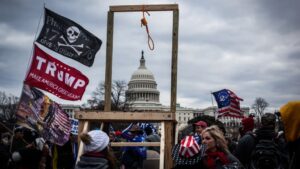
Social media is sabotaging internet democracy by giving a voice to ignorance and bigotry

Posted on

by


Democracy and ignorance mesh together like Mentos and Coca-cola… (Credits: Shay Horse/Getty Images)


Abstract:

The internet had always been a paradox between freedom of speech, expression and tolerance pitted against bigotry and misinformation. With the widespread use of social media, this paradox is brought to its peak, a curious (yet unsurprising) phenomenon analyzed through this thesis that focuses on the behaviour of Trump supporters, their roles and misuse of Social media platforms and their open hostility against progressive values online. This thesis defends restrictions on online freedom of speech to preserve tolerance and ethics. The spreading of misinformation on social media, made worse by echo chambers and confirmation bias, is threatening societal cohesion and harsh measures (with accountability) must be enforced to fight the normalization of hatred and ignorance online, a role that should be upheld by society as a whole to create a safer digital landscape for everyone and by everyone because, hey, we don’t want to revert back to the 50s, ain’t we?


Give every fool a voice and they’ll make sure theirs is louder…


Introduction/

Democracy. Tolerance. Freedom. Three beautiful ideals that have long ruled the dreams and aspirations of humankind. The dream to see a utopia, a place where everyone would stand as equals, with the right to express themselves in all sorts and forms of manners without fear of ridicule, judgment, or imprisonment. We, humans, have managed to create this place out of our fantasies and simply named it… the internet! Yet this is only a paradox, as for every shiny ideal lies its ugly shadow, forever creeping in its wake. As freedom of expression and democracy are touted as upfront, so too emerge concepts that tolerance itself has always fought: tribalism, ignorance, division, the silencing of minorities, the threat to civic discourse and the rise of right-wing populism. To support my argument, this paper thus delves into the behavior of a closely bonded group akin to a cult: Trump supporters. It examines how their spreading of misinformation and hostility is threatening the democratic ideals intended to thrive on the online utopia that the internet was supposed to be and why social media democracy has to be limited to maintain tolerance and ethics online.


1/ The Freedom to spread misinformation and incite hatred

It would be fair to start this first part with what the word “freedom” means as it is one of the main driving forces of my thesis statement. According to the dictionary, freedom is the “state of being free” (Merriam-Webster 2024), of being allowed -in this context- to have the right to express ourselves. But what if I claimed that too much freedom is the key to destroy freedom? That allowing too much tolerance is the trigger for more intolerance? And the apparent democracy allowed on social media is a tool that extremist forums and groups are completely aware of, as social media platforms are becoming a breeding ground for misinformation and incitement for hatred and direct actions (Zhuravskaya, Petrova, Enikolopov 2020), thanks to their usefulness in communication and public information distribution. And alongside the idea of freedom destroying freedom (this sounds a tad silly but I’ll justify my case), the medium of information spreading that social media are is slowly being corrupted by groups of individuals with counter-intuitive ideals. People have the right to express themselves and should be free to believe in what they want, but the line should be drawn at when these beliefs and thoughts become harmful to everyone’s cohesion or are jeopardizing the ideals of respect and tolerance between different groups online. As stated earlier, social media is becoming a ground for misinformation for allowing the proliferation of nefarious groups disseminating falsehoods and distorting reality.


Now, with that information in mind, echo chambers are aggravating this issue by exposing -often wrongful- informations to users reinforcing their beliefs in a matter they want to feel knowledgeable about. Confirmation bias too? Because a non-negligible size of the population only watches news outlets or websites that will comfort their view (Cinelli et al. 2021), no matter how narrow-minded these positions might be. The notorious cases of QAnon and Alex Jones, viral conspiracy theorists that were proven wrong multiple times, serve as good examples of the dangers of unverified misinformation on social media as -like cancerous cells spreading and multiplying- they generate more and more followers, the latter drinking these theories like milk and honey and leaving aside common sense and critical thinking for superstitions and unproven theories (Enikolopov et al. 2020). Moreover, these echo chambers are creating more mistrust in established institutions, such as the case of Trump supporters refusing to accept Biden’s investiture and calling for fraud while rejecting any form of government that doesn’t go their ways and these type of behaviors can degenerate quickly, such as the example of the January 6th where a crowd of Trump supporters, encouraged by the QAnon tweets among others, tried to take over the Capitol in a bid to replace an old Constitution guaranteeing a people-elected president to assume office for a state coup dictatorship. As we can see, nothing good comes off allowing these types of people access to social media. Furthermore, the normalization of hatred, ignorance and toxicity on social media platforms poses a threat to societal cohesion and well-being (Mathew et al. 2019). Filter bubbles, created by algorithms that are following content to users’ preferences, contribute to the proliferation of hateful discourse by isolating individuals within ideological bubbles, further reducing an already narrow mind (Wolfowicz, Weisburd, Hasisi 2021), so, for instance, a person with extreme political views may find themselves surrounded by like-minded individuals online, leading to the proliferation of hateful rhetoric directed towards opposing ideologies, ultimately worsening societal division and the individual’s radicalization.


This isolation fosters the “otherism” of other groups on the internet (marginalized or not) and promotes anti-woke rhetoric (anti-feminism, rejecting LGBTQ rights or downplaying the achievements of People of color) based on ignorance, fueling division and animosity in online communities. Social media platforms like 4chan or formerly Reddit, where people are free to express themselves without filters, provide fertile ground for the dissemination of hateful ideologies, the widespread usage of slurs, enabling users to spread toxic content with impunity, and echo-chambers with literal neo-Nazi groups to proliferate like mold in a cave (Rieger et al. ND). The unchecked spread of misinformation and the normalization of hatred on social media platforms highlights the urgent need for regulatory measures and increased accountability. Without intervention, the consequences of unchecked misinformation and online toxicity will continue to threaten the foundations of democracy and social cohesion, at the price of unbridled freedom of expression. In the end, policymakers, tech companies, and society as a whole MUST tackle these challenges head-on and work towards creating a safer and more inclusive digital landscape as these kinds of behaviors will also have its stained influence on the next generation (Kordyaka et al. 2023).


2/ The rise of Trump and Right-wing political activism

Moving on to the second part of my thesis, it is important to note that today’s digital age witnessed an emerging of online communities as formidable tools for political activism, particularly among proponents of right-wing populist movements such as Trumpism. Using social media platforms and conservative think tanks, these groups are able to gather support through marketing tactics and advertisements on any social media platforms and propagate their ideologies (Groshek, Koc-Michalska 2016), like PragerU or The Daily Wire, appearing on someone’s feed as simple videos with basic facts any novices to their channels would agree with before plunging into a darker rabbit hole of right-wing ideologies and fallacies (Persily 2017). Through the cultivation of an “us vs. them” mentality, they foster solidarity among their ranks, forging a cohesive collective that stands in opposition to perceived adversaries (Reyes 2020). This tactic of digital cohesion to sow division allows them to shape public opinion and manipulate any narrative to align with their agenda. By harnessing online communities, the Trump crowd (yes, we’re back on them again) effectively exploits the power of social media and news outlets to disseminate propaganda and sway political discourse (Groshek, Koc-Michalska 2016). Furthermore, they capitalize on the anonymity and echo chamber dynamics (stated in my earliest paragraphs) of online platforms to amplify their message and attract new adherents (Groshek, Koc-Michalska). Consequently, they wield an ever-increasing influence over public sentiment, posing a significant threat to democratic principles and institutions by their zeal alone: in 2023, Republican candidates to the White House all lost a debate against an absent nominee: Trump who benefitted -in absentia- from the massive support of his supporters (Blake 2023).


Which leads us to the emergence of Trumpism and right-wing populism online, which had a detrimental impact on democratic values and principles. Through the use of digital activism and social media, Trump supporters spreads false rhetoric and propaganda to manipulate public opinion and advance their political agenda (Groshek, Koc-Michalska). Hashtags like #MAGA (Make America Great Again) serve as rallying cries for their supporters, mobilizing an affective public and amplifying their message across online platforms (Gantt Shafer 2017). Moreover, it would be foolish to ignore the level of organization and cohesion of Trump supporters, taking advantage of social media to organize protests, rallies, boycotts, vandalism, other political events and even state coups, the level of zealotry displayed by the populist wave being nothing else than deep devotion. This organized effort to spread misinformation, disinformation and even outright violence, like when they harassed a campaign bus of another political party, undermines the integrity of democratic processes (Piazza, Van Doren 2022). Furthermore, the rhetoric and policies promoted by the Trump crowd are often reminiscing of a bygone era, perpetuating outdated and discriminatory attitudes reminiscent of the 1950s, no wonder they adopted the MAGA slogan as they still believe in a once great America, that of the post-world war two era and that of the Reagan era (Lucks 2020). By championing regressive ideologies, opposing progressive policies and seeking to roll back progress on issues such as civil rights, the right for abortion and social justice, they threaten to undo decades of progress and set societal mentalities back to a time of division and intolerance (Stempel 2022). As such, the unchecked influence of the Trump crowd draw attention to the need for measures to combat online extremism and protect democratic values in the digital age, like what reddit did in 2020, purging its website off Trump-affiliated subreddits (Rothwell, Diego-Rosell 2016).


Conclusion/

In a nutshell, the spreading of misinformation and the normalization of hatred on social media shows us the need for restrictions and the enforcement of social media authoritarianism against hatred and ignorance to prevent further dangerous actions by zealot individuals. While social media platforms were designed to ease up connectivity and communication as well as giving a voice to every user, they have been taken advantage of by certain groups to sow division and discord among users. The root of the problem doesn’t lie within the platforms themselves, but with the individuals that exploit them for negative purposes. By implementing measures to stop the spread of ignorance and limit the influence of malicious populists on social media, we can reclaim these platforms as tools for positive interaction and see the utopia they were supposed to be turn into reality. It is upon us, as users, to work towards results that maintain democratic values, tolerance and respect on this amazing digital place that is the internet.


By ANDRIANIRINA M. Joel


Reference list/

Blake, Aaron. 2023. “The Winners and Losers of the Third Republican Debate.” Washington Post. November 8, 2023. https://www.washingtonpost.com/politics/2023/11/08/who-won-republican-debate/


Cinelli, Matteo, Gianmarco De Francisci Morales, Alessandro Galeazzi, Walter Quattrociocchi, and Michele Starnini. 2021. The Echo Chamber Effect on social media | proceedings of the National Academy of Sciences. https://www.pnas.org/doi/10.1073/pnas.2023301118.


Gantt Shafer, Jessica. 2017. “Donald Trump’s ‘Political Incorrectness’: Neoliberalism as Frontstage Racism on Social Media – Jessica Gantt Shafer, 2017.” Sage Journals. https://journals.sagepub.com/doi/full/10.1177/2056305117733226.


Groshek, Jacob, and Karolina Koc-Michalska. 2016. “Helping Populism Win? Social Media Use, Filter Bubbles, and Support for Populist Presidential Candidates in the 2016 US Election Campaign: Information, Communication & Society: Vol 20, No 9.” Taylor & Francis Online. https://www.tandfonline.com/doi/abs/10.1080/1369118X.2017.1329334.


Kordyaka, Bastian, Solip Park, Jeanine Krath, and Samuli Laato. 2023. “Exploring the Relationship between Offline Cultural Environments and Toxic Behavior Tendencies in Multiplayer Online Games.” ACM Transactions on Social Computing 6, no. 1–2: 1–20. https://doi.org/10.1145/3580346.


Lucks, Daniel. “Reconsidering Reagan, Racism, Republicans and the Road to Trump.” Google Books, 2020. https://books.google.mu/books?hl=en&lr=&id=YebvDwAAQBAJ&oi=fnd&pg=PA1&dq=trump%2Bsupporters%2Band%2Breagan&ots=UgGezgM6I8&sig=NXV237_UoT758l7NSq51O4NjBBE&redir_esc=y#v=onepage&q=trump%20supporters%20and%20reagan&f=false.


Mathew, Binny, Ritam Dutt, Pawan Goyal, and Animesh Mukherjee. 2019. “Spread of Hate Speech in Online Social Media: Proceedings of the 10th ACM Conference on Web Science.” ACM Conferences. https://dl.acm.org/doi/10.1145/3292522.3326034.


Persily, Nathaniel. 2021. Can Democracy Survive the Internet. HeinOnline. https://heinonline.org/HOL/LandingPage?handle=hein.journals%2Fjnlodmcy28&div=30&id=&page=.


Piazza, James, and Natalia Van Doren. 2022. “Approval of Donald Trump, Racism, Xenophobia and Support …” Sage Journals. https://journals.sagepub.com/doi/abs/10.1177/1532673X221131561.


Reyes, Antonio. 2020. “I, Trump: The Cult of Personality, Anti-Intellectualism and the Post-Truth Era.” Journal of Language and Politics. https://www.jbe-platform.com/content/journals/10.1075/jlp.20002.rey.


Rieger, Diana, Anna Sophie Kümpel, Maximilian Wich, Toni Kiening, and Georg Groh. ND. Assessing the Extent and Types of Hate Speech in Fringe Communities: A Case Study of Alt-Right Communities on 8chan, 4chan, and Reddit. Accessed April 7, 2024. https://doi.org/10.1177/20563051211052906.


Rothwell, Jonathan T., and Pablo Diego-Rosell. 2016. “Explaining Nationalist Political Views: The Case of Donald Trump.” SSRN. https://papers.ssrn.com/sol3/papers.cfm?abstract_id=2822059.


Wolfowicz, Michael, David Weisburd, and Badi Hasisi. 2021. “Examining the Interactive Effects of the Filter Bubble and the Echo Chamber on Radicalization – Journal of Experimental Criminology.” SpringerLink. https://link.springer.com/article/10.1007/s11292-021-09471-0.


Zhuravskaya, Ekaterina, Maria Petrova, and Ruben Enikolopov. 2020. “Political Effects of the Internet and Social Media.” Annual Review of Economics 12, no. 1: 415–38. https://doi.org/10.1146/annurev-economics-081919-050239.


Search Site

Your Experience

We would love to hear about your experience at our conference this year via our DCN XV Feedback Form.

Comments

22 responses to “Social media is sabotaging internet democracy by giving a voice to ignorance and bigotry”

  1. Mishma Noyan Avatar
    Mishma Noyan

    Hello Joel. I find your paper interesting and agree that social media is full of hatred and misinformation.
    In your paper, you mentioned that “Isolation fosters the “otherism” of other groups on the internet and promotes anti-woke rhetoric (downplaying the achievements of People of colour) based on ignorance, fueling division and animosity in online communities.”

    So, for the people who are constantly belittled and considered to be “the other”. What do you suggest they do to change this situation in their favour?

    1. Joel Avatar
      Joel

      Hi Mishma!

      Thanks for taking the time to comment here and give your insights, much appreciated!

      So, for a start, most of the marginalized people that we are talking about (namely people of color, the LGBTQIA community, people of different religious professions and especially feminists)… cannot do anything against it! They cannot change -and the chances are slim- years of hatred that has been inside the hearts of right-wing grifters and no amount of activism, protests nor education will remove nor change beliefs that have been implanted from a young age.

      The marginalized communities might engage in online conversation, push for broader education. But it’s hard to argue with people who believe that violence is an end to all means. And even harder to discuss with people who have been groomed their entire lives to believe they are better than others.

      Answering to your question, I would advise for the marginalized communities to just ignore the noise at this point since it is known that right-wing groups are heavily anti-intellectuals. It’s netter to not give attention to these hateful groups. But how long is this going to last, knowing that social media itself is pushing for provocative right-wing contents on our own feeds?

      I hope I answered to your question and gave you more food for thoughts.

      Regards,
      Joel

  2. Cedric Li Avatar
    Cedric Li

    Hi Joel, I just read your paper which was full of interest points, especially about politics and the use of social media to shape other’s perspectives on it. I am not too much into politics but I sometimes follow American news and hear a lot about it. I don’t know if you heard recently about Taylor Swift and her impact on politics’ influence via the Swifties but my point is that social media has a huge impact on politics as celebrities could change and influence people to vote for anyone in particular. My point is that should we allow social media to influence politics, especially in a negative way, and what could be done to improve such discrimination about it?

  3. Joel Avatar
    Joel

    Hello Cedric!

    First of all, I am thankful for your insight on my thesis. I understand that politics are quite a complex topic so your question is greatly appreciated.

    In my opinion, yes, social media should be allowed to influence politics as it has cemented its seat as a source of knowledge that is equal to traditional journalism, if not, better. It’s people that are using social media that should be restrained, not social media itself. I don’t know if you are aware of it but there are independant investigative journalist that are able to denounce political corruption thanks to social media, so yes, it should be allowed.

    However, it’s the people that are using it that should be under surveillance as we’ll never know who will spread fallacies to get to their objectives. And I’m focusing here on people with a massive platform, especially political influencers. Or politicians who happen to have a say on social media, and the latter should be restrained as they encourage toxic behaviour on social media.

    In short, yes, it should be allowed to influence politics, to denounce wrongdoings or to educate people on political issues. But on the other hand, we should filter whoever have the rights to spread those messages as they have more impact than what we tend to believe.

  4. Neelen Murday Avatar
    Neelen Murday

    The article provides a comprehensive and thought-provoking analysis of the impact of social media on democracy. It effectively highlights the detrimental effects of misinformation, the normalization of hatred, and the manipulation of public opinion on social media platforms. The author’s exploration of how echo chambers, confirmation bias, and divisive tactics are perpetuating societal division is particularly insightful. The call to action for regulatory measures and increased accountability is crucial in addressing the challenges posed by the misuse of social media for negative purposes. Overall, the article raises important questions about the role of social media in shaping democratic processes and underscores the need for proactive measures to uphold democratic values in the digital age.

  5. keshini.S Avatar
    keshini.S

    Hello Joel,

    I found your paper insightful with interesting points! I am not a fan of politics but I can see that you highlighted the dangers of misinformation, echo chambers, and the rise of right-wing populism. However, while restrictions on hate speech and misinformation may seem necessary to preserve societal cohesion, there’s a potential danger of infringing upon people’s rights to freedom of expression. How do you propose to strike a balance between regulating harmful content and upholding the principles of free speech online?

    1. Joel Avatar
      Joel

      Hi Keshini!

      Thank you for leaving your insight on this thesis as this is a really good question.

      Where should I start? Firstly, I believe education is the perfect way to find balance between people’s freedom of expression while maintaining cohesion and respect between everyone. The problems always come from people who lack education while having a platform to express their ideas at the same time, which coincidentally links with a lack of self-awareness online, a rude behaviour they try to pass as acceptable, media illiteracy and an inability to read the room. I know I am generalizing and my personal experience should not serve as a end-all-be-all, but it is a known fact that mixing democracy with a lack of education is a recipe for disaster.

      Education is the best answer. Educate the masses. Teach them self-awareness. Teach them how to read between the lines, how to behave online even behind a fake account, how to think critically and to always doubt any sources of medias spread by people who have no other gains but to rage-bait and make money on the back of the fools. With that enforced, we will have less toxicity on online platforms.

      Otherwise, I see no issue in limiting their personal freedoms if it means creating a nicer online environment because… we cannot coexist with people who are not willing to listen anyway.

      Regards,
      Joel

  6. 19965046 Avatar
    19965046

    Hi Joel,

    I enjoyed reading your paper and seeing your point concerning the Donald’s Trump supporters impact on the social media. I must say it is true that during the year data collectivism and advertising on the internet lean toward the Trump’s campaign, which we can say a great thanks to Cambridge Analytica for the enhancement of his campaign online.
    Your point through out the paper is to find a way to restrict some information on social media as what social media in particular ?
    In addition, social media and internet being compared as technical determinism as to increase mobility as you said for communication and so on, however, compared to traditional journalism was also used to pass information on a longer basis, and we’re also used for propaganda by political party. My point is that, the concept of awareness will always follow the trend to be able to touch one another and as you said creates division into society for a better ruling, but to censored content will push one another to dig forward and create more attraction. Overall, I can clearly see your point and what is your wish upon this factor. Great paper mate. I’d love to have a chat with you around my paper, you can find the link below. https://networkconference.netstudies.org/2024/csm/4205/facebook-is-incr…modern-community/

    1. Joel Avatar
      Joel

      Hi Yohann!

      Thank you for coming to my thesis and leaving your insight as, truth be told, you raised a very valid point that I will do my best to address in my response.

      To begin, I hope my stance doesn’t come across as that of a stereotypical text-book villain when defending a controversial position. However, it’s worth noting that my arguments regarding the limitation of freedom of speech are applicable to the most popular social media platforms. These platforms, such as Instagram, TikTok (where I, for the first time, encountered right-wing content), Twitch, and YouTube, tend to attract nefarious individuals like moths to a flame. I omitted discussing Facebook on purpose, as it is a case that we may talk about later in your paper (and also being a nest of unchecked news, I’d rather not talk about it here).

      Moreover, I do agree with you, specifically whenever some contents are censored, especially right-wing contents, “another one will push forward to create more attraction”. Wouldn’t it be better? If, in order to obtain a space where everyone respect everyone, we should get rid of the bad misbehaving right-wing seeds beforehand? A place with censorship, yes, but a place without racism, hateful trollings or homophobia. A place without discrimination at the cost of total freedom. There are reasons why us, humans, have created laws and rules to maintain civilization afloat. For one, to maintain ethics and push away disruptive elements of society. And for two, because we know that a unified society, laying on the foundations of the group’s well-being, mutual respect and progress is a thousandfold preferable to a jungle where everyone would raise their voices to put their personal interests before anyone else.

      I hope my answer was not too disorganized and I hope that my thoughts were presented to you clearly and comprehensibly.

  7. annaconwayyy Avatar
    annaconwayyy

    Hi

    Your paper was very insightful. You paper mentions about how the media is full of hate and misinformation. Do you think that these platforms create a third space for conservatives as all these platforms is apace that isn’t in the home or the workspace where individuals gather to connect, interact, and foster a sense of community? Do you think these spaces are pushing misinformation and “falsehood” and inherently promoting hatred (Wolf, 2024). Do you think conservatives openly and willing to have these conversations can change the discourse around American politics as long as it respectable. CNC really highlights empathy and not treating them like idiots (Wolf, 2024). Do you think having media literacy and better communication skills can help navigate and dissemble this hatred amongst political groups.

    Wolf, Z. B. (2024, April 28). Analysis: Misinformation has created an alternative world for some Americans | CNN Politics. CNN. https://edition.cnn.com/2024/04/28/politics/election-misinformation-conspiracy-theories-what-matters/index.html

    1. Joel Avatar
      Joel

      Hello Anna!

      I really appreciate your comment on this thesis and every question that you asked, so allow me to break them down one by one.

      For a start, I wouldn’t openly call these social media platforms as being full of hate or misinformation, but rather help and amplify the spreading of negative messages because of the wrong users. The right tools might be used by the wrong people and social media are not exempt of that case.

      I do agree that these platforms give conservatives another space to interact, connect and build a community, which is… positive at first glance. But not everything is all rainbows and sunshine! Most of the time, these spaces can degrade an individual’s beliefs by only showing what they only agree with, as there is no space for critical thinking nor challenging. And to be honest, online interactions, with users hidden behind an avatar, are not comparable to real-life communications. Sometimes, it’s hard to really get where someone is coming from when you’re not sitting across from them, if you get what I mean.

      For your second question, yes, they do. These spaces, ranging from the simple Instagram account centered around famous conservative figures, to subreddits gathering right-wing users, to entire social websites that are anti-progressives (Donald Trump’s Truth Social or infamous forums like 4chan) are pushing misinformation (for example, QAnon has been debunked so many times for a community spreading their own versions of the truth) and even hatred. And I say this as a former conservative who witnessed the disgusting amounts of statements they spread, from mysoginy, r*pe jokes and transphobia to homophobia and racism, that would make one believe he came back in time. Hence why I left these toxic spheres.

      It is hard to see beings like those with respect. Albeit I am well-aware that there are educated right-wing intellectuals that would be open for discussion but they’re rare. Just putting the terms “right-wing” and “intellectuals” together feels like an oxymoron. I might be a bit too generalizing as the average right-winger, to me, is someone in the likes of MMA fighter Jake Shields or Sean Strickland, people that lack education and are using their mouths and their fists instead of their brains, as they believe more in strength rather than education (like the MAGA crowd, what a shocker) but I do agree that there are conservatives, separated from the right-wing crowd, that are worthy of praise because of their devious ways of defending their positions (I hate to say it but… Tucker Carlson is one of them).

      In the end, is conversation possible as long as it starts with respect and tolerance in mind? Yes. But the problem with Americans, either conservatives or not, is that they want to have the last word. They want that “Gotcha!” moment. And a polite conversation will never be possible as long as everyone remains uneducated, close-minded and unwilling to lower their egos. Hence why education and media literacy are important. Much more than communication skills as someone with a golden tongue will make sure their own voice will rise above that of the average person.

      I hope I replied to all of your questions with clarity.

      Regards,
      Joel

  8. Douglas Baker Avatar
    Douglas Baker

    Hello Joel,
    thankyou for your paper. I found it easy to read and thought provoking. Any discussion of Freedom generally reminds me that we may have the right to express ourselves but it does not mean that people must agree with you.
    With respect to your reply to Cedric, I don’t know if it is worth considering if social media should be allowed to influence politics, any interaction people have with any form of media will impact on their experience and hence influence them politically. Anna raises the point of media literacy and communication skills as an opportunity to defuse the current situation, which I believe history can confirm is the best basis for an increasingly stable democracy. From what I am aware of in the American education system, media literacy and communication skills are not something that is developed by all students due to various situations. How to address that is the big question.

    Regards
    Douglas Baker

    1. Joel Avatar
      Joel

      Hello Douglas!

      My apologies for the late reply as I was quite busy during the week. Now, you raised very valid concerns, especially in the latter parts of your comment.

      In my opinion, instead of looking for a way to adress the implementation of media literacy and communication skills in the US educational system, I believe the question should rather be: why isn’t the US educational system well-funded? And why are public schools setting the average American student for failure? I have noticed below that a comment, from Kayu, made a lot of sense as the US are slowly turning into a failed 1st world country, and instead of looking for who to blame for that, the US should instead look at a way to repair what is damaged and adress that issue in the first place. I might understand that there are students, with various backgrounds, that might be unable to develop communication skills or media literacy. But this is what schools are for. This is what teachers are for. This is what books and the internet should exist for. But what to expect when the average public school doesn’t even have enough funds nor enough staffs for students in difficult situations?

      Consequently, there is no democracy and development if nobody is educated. And what I mean by “educated” is not having a simple high school diploma or a college degree. It also encompasses being raised well, being open-minded to alternative situations/options and being able to politely disagreeing with the other side without having to recourse to violence or to the classical “whataboutism”. Debating should be about learning about the other side, not about trying to catch them in a fallacy to prove them wrong.

      Despite my title implying that social media are a threat to internet democracy, I will always stay on the position that they are only mere amplifiers, simple tools for the wrong people with the wrong intentions.

      I hope I replied to all of your concerns with enough clarity.

      Regards,
      Joel

  9. El Ashcroft Avatar
    El Ashcroft

    Interesting read, you caught my eye with “Give every fool a voice and they’ll make sure theirs is louder…“. I noticed during the Indigenous Voice to Parliament campaign that there were more misinformed and racist comments across social media than there were informed, do you think this is generally the case when it comes to political related speech across social media?

    You discuss echo chambers, filter bubbles and algorithms creating feeds that expose users to other users and information that can reinforce their beliefs, however you also mention that the root of the problem doesn’t lie within the platforms themselves, do you think that the platforms have the responsibility to make sure that their algorithms don’t lead to the creation of echo chambers and filter bubbles? And, would making them responsible make any difference?

    If you wouldn’t mind could you take a look at my paper? https://networkconference.netstudies.org/2024/onsc/3578/how-yes-and-no-supporters-used-social-media-to-influence-the-indigenous-voice-to-parliament-vote/

    1. Joel Avatar
      Joel

      Hello!

      I really appreciate your comment and I’m flattered to see that the quote in my thesis caught your attention!

      Well, for starters, it is a sad occurence to see how venomous speeches on social media have become. Ignorance? Misinformation? Or outright negativity? I believe it’s a blend of the three as I am not surprised to hear about the prevalence of toxic comments on social media. At the same time, I might have forgot to mention it in my paper, but any user with an internet access and anonymity help to spread these kind of pathetic behaviours. Finally (and sadly) yes, these phenomenons are quite common in any political discourses across social media platforms.

      As I said, the issues does not stem from the platforms themselves. The issues, as you might expect it… is us. It is us for allowing these platforms to become the voices of tribalism and misinformation. It is us for trying to push for tolerance and receiving racism and ignorance in return. It is us for not enforcing harsher laws on toxic behaviours. And while platforms need to show less leniency toward disruptive users, the overall issue goes way beyond some slurs thrown on the internet.

      It starts at home, it starts with education, it starts among peers under the same roof. And if people are growing in an environment that tells them they already know everything, and are better than others because of that fact alone, it obstructs the path to learning and education. We know how it ends as this seemingly small issue snowballs into ignorance, intolerance, and racism when given the platform to express itself.

      That being said, no matter how much platforms try to push for education and tolerance online, no matter how much they try to ensure their algorithms doesn’t help in spreading more echo chambers and no matter how much they might try to educate users by showing more positivity online… it would amount to nothingness. Because the problem starts at home. In the user’s environment. And trying to redirect deeply ingrained thoughts/ideologies established since childhood is a difficult task, one that social media platforms will rarely accomplish with success.

      I feel bad for writing an entire novel here but I hope my thoughts are not too disorganized nor out of topic. Also, it will be a pleasure to comment on your paper!

      Regards.

  10. Mitali Kangalee Avatar
    Mitali Kangalee

    Hi !

    The essay you wrote covers some relevant issues on the negative side of social relationship, especially the diffusion of false information and the turnout of populism among the right wing people. It is super important to deal with these problems so that healthy democracy period will be continued and social cohesion can be accused. Nonetheless, what other elements than the social media platforms do you think can be added that are leading to these problem above? As such, disgracefulness accompanying socioeconomic imbalances and also political persuasion contribute in societal mediocre this to socioeconomic inequality and also political polarization that also happen in the digital world. Could you tell me your opinion on the wider social network issues such as large spread of fake news and hostility on social media?

    Also, the prohibition of adverse content and raising media literacy in social platforms are useful tools, but do you think that they can be used to unintentionally block legitimate political discussions and dissent? What is the best way to maintain the equilibrium between blocking content that can be hurtful and preserving open debate and expressions of ours in this digital medium?

  11. Kayu Avatar
    Kayu

    Hi Joel.

    I found your paper very interesting to read.

    I believe America was better off in the 50’s and is slowly becoming a failed 1st world country. America aimed to be like Dubai in terms of infrastructure and global power and many Americans are angry at a failed government.
    One look at Biden ‘attempting’ to give a prewritten speech from his team shows the current state America is in. I believe trump is so well like as he speaks from the heart, and while it may not always be politically correct, voters truly knew who he was as a man and what he stood for.

    Politics in their nature are very sensitive topics and as an Australian with no real care for either Joe, Trump or American politics, I think America has to choose between two candidates who both lack the ability to rule with any real care for the average American.

    With trump being a former president and having the majority of America support him, do you think that his ideas are one with American culture?
    With his current polling lead over Biden, do you think he will be voted into power again?

      1. Joel Avatar
        Joel

        Hello Kayu!

        This reply might come late but I take great interest in responding to your comment that really stood out, and will answer point by point.

        America was better off by the 50s… economically, yes. They just came victorious out of a world war, their economy was at an all-time high and their industries were working relentlessly. For people who value money, it would be a golden era. However, the sun doesn’t shine equally for everyone and you must be well-aware of how terrible civic rights and the general mentality was back then. It is easy to dismiss it as “oh yeah, it’s only minor issues, everything is doing fine” but nothing could be further from the truth. However, it is all a perspective concern, so why would the average american care about what the average non-white person is going through? Anyway, in all honesty, I would rather live in today’s imperfect -but trying- America than in the 50s “perfect” and dystopic America (I don’t want to be forced at the bottom of the ladder because of my darker complexion or be accused of being a communist and fired from my job because I wanted better treatment for fellow workers).

        I do agree that it is becoming a failed 1st world country but I wouldn’t put the blame on this side or that side (although one side is openly anti-intellectual and prefers conspiracy theories rather than science, just saying). The issue is the underfunding of the educational system and the easy access to entertainment and social media instead. Another issue is using the money for invading or supporting the country’s interests worldwide instead of focusing on domestic issues. What is the result? A powerful country filled with struggling people, just as comparable as a poor sicklish man with a Gucci belt.

        Furthermore, I’d like to clarify that opposing Trump doesn’t equate to endorsing Biden. However, I understand why fellow liberals, like myself, might go for the lesser of two evils. Both are not clean, but I’d trust the man who genuinely has worked for the less fortunate than the man who pretends to do so. While Trump may speak from the heart (which is calculated too), his position demands someone with more intellect than a relentless tongue. I am not even going to talk about Biden who is committing blunders after blunders and is losing supports from all sides.

        But this is politics, and honesty is among the least essential skills required to lead a country as vast and influential as the US. Trump’s team knew his “honesty” will be a weapon for his image. And they used it extremely well.

        Finally, having the support of America is a bit exaggerated. In the Art of War, Sun Tzu stated: “Appear strong when you are weak and appear weak when you are strong…” I do not imply anything nor am I diminishing the support Trump has from his followers, but hey, as we said, the vocal minority can create the illusion of a majority. Like their leader, the louder they are, the stronger they appear and that seduces the American people. His ideas might not be one with the American culture but he is the embodiment of the American culture. A self-calling self-made man, loud, straightforward, dominant, bullyish, wide and tall. He is America. Not the America of the educated from big cities. But the America of the countrysides, Texas’ America, the America of rich, powerful men who never shied away from getting their hands dirty to achieve their goals.

        Additionally, pollings are not the final results but I reckon that Trump is winning more and more people to his side. And since Biden’s popularity is at an all-time low (The Palestine genocide did hit the final nail on the coffin), I fear Trump will win this time.

        It was a pleasure responding to you (in the hopes that I didn’t wrote an entire novel) and I would gladly comment on your paper!

        Regards,
        Joel

  12. madelinesummers Avatar
    madelinesummers

    Hi Joel,

    Firstly, I just have to ask, are you a writer? Because this was so damn good, I actually laughed at points. Congratulations, because this paper is a work of art. Imagine the outrage if you posted this amongst the pro-Trump communities, I can’t imagine.

    Okay, I assume you and I share similar ideologies, because every point you made resonated with me. Perhaps our own echo chamber, but at least here it’s against the evil, scary being that is Trump supporters.

    On a more serious note, I think your exploration of ‘too much freedom destroys freedom’ particularly fascinating. Do you think censorship is necessary? In which case, should all political discussion be censored? With that point, I do struggle. Politics is tricky, and will forever indict discourse. In terms of Trump, my own personal biggest gripe is that a man with his history is even eligible to be a major political leader (I am staunchly anti-Trump, by the way). I’ve never involved myself in online conversations about him – I’d get too angry – and as such am blissfully unaware of the echo chambers that continually reinforce each others opinions regarding him. In that sense, it’s hard to have an opinion. But I have to ask, what is the solution here? It feels like an impossible problem.

    I feel like I’d have some very interesting conversations with you, thank you so much for sharing your paper!
    Maddie

    1. Joel Avatar
      Joel

      Hi Maddie!

      I’m glad you enjoyed my paper and noticed the light-hearted jokes occasionally thrown in! And yes, I was a bit concerned about the conference being opened to the grand public at first as I feared pro-Trump individuals might discover this paper, but in the end, I am glad to see the conference is only reserved for Curtin students.

      Moreover, your concerns are completely fine as I really do relate to them, especially on Trump and online conversations about him. I understand why he was elected but will never approve of someone like that, as well as his regressive policies. Now, to answer your questions, yes, censorship is necessary. People might dislike it. People might oppose it. People might have an argument to defend freedom at all cost. But unbridled freedom is definitely not the best option, especially on the internet. There should be a limit to it. Additionally, you are completely right to not engage in online discussion about the topic. His supporters wouldn’t even bother to hear your position and use ad-homine to discard your opinions. It is much better to engage in conversation with educated conservative figures that do not endorse Trump, than one of his minions.

      On the other hand, political discussion should not be fully censored, only those that are preaching hateful rhetorics and fully disrespectful should be… banned. No access to the internet. Period. I mean, those regressive individuals want to come back to the past so badly, why are they allowing themselves the right to use modern technology?

      Anyway, the internet is like a human body, with functioning limbs and organs. And if a limb is caught by gangrene, it has to be severed to not allow it to spread. On the internet, these dangerous and ignorant individuals should be cut short before they spread their fallacies. We want inclusivity, respect and tolerance online, and the best way to maintain that state… is to not allow uneducated and hateful individuals on social media platforms.

      In the end, I do believe that it isn’t that much of an impossible problem as the source of these hateful rhetorics mostly come from a lack of education and tolerance that should be taught at home or in schools. But what to expect when Trump’s entire fanbase is made of people that are openly anti-intellectual? At this point, the best way to educate them would be to force them to open a book, go to school again and learn basic manners if nothing else works!

      I really do appreciate your comment on my paper and hope we can converse about our common disdain of Trump and his stans!

      Regards,
      Joel

  13. Aliah Motaleb Avatar
    Aliah Motaleb

    Hello Joel,

    It was a vey nice paper showing how social media can spread harmful ideas and divide people.

    However, i think that it is important to make a balance between restraining harmful content like hate speech while justifying the freedom for individuals to express their views.
    How can we make rules for what people can say online that are fair? We want to stop hate speech for example, but we also want to make sure everyone can still share their ideas freely. How can we find the right balance?

    Thank you.

Leave a Reply

Skip to content