Abstract
Introducing new technologies has created platforms for people to develop a voice for their opinions and beliefs. Platforms have developed a tool in which individuals have the power of freedom of speech or, in other words, a point of view that they can share on their own with anyone at any time. This conference paper argues that social media platforms have emerged as powerful tools for raising awareness about political issues on a global level. Throughout this text, there is an understanding of several areas in which technologies can be used to spread awareness. As technologies evolve and new social platforms are developed, social media’s ability to increase international awareness of social and political issues is becoming more prevalent.
Keywords: Bella Hadid, social platforms, networking, free speech, online networks, online communities, social trends, self-representation, Palestine, technologies, Twitter (X), Facebook, identity, activism.
———————————————————————————————————————————————————–
Introduction:
Today, communication is ever-evolving with new technologies; through the rise of new social trends and self-representation, users have created online communities to build a political point of view on specific topics and raise awareness of situations worldwide. Social media marketing has grown into the dominant tool in which a person can build awareness and influence on a global scale. You may ask yourself, “How might social media positively and negatively affect and allow social “change?”. This standpoint is where social networks have the power to create change through the rapid evolution of online platforms. Platforms have developed a tool in which individuals have the power of freedom of speech or, in other words, a point of view that they can share on their own with anyone at any time. This conference paper argues that social media platforms have emerged as powerful tools for raising awareness about political issues and have created the rise of social trends and self-representation. Users have formed online communities to build political points of view on specific topics and raise awareness of global concerns. As technologies evolve and new social platforms are developed, the media’s ability to increase international awareness of social and political issues is becoming more prevalent.
The Power Of Influencers:
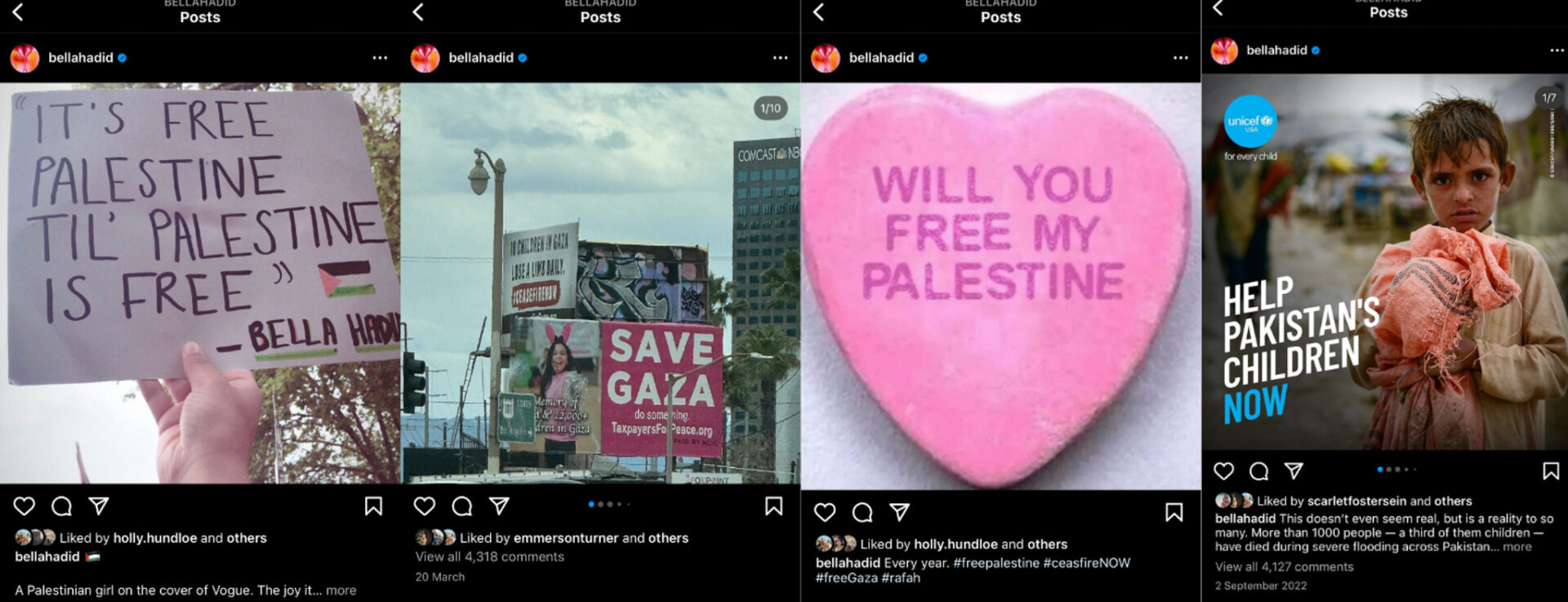
Introducing new technologies has created platforms for people to develop a voice for their opinions and beliefs. Having today’s today’s society creates a community in which people believe and follow what you may portray through social media platforms. The sudden emergence of “influencing has created a path where people can advocate for topics such as activism for Palestine and, through social media technologies, create hashtags that start to trend and spread awareness worldwide (Karamar & Farooq, 2016). A particular person of focus, Bella Hadid, used her online presence to give a voice to the Palestinians and the war that is going on between them and Israel. This has become a controversy as such a large platform of 60.8 million creates a topic of discussion. Media can give back control to the voices of those who have been silenced. It is essential to understand the strength a simple post may have towards a movement and the power it creates for more and more people to become a part of the ‘trend’ and share more worldwide (Karamar & Farooq, 2016). We see this through Bella Hadid’s post, where she posted the word” Palestine” with three love hearts, with the colours representing the Palestinian flag, creating positive and negative reactions worldwide (Dunn, 2023). This isn’t the first time the model has posted her support for Palestine; back in 2020, she posted that she would donate to charities that support those who have experienced conflict during the war (Dunn, 2023). This dedication to the cause has led the model to lose jobs and partnerships with huge brands such as Dior, creating an abruption to her career (Dunn, 2023). “So many companies stopped working with me, and my friends completely dropped me” (Hadid, 2021). The courage that Bella Hadid has shown throughout the Palestinian suffering and support through her social platforms is an example of the power social media can have in today’s society. The simplicity with which people view social media as not a dominant tool to spread awareness of a cause has proven to be erroneous. Having your voice and a social platform can be a political tool to spread awareness to all generations from any world sector. The importance of understanding the strength of such platforms can be the downfall of others.
Network Engagement:
As we further understand the importance of Web 2.0 technologies, the growth of social platforms has increased awareness of social issues and spread understanding. Another sector we need to investigate is how the innovation of the implications of new social techniques, such as hashtags and social channels, can significantly impact the potential of a message reaching an audience and being effective. Brand awareness refers to consumer recognition and the capability to reach an audience and engage with a particular message (Biglin, 2018). The impact of the effectiveness of a social platform can affect the behaviour and reaction of the community targeted; when we investigate the effect Bella Hadid had on a simple post on her social platform, the effect made significant changes with the support of the people affected by the crisis and created a safe hold for a community to come together and feel more exposed with their expression (Dunn, 2023). Instagram and Twitter are two of the most potent platforms worldwide used for free expression and creating authenticity; this online identity is where people can advocate for social problems and create a stance that makes a significant difference from 20 years ago when social media was not as evolved.
The number of shares can measure the engagement of networks and likes a particular topic is affected by; a simple hashtag can create the notion of spreading awareness more profoundly into the core of the world, developing a powerful tool used in political issues around the world. An example of this is seen through the hashtag #StandWithPalestine; this hashtag has been used by celebrities, politicians, and activists to create a movement within the social media communities to pursue a change in the way the world is proceeding at the moment (Chakraborty, 2023). The hashtag is part of a broader movement to support the Palestinian people and their rights to express self-determination in the conflict against Israel (Chakraborty, 2023). Although the hashtag has created controversy, is said to be biased, and does not express the complexities of the conflict, it remains a powerful tool to raise awareness across the world that did not exist prior. The understanding that social media spreads is detrimental to the outcome of wars; the emergence of these technologies creates more of a difference than ever as more people are becoming aware of the significance of what is happening in the world.
Social Networks After A Disaster:
With the understanding of these topics we have overlooked throughout this text, we begin to understand the importance of technology in today’s technological world. Not only are social platforms used for free expression and a way to spread awareness globally, but they are tools that people can use to reflect on a particular occasion that may have taken place in the past and form a community in which they can express their thoughts internationally. Social platforms such as Twitter and Instagram play a critical role in disaster management and the effect of building a community to help donate to organizations that support these issues. Social media platforms over the past few decades have become one of the main communication channels to spread awareness on a global scale (Acikara, Xia, Tan & Hon, 2023). Social media analytics have now become a tool to measure tourism and hospitality rates, and disaster management is no exception. Through shares and likes, analytics can measure the effectiveness of disaster responses and improve a particular disaster’disaster’s situational awareness (Acikara, Xia, Tan & Hon, 2023).
Looking further into the effectiveness of social media as a tool for disaster management, a vital disaster to underline is the 2016 flood in Louisana that damaged over 60,000 homes. This disaster was one of the worst U.S. disasters after Hurricane Sandy; this led to the importance of social networks and the ability to collect data to create insights into online users’ pausers’ to spread awareness through Facebook and other platforms (Kim & Hastak, 2018). Social media was used to communicate disaster-effective requests to people affected by the disaster and through the sharing and reposting of the worst affected (Kim & Hastak, 2018). This disaster is an example of the power social platforms have when it comes to spreading awareness and creating change within a disaster or problem on a global scale. Comparing this to the Palestinian movement conveys the trend in which social platforms are the new tools for collecting data and spreading awareness in hopes of making a difference in society today.
Misleading Content:
As we raise awareness that social media has the power to spread awareness globally, we also need to look at how there may be cases of information being misleading or false. One downfall that plays a crucial role in misusing social media is false equivalencies (Freelon, Marwick & Daniel, 2020). Online activism is one of the main tools to build a community and create change throughout a disaster or political issue. Still, there are always negatives that come with the positives of online activity. A significant concern for elections, scholars and news media is the problem of misleading and false political content (Freelon, Marwick & Daniel, 2020). Users have the opportunity to post content that may not be literal through the emergence of new technologies such as AI; any person can create false headlines that can be detrimental to anyone. The power of social media can be positive but negative when misused. Through the trends of conspiracy theories, hoaxes and inflammatory opinions, the rise of false information has increased rapidly as more and more people have access to technologies that allow these causes (Freelon, Marwick & Daniel, 2020).
Conclusion:
As we gather all the information overlooked throughout this text, we understand the power social media platforms use when spreading awareness on controversial and political topics. Throughout this text, there is an understanding of several areas in which technologies can be used as a tool to spread awareness on a global scale. The emergence of social media is changing the attitude and behaviour of the youth; different online pages and accounts create a new perception in which political activism can be spread through medians to influence new people to have awareness, such as activism for Palestine by amplifying citizen voices. The sudden emergence of ‘influencing’ has created a path where people can advocate for such issues as activism for Palestine and, through social media technologies, create hashtags that start to trend and spread awareness worldwide (Karamar & Farooq, 2016). A particular person of focus, Bella Hadid, used her online presence to give a voice to the Palestinians and the war that is going on between them and Israel. Social platforms such as Twitter and Instagram play a critical role in disaster management and the effect of building a community to help donate to the organizations. Social media platforms over the past few decades have become one of the main communication channels to spread awareness on a global scale (Acikara, Xia, Tan & Hon, 2023).
Social media analytics have now become a tool to measure tourism and hospitality rates, and disaster management is no exception. The impact of the effectiveness of a social platform can affect the behaviour and reaction of the community targeted; when we investigate the effect Bella Hadid had on a simple post on her social platform, the effect made significant changes with the support of the people affected by the crisis and created a safe hold for a community to come together and feel more exposed with their expression (Dunn, 2023). Instagram and Twitter are two of the most potent platforms worldwide used for free expression and creating authenticity; this online identity is where people can advocate for societal problems and create a stance that makes a significant difference from 20 years ago when social media was not as evolved. One downfall that plays a crucial role in misusing social media is false equivalencies (Freelon, Marwick & Daniel, 2020). Online activism is one of the main tools to build a community and create change throughout a disaster or political issue. Still, there are always negatives that come with the positives of online activity. A significant concern for elections, scholars and news media is the problem of misleading and false political content (Freelon, Marwick & Daniel, 2020). As technologies evolve and new social platforms are created, social media’s increased global awareness of social and political issues becomes more prevalent.
References:
Acikara, T, Xia, B, Tan Y & Hon C. (2023). Contribution of Social Media Analytics to Disaster Response Effectiveness: A Systematic Review of the Literature. Sustainability; Basel. https://doi.org/10.3390/su15118860
Bi̇lgi̇n, Y. (2018). The effect of social media marketing activities on brand awareness, brand image and brand loyalty. Business & Management Studies: An International Journal, 6(1), 128–148. https://doi.org/10.15295/bmij.v6i1.229
Chakraborty, A. (2023). #StandWithPalestine: A social media movement to raise awareness of the Israeli-Palestinian conflict. LinkedIn. https://www.linkedin.com/pulse/standwithpalestine-social-media-movement-raise-anirban-chakraborty/
Dunn, B. (2023). Bella Hadid Posts New Message of Palestinian Support. Newsweek. https://www.newsweek.com/bella-hadid-posts-message-palestinian-support-1853210
Freelon, D, Marwick, A & Daniel K. (2020). False equivalencies: Online activism from left to right. Science. https://www.science.org/doi/10.1126/science.abb2428
Karamar, A & Farooq, A. (2016). Emerging Role of Social Media in Political Activism: Perceptions and Practices. South Asian Studies. https://www.proquest.com/docview/1832679116/abstract/27697D26FDCB41F7PQ/1?accountid=10382&sourcetype=Scholarly%20Journals
Kim J & Hastak M. (2018). Social network analysis: Characteristics of online social networks after a disaster. ScienceDirect. https://www.sciencedirect.com/science/article/abs/pii/S026840121730525X?via%3Dihub
Featured Image:
Bella, H. (2023). Instagram. https://www.instagram.com/bellahadid/


Leave a Reply
You must be logged in to post a comment.