Creating online communities through social media and engaging content have played a vital role in bringing FORMULA 1 back to the forefront of international sports.
- Revel in the Racing – Improving the viewing experience for people watching at home, which involved being more selective in what was shown to fans during live broadcasts of races. This included lowering camera angles to show the speed of the Formula One cars. This continues to be shown today as new camera angles are added every year to Formula One, such as helmet cameras in 2022, and the new brake duct camera shown first at Suzuka at the Japanese Grand Prix in 2024.
- Breaking Borders – Providing more digital access to fans through extra content such as the free Formula One post show livestream on YouTube, while “remaining an air of in-person exclusivity.”
- Make the Spectacle more Spectacular – Increasing the amount of Formula One themed activities in host cities through fan experiences such as F1 Esports hubs where fans can race in simulators, feature races such as Porsche Cup races and celebrity drivers in vintage Formula One cars.
- Feel the Blood Boil – Show fans a more intimate side of the sport through showcasing the personalities of the drivers. This includes Drive to Survive.
- Taste the Oil – Get fans interested in the engineering side of the sport. This is achieved through bringing the fans at home closer to the garages with increased access to the pit lane for broadcasters, asking questions to engineers and team principals that target the mechanical side of the sport, as well as shows such as F1 Tech Talk which is a broadcast with host former engineer Sam Collins
Bernie Ecclestone
A Changing Demographic
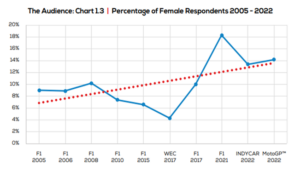
Research completed by Nielsen and Motorsport Network from 2005-2023 shows evidence of the difference Liberty Media have made to Formula One. The most recent survey was published in January of 2022, with over 160,000 participants, which made it the largest ever sports survey conducted. Burrows et al. say that the “most striking data” is the increase of female respondents from 2017 to 2021 from 10% in 2017 (appendix A.) to 18.3% in 2021, which equates to an increase of 83%. This data is in conjunction with the transfer of ownership of Formula One to Liberty Media. The report also states that 30 percent of the respondents to the research survey had been fans of Formula One for less than 5 years which is again, linked with the changes in ownership of Formula One and the “loosening of restrictions on social video for competitors and media (Burrows et al. 2023). 30% of motorsport fans access content through social media (Burrows et al. 2023), including Instagram, Twitter, and Facebook, with the official Formula One Instagram page amassing 28 million followers.
Social Media
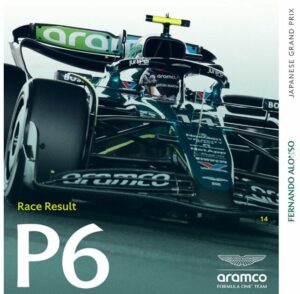
Social media has become a widely adopted tool by sports teams that is utilised for two-way communication with their fans. Sites such as Instagram and X (formerly twitter) have become pillars for marketing in world sports. Instagram is unique for its way to communicate without needing to rely on written content (Anagnostopoulos et al. 2017) Consumer engagement is the customers level of connectivity and investment in behavioral, cognitive, and emotional aspects (Brodie et al. 2011). These social media pages have numerous benefits to Formula One and its competitors such as promoting and attracting sponsors, as well as communicating to current fan bases and expanding them (Anagnostopoulos et al. 2017). Alongside these positives, social media surpasses borders and geographical distances which is important not only in the context of the world and its economy, but also in the context of marketing. This allows fans to feel close, by keeping up with the current activities of their favourite teams in places that are separated by large geographical distances (Gibbons and Dixon 2010). Social media posts such as Appendix C, allow fans to communicate ideas and share thoughts with one another in forum-like comments sections underneath Instagram posts, leaving a majority of the discussion up to more emotionally invested fans, while the minimalism of the actual post allows casual fans to keep updated with how their favourite team is travelling.
TikTok
Fernando Alonso was voted the best public figure in Spain in 2023 at the TikTok awards, with 2 million followers. This very unserious page, with 42-year-old Alonso recreating TikTok trends shows how Formula One teams have recognised the importance of marketing towards a younger audience. This younger age demographic is highlighted in Appendix B, which shows that almost 35% of survey respondents are aged 16-25 years old. Thomson (2006) describes human brand theory as the act of forming attachments to “attractive, accessible and authentic people, yielding positive marketing results.” Through the use of social media, athletes are able to show themselves as being relatable, charismatic, and attractive. Social media does its job, closing the distance between previously inaccessible athletes, bringing them closer to fans. Yiran et al. 2020 concluded that TikTok’s playfulness and performativity, as well as its authenticity are the reasons why TikTok has become such a focus to athletes and furthermore, Formula One. The playful and unserious nature of professional athletes adhering to TikTok’s copycat culture by participating in the latest trends, athletes have a potent tool of engagement and excitement. Fernando Alonso has a total of 44 posts on his TikTok page amassing over 24 million likes, which equates to over 500 thousand likes per post, showing how impressive a tool TikTok can be for athletes and marketing. TikTok’s authenticity is also a key factor in its success for athlete marketing. The raw nature of TikTok pushes viewers to perceive the authenticity of their personas, with the juxtaposition of professional athletes being so normal on camera adding a level of relatability. Athletes like Fernando Alonso are capitalising on the power of social media and younger audiences to propel not only their own relevance, but also the relevance of the league or competition they belong to.
Drive to Survive
Formula One was the fastest growing sport on social media in 2021 across YouTube, Facebook, TikTok, Instagram, Snapchat, Twitch and Twitter, registering 49.1 million followers, increasing by 40% from the previous year (Wood and Burkhalter 2023). Creating an online community of fans of all ages and in all countries through engaging content including Formula One: Drive to Survive, has led to a massive expansion of Formula One. A case study of Formula One is proof that pivoting to contemporary marketing techniques and targeting young audiences is beneficial to brands. Therefore, marketers must not make the same mistake as Bernie Ecclestone, remembering that while speed kills, complacency does too.
Bibliography
ESPN. 2014. “F1 does not need young fans” http://en.espn.co.uk/f1/motorsport/story/184001.html
Silk, Atifa. 2014. “Exclusive: F1 boss Bernie Ecclestone on his billion-dollar brand.” Campaign. https://www.campaignasia.com/article/exclusive-f1-boss-bernie-ecclestone-on-his-billion-dollar-brand/392088
Saunders, Nate. 2017 “F1’s new owners relax social media rules.” ESPN. https://www.espn.com/f1/story/_/id/18787004/f1-new-owners-relax-social-media-rules
F1 Experiences. 2023. “Explained: what is guided paddock access.” Formula One Group. https://f1experiences.com/blog/explained-what-is-guided-paddock-access
Rencken, Dieter and Hazel Southwell. 2021. “Drive to Survive is creating “avid” new Formula 1 fans – Brown” RaceFans.net. https://www.racefans.net/2021/06/19/drive-to-survive-is-creating-avid-new-formula-1-fans-brown/
Bauer, Hans H., Stokburger-Sauer, Nicola E. and, Stefanie Exler. 2008. “Brand Image and Fan Loyalty in Professional Team Sport: A Refined Model and Empirical Assessment.” Journal of Sport Management 22 (2): 205-226. https://doi.org/10.1123/jsm.22.2.205
Brodie, R. J., Hollebeek, L. D., Jurić, B., and, Ana Ilić. (2011). “Customer Engagement: Conceptual Domain, Fundamental Propositions, and Implications for Research.” Journal of Service Research 14 (3): 252-271. https://doi.org/10.1177/1094670511411703
Gibbons, Tom, and Kevin Dixon. 2010. “‘Surf’s up!’: A Call to Take English Soccer Fan Interactions on the Internet More Seriously.” Soccer & Society 11 (5): 599–613. https://doi.org/10.1080/14660970.2010.497359
Matthew Thomson. 2006. “Human Brands: Investigating Antecedents to Consumers’ Strong Attachments to Celebrities.” Journal of Marketing 70 (3): 104-119. https://doi.org/10.1509/jmkg.70.3.104Su, Yiran, Baker, Bradley J., Doyle, Jason P. and Meimei Yan. 2020. “an Engagement in 15 Seconds: Athletes’ Relationship Marketing During a Pandemic via TikTok.” International Journal of Sport Communication 13 (3): 436-446.https://doi.org/10.1123/ijsc.2020-0238Wood, Ava M. and Janée N. Burkhalter. 2023. Fans, Fame, F(Ph)ilanthropy, and Fury: The Impact of Netflix’s “Drive to Survive on F1 Racing. Sage Sage Publications https://doi.org/10.4135/9781071914274

Appendix A
Appendix B
Appendix C


Leave a Reply
You must be logged in to post a comment.