Formula 1: Drive to Survive (the Digital Age)

Posted on

by


Creating online communities through social media and engaging content have played a vital role in bringing FORMULA 1 back to the forefront of international sports.

The sport industry is nowadays seen as part of the wider entertainment industry” (Anagnostopoulos et al. 2017 as quoted by Bauer et al. 2008). Formula One is the world’s premier single-seated motor racing competition. Running for a record 24 races in 2024, the sport has only increased in size since the utilization of social media after the acquisition of Formula 1 by the Colorado, USA based, media and entertainment company Liberty Media in January of 2017. CEO of Formula One at the time, Chase Carey, Sean Bratches (Former Vice President of Sales at ESPN) and Ross Brawn (Wood and Burkhalter 2023), the former team principal of Brawn GP, who famously won the only Formula One World Championship they entered in 2009 with Jensen Button and Rubens Barichello.
The Five North Stars
Wood and Burkhalter (2023) explain how Carey, Bratches and Brawn created 5 pillars called the “five North Stars.” These objectives would outline the key goals that the trio put in place to push Formula One to the next level. The five North Stars are:
  1. Revel in the Racing – Improving the viewing experience for people watching at home, which involved being more selective in what was shown to fans during live broadcasts of races. This included lowering camera angles to show the speed of the Formula One cars. This continues to be shown today as new camera angles are added every year to Formula One, such as helmet cameras in 2022, and the new brake duct camera shown first at Suzuka at the Japanese Grand Prix in 2024.
  2. Breaking Borders – Providing more digital access to fans through extra content such as the free Formula One post show livestream on YouTube, while “remaining an air of in-person exclusivity.”
  3. Make the Spectacle more Spectacular – Increasing the amount of Formula One themed activities in host cities through fan experiences such as F1 Esports hubs where fans can race in simulators, feature races such as Porsche Cup races and celebrity drivers in vintage Formula One cars.
  4. Feel the Blood Boil – Show fans a more intimate side of the sport through showcasing the personalities of the drivers. This includes Drive to Survive.
  5. Taste the Oil – Get fans interested in the engineering side of the sport. This is achieved through bringing the fans at home closer to the garages with increased access to the pit lane for broadcasters, asking questions to engineers and team principals that target the mechanical side of the sport, as well as shows such as F1 Tech Talk which is a broadcast with host former engineer Sam Collins

Bernie Ecclestone

In 2014, Bernie Ecclestone, the now, former chief executive of Formula One group infamously said that Formula One should not be interested in marketing towards younger fans. While both F1 live and television audiences were decreasing and two teams in Marussia (now HAAS) and Caterham (formerly Lotus, Lotus-Renault, Renault and now Alpine) falling into administration, the former Formula One chief executive declined to believe that Formula One could be revitalised through marketing towards a younger audience, saying in an interview for Campaign Asia (2014) that because a young child does not have the money to buy any of the products that are advertised such as Rolex or do not care about banking (referring to another sponsor UBS), Formula One should not go after the viewership of this younger audience. Ecclestone then went on to explain his lack of faith in social media, even going as far to say that he is “not a great supporter” of it, though he also expresses that he should use social media to promote Formula One, but just doesn’t know how.
Liberty Media
Prior to the Liberty Media buyout which occurred in 2017, filming by “other than broadcasters with a TV deal and Formula One Management (FOM) themselves” (ESPN, 2017) inside the F1 paddock, which is described as the working area of Formula One (F1 Experiences, 2024), was banned under the rules at the time. This meant that even, driver, Lewis Hamilton was asked to delete videos that he had shared online on multiple occasions. The acquisition of Formula One by Liberty media came with a new set of rules which allowed teams more freedom around what they share with their fans. The F1 Guidelines help outline the difference between acceptable and unacceptable user-generated content. Previously, fans were unable to share videos using any Formula One broadcasts and all videos on social media platforms with any unauthorised footage were removed. This hindered the expansion of Formula One as it disallowed casual viewers to catch up on race highlights on everyday services such as YouTube or Facebook. Full highlights of practice sessions, qualifying and races were only made available at the sport’s season opener in 2017.

A Changing Demographic

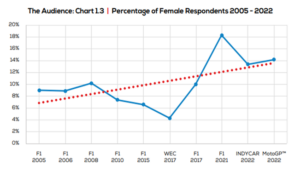
Research completed by Nielsen and Motorsport Network from 2005-2023 shows evidence of the difference Liberty Media have made to Formula One. The most recent survey was published in January of 2022, with over 160,000 participants, which made it the largest ever sports survey conducted. Burrows et al. say that the “most striking data” is the increase of female respondents from 2017 to 2021 from 10% in 2017 (appendix A.) to 18.3% in 2021, which equates to an increase of 83%. This data is in conjunction with the transfer of ownership of Formula One to Liberty Media. The report also states that 30 percent of the respondents to the research survey had been fans of Formula One for less than 5 years which is again, linked with the changes in ownership of Formula One and the “loosening of restrictions on social video for competitors and media (Burrows et al. 2023). 30% of motorsport fans access content through social media (Burrows et al. 2023), including Instagram, Twitter, and Facebook, with the official Formula One Instagram page amassing 28 million followers.

Social Media

Social media has become a widely adopted tool by sports teams that is utilised for two-way communication with their fans. Sites such as Instagram and X (formerly twitter) have become pillars for marketing in world sports. Instagram is unique for its way to communicate without needing to rely on written content (Anagnostopoulos et al. 2017) Consumer engagement is the customers level of connectivity and investment in behavioral, cognitive, and emotional aspects (Brodie et al. 2011). These social media pages have numerous benefits to Formula One and its competitors such as promoting and attracting sponsors, as well as communicating to current fan bases and expanding them (Anagnostopoulos et al. 2017). Alongside these positives, social media surpasses borders and geographical distances which is important not only in the context of the world and its economy, but also in the context of marketing. This allows fans to feel close, by keeping up with the current activities of their favourite teams in places that are separated by large geographical distances (Gibbons and Dixon 2010). Social media posts such as Appendix C, allow fans to communicate ideas and share thoughts with one another in forum-like comments sections underneath Instagram posts, leaving a majority of the discussion up to more emotionally invested fans, while the minimalism of the actual post allows casual fans to keep updated with how their favourite team is travelling.

TikTok

Fernando Alonso was voted the best public figure in Spain in 2023 at the TikTok awards, with 2 million followers. This very unserious page, with 42-year-old Alonso recreating TikTok trends shows how Formula One teams have recognised the importance of marketing towards a younger audience. This younger age demographic is highlighted in Appendix B, which shows that almost 35% of survey respondents are aged 16-25 years old. Thomson (2006) describes human brand theory as the act of forming attachments to “attractive, accessible and authentic people, yielding positive marketing results.” Through the use of social media, athletes are able to show themselves as being relatable, charismatic, and attractive. Social media does its job, closing the distance between previously inaccessible athletes, bringing them closer to fans. Yiran et al. 2020 concluded that TikTok’s playfulness and performativity, as well as its authenticity are the reasons why TikTok has become such a focus to athletes and furthermore, Formula One. The playful and unserious nature of professional athletes adhering to TikTok’s copycat culture by participating in the latest trends, athletes have a potent tool of engagement and excitement. Fernando Alonso has a total of 44 posts on his TikTok page amassing over 24 million likes, which equates to over 500 thousand likes per post, showing how impressive a tool TikTok can be for athletes and marketing. TikTok’s authenticity is also a key factor in its success for athlete marketing. The raw nature of TikTok pushes viewers to perceive the authenticity of their personas, with the juxtaposition of professional athletes being so normal on camera adding a level of relatability. Athletes like Fernando Alonso are capitalising on the power of social media and younger audiences to propel not only their own relevance, but also the relevance of the league or competition they belong to.

Drive to Survive

Netflix’s ability to create excitement and engagement make it such a potent force in the marketing world, hence the creation of the term “the Netflix effect” which describes the video streaming site’s grasp on the entertainment world. Formula One debuted on Netflix in 2018, with the first season of the docuseries Formula 1: Drive to Survive (DTS). The series delves into the previously unseen dramas of the sport and helped show the individual personalities of the drivers, bringing a more personal, intimate experience to screens. This dramatisation appeals to not only Formula One fans, but also to viewers with little or no previous exposure to the sport. Traditional narrative techniques from Formula 1: Drive to Survive created an engaging series which has become a major part in the expansion of the community of Formula One.  According to Soble and Lowes (2024), the main narrative techniques employed by the directors of DTS are adventure, ascension/descension, rivalry, sacrifice, and hero. Engaging viewers through these traditional and proven literary techniques provide an easier way to enter the Formula One world for new fans. The deliberate choice to tell a compelling narrative through DTS and reach a global audience is why McLaren Technology Group’s Chief Executive Officer, Zak Brown believes that the Netflix show has been a major catalyst in the growth of the popularity of Formula One within North America, even going on to say that he believes that it is the “single most important impact in North America… turning people into avid fans.” Zak Brown said that it is, “a great thing that Liberty (Media) did very early on” in an interview with website RaceFans.net in 2021 after the French Grand Prix (Rencken and Southwell 2021.) Formula One almost doubled its television viewership in the United States from 554,000 to 1.11 million per race from 2017 to 2023, measuring an average increase of 15% a year (Hall 2023). This effect translated into increases in live attendances as well, when the 2021 Austin Grand Prix sold all 380,000 ticket allocations. The series’ success has been replicated in following titles such as The Last Dance (2020), which tells the legacy of Michael Jordan and golf documentary Full Swing (2023).
Conclusion

Formula One was the fastest growing sport on social media in 2021 across YouTube, Facebook, TikTok, Instagram, Snapchat, Twitch and Twitter, registering 49.1 million followers, increasing by 40% from the previous year (Wood and Burkhalter 2023). Creating an online community of fans of all ages and in all countries through engaging content including Formula One: Drive to Survive, has led to a massive expansion of Formula One. A case study of Formula One is proof that pivoting to contemporary marketing techniques and targeting young audiences is beneficial to brands. Therefore, marketers must not make the same mistake as Bernie Ecclestone, remembering that while speed kills, complacency does too.

Bibliography

Hall, Andy. 2023. “Formula 1 2023 Season on ESPN Platforms End as Second Most-Viewed Ever on U.S. Television.” https://espnpressroom.com/us/press-releases/2023/11/formula-1-2023-season-on-espn-platforms-ends-as-second-most-viewed-ever-on-u-s-television/#:~:text=The%202023%20Formula%201%20World,setting%20average%20of%201.21%20million.
ESPN. 2014. “F1 does not need young fans” http://en.espn.co.uk/f1/motorsport/story/184001.html
Silk, Atifa. 2014. “Exclusive: F1 boss Bernie Ecclestone on his billion-dollar brand.” Campaign. https://www.campaignasia.com/article/exclusive-f1-boss-bernie-ecclestone-on-his-billion-dollar-brand/392088
Saunders, Nate. 2017 “F1’s new owners relax social media rules.” ESPN. https://www.espn.com/f1/story/_/id/18787004/f1-new-owners-relax-social-media-rules
F1 Experiences. 2023. “Explained: what is guided paddock access.” Formula One Group. https://f1experiences.com/blog/explained-what-is-guided-paddock-access
Rencken, Dieter and Hazel Southwell. 2021. “Drive to Survive is creating “avid” new Formula 1 fans – Brown”  RaceFans.net. https://www.racefans.net/2021/06/19/drive-to-survive-is-creating-avid-new-formula-1-fans-brown/
Bauer, Hans H., Stokburger-Sauer, Nicola E. and, Stefanie Exler. 2008.  “Brand Image and Fan Loyalty in Professional Team Sport: A Refined Model and Empirical Assessment.” Journal of Sport Management 22 (2): 205-226. https://doi.org/10.1123/jsm.22.2.205
Brodie, R. J., Hollebeek, L. D., Jurić, B., and, Ana Ilić. (2011). “Customer Engagement: Conceptual Domain, Fundamental Propositions, and Implications for Research.” Journal of Service Research 14 (3): 252-271. https://doi.org/10.1177/1094670511411703
Gibbons, Tom, and Kevin Dixon. 2010. “‘Surf’s up!’: A Call to Take English Soccer Fan Interactions on the Internet More Seriously.” Soccer & Society 11 (5): 599–613. https://doi.org/10.1080/14660970.2010.497359
Matthew Thomson. 2006. “Human Brands: Investigating Antecedents to Consumers’ Strong Attachments to Celebrities.” Journal of Marketing 70 (3): 104-119. https://doi.org/10.1509/jmkg.70.3.104Su, Yiran, Baker, Bradley J., Doyle, Jason P. and Meimei Yan. 2020. “an Engagement in 15 Seconds: Athletes’ Relationship Marketing During a Pandemic via TikTok.” International Journal of Sport Communication 13 (3): 436-446.https://doi.org/10.1123/ijsc.2020-0238Wood, Ava M. and Janée N. Burkhalter. 2023. Fans, Fame, F(Ph)ilanthropy, and Fury: The Impact of Netflix’s “Drive to Survive on F1 Racing. Sage Sage Publications https://doi.org/10.4135/9781071914274
Appendix

Appendix A

Appendix B

Appendix C


Search Site

Your Experience

We would love to hear about your experience at our conference this year via our DCN XV Feedback Form.

Comments

8 responses to “Formula 1: Drive to Survive (the Digital Age)”

  1. ezra.kaye Avatar
    ezra.kaye

    Hi,

    This was such a fun article to read and is very relatable to me!

    I’m a big sports fan. I love the Premier League, NBA, Tennis, and AFL, but I was never really interested in motor racing.

    However, a friend at work recommended watching the Netflix Drive to Survive series as something to watch after the Last Dance. And I’ve haven’t looked back since.

    I now follow all the drivers on Instagram, check the qualifying and race results for every grand prix, and have become something of a Daniel Ricciardo stan.

    Interestingly though, I am yet to watch a whole race on the TV. I’m definitely not opposed to it, but I’m not sure if I have the attention span to last a whole day of racing.

    I think I prefer to watch the season through the Netflix series which is a little more engaging. I’m well aware this makes me a bit of a fake fan and definitely not an F1 purist. I don’t deny that at all.

    I wonder if you think there are a lot of people like me who are fans of the show, but won’t necessarily watch the races?

    Thanks,
    Ezra

    1. 20366669 Avatar
      20366669

      Hey Ezra,

      Thanks for reading I appreciate it heaps!

      Don’t feel like a fake fan as the races have been a bit boring this year so far!

      That’s an awesome point you make. I wonder if it has anything to do with the physical accessibility of the sport. I love playing AFL and soccer frequently and I follow the NBA like you. It would be very interesting to see if there is any studies between the connection between watching sport and being able to physically take part in it proactively.

      To me, the one thing that sticks out as being a barrier to watch the Formula One races is that there is only one event every few weeks. This makes it hard to just tune in and out and I think social media fills that gap quite well. Seeing results on social media after races often can spoil the race and it honestly feels like a massive effort to watch 2 hours of a race you know the outcome of.

      I’d also be interested to know if you watch the highlights?

      Thanks,

      Jake

      1. ezra.kaye Avatar
        ezra.kaye

        Thanks for the reply!

        That’s an interesting point about how the physical accessibility of a sport may be linked to how much you watch it!
        Personally, there’s definitely more of an interest in watching the sports which I play (soccer), but it’s not a dealbreaker. I still watch other sports which I’m completely useless at ahaha.

        As for your question about the F1 highlights, yes I do try to watch them where I can!

  2. Suhayl Judoo Avatar
    Suhayl Judoo

    Hi Jake,

    As a Formula 1 fan myself, I really enjoyed your paper and Drive to Survive has indeed attracted more people towards the sport. However, although entertaining, the show has been massively accused for exaggerating and fabricating content. The use of fake radio messages, non exixtent rivalries betwwen teammates or other drivers and fabricated storylines are used by Netflix to make the show more interesting and keeping the viewers interested. The younger generation who wants to become a fan of the sport always starts by watching the show nowadays. Amidst these controversies surrounding the show. do you think that Drive to Survive is the right place to start for new fans who wants to unserstand the sport?

    I would also appreciate your thoughts on my paper : https://networkconference.netstudies.org/2024/csm/3742/racism-towards-black-football-athletes-has-become-a-norm-on-twitter/

    Thanks,

    Suhayl

  3. Mishma Noyan Avatar
    Mishma Noyan

    Hello! Being an F1 fan, I loved reading your paper. Well done! I have learned many things through your paper!

    For one of the five North Stars you mentioned, you discussed Revel in Racing. I wanted to show you what Red Bull posted about a month ago.
    Red Bull video: https://youtu.be/9pEqyr_uT-k?si=zclFHLM_F-DnmkPb
    At the Silverstone circuit, Red Bull introduced the “World’s Fastest Camera Drone” to improve people’s experience of watching broadcasts at home. The image quality and speed of the drone are incredible, and I cannot wait for the drones to be used in the near future.

    So, what are your opinions of this drone and its contribution to improving fans’ experiences worldwide?

  4. Mikayla Avatar
    Mikayla

    I find it interesting how Formula 1 is very popular on TikTok, as someone who’s more into fashion than cars, it’s been interesting to see so many “get ready with me” videos centred around Formula 1 events. how might the sport capitalise on this growing interest from different demographics? I’d love to hear your thoughts on where you see Formula 1 heading in terms of its cultural influence and fan engagement.

  5. Jarryds Avatar
    Jarryds

    Hi Jake,

    Great paper! I’m a huge F1 fan I have to give credit to the Drive to Survive series to getting me hooked on the sport. It was disappointing to hear that some of the content was faked through-out the series, although, what it did give me was insight to each of the drivers as characters so I could relate to them. I admit I now follow along to each of them and now watch each race with an extra bit of insight which builds the drama for on and off the track. I think all motor sports need to think about promoting their series in a different way to help build a larger audience so others can relate to them like I have. Rather than people viewing it on it’s face value of “just cars going around in a circle” etc

    What are your thoughts on the F1 owners taking over the MotoGP? Could we see a similar increase in that sport like F1 with different owners?

    Jarryd

  6. Chris May Avatar
    Chris May

    An interesting read, and one that highlights how brands can utilise social media to reach new demographics and change their image.

    I personally was a fan of Formula 1 since childhood, I remember watching Senna, Prost, Mansell, and other legends tear around the track. For me, the drama was always in the sport itself, the on-track passes and manoeuvres, an exceptionally fast/slow pit stop, a timely safety car or change in the weather, seeing how the teams and drivers responded in the moment as a sporting spectacle was what drew me to the sport more than the mechanics or the inter-personal dramas of the drivers and team bosses.

    While Drive To Survive certainly offers something different, and is proving popular enough, for me it feels manufactured… as all reality TV does. Every little thing is sensationalised to the point where it isn’t a true reflection of what happened. It seems that Liberty Media’s focus on improving the spectacle and entertainment factor of the sport have had an unintended consequence of making it less “real” and driving away the purist. Would you agree?

    Myself, I stopped watching Formula One after the Abu Dhabi Incident a few years back where, with the world watching after the closest and most dramatic season in recent history (albeit one marred with a series of questionable and downright ridiculous stewarding), the Race Director at the final race of the season undid years of rules precedent on the fly to stop a race finishing behind a safety car (to improve the “spectacle”), and in doing so gifted the championship to the driver who had been in second-place the entire race. It was at this point that I realised that the sport had prioritised spectacle over sporting integrity, and the purist fan in me died. I’ve not watched a race since.

Leave a Reply

Skip to content