Abstract
In recent years, social media has become increasingly popular and widely used. People use it to share their knowledge, stories, skills, and to create trends and other content that many users have in common. One such app that has gained popularity is TikTok, which offers a platform for users to share their experiences. With its ability to share perspectives on romantic relationships, it has become a popular tool for expressing one’s thoughts and feelings on this topic.
In this paper, I will discuss why social media platforms like TikTok have become a safe space for teenagers and young adults to talk about their love lives. This includes their willingness to judge others, which contributes to the creation of safe spaces for discussing unknown individuals. We will also examine whether oversharing and forming biased views based on personal experiences has resulted in the formation of groupthink or an “echo chamber” of individuals with particular beliefs about romantic relationships. Additionally, we will explore the consequences for users outside of this group. It is essential to consider how other people’s definitions of a safe space can affect one’s relationships when similar events occur, which could have a significant impact on the community’s well-being.
Introduction
Social media plays a significant role in our daily lives, especially when it comes to relationships. It offers a distinctive way for people to interact online, and the experience differs for everyone (Gogos, 2022, as cited by Valkenburg et al., 2016). Social media provides us with a platform to share our thoughts, backgrounds, and learn about each other’s interests and activities based only on what we post. Moreover, it has become a common practice for couples to flaunt their romantic relationships publicly on social media.
A recent poll conducted in the United States revealed that approximately 87% of single social media users come across posts related to romantic relationships on a regular basis (Vogels & Anderson, 2020). This is because popular platforms like TikTok allow users to create and share trends that involve their romantic partner, which eventually spreads across multiple channels beyond the app itself.
Due to this emerging tendency on social media for couples to follow, the comments that I’ve observed and gathered vary depending on whether the user is single, in a relationship, or has gone through a breakup. This is when they highlight how they choose to communicate their sentiments about specific trends by partaking in them despite not being in a relationship, for example. This is how a ‘safe place’ is developed, especially when we encounter other individuals who have had similar experiences to us. In this discussion, we will explore the following points:
- TikTok has created a safe platform for teens and young adults to share their romantic relationship status and feelings.
- Has this community produced an echo chamber where users define relationships with their own definition and set unrealistic dating standards?
It is crucial to address the challenge of oversharing in the context of dating. This is because on platforms like TikTok, people tend to express their feelings openly and without filters. However, this habit of oversharing may lead to problems in external relationships. This is because people tend to relate their experiences to others who are in similar early stages, which can create a sense of false connection and mislead individuals. Therefore, it is important to be mindful of what and how much we share about ourselves in the early stages of a relationship.
Safe Space
According to Doyle (2024), users spend an average of 95 minutes a day on TikTok. The app’s algorithm often brings up posts where people share their personal life experiences or stories. This has created a “comfort space” within TikTok, where users with similar experiences can come together and form a community. Such users can relate to each other and showcase their shared experiences which in result was found that 48% of people aged 18 to 29 use social media to share or discuss their dating experiences (Vogels & Anderson, 2020).
This suggests that a third space has been commonly created for users of social media sites, particularly teenagers and young adults, to address issues related to romantic relationships. What created this feeling of safe space as further stated by Şot (2022) is how “They employ various methods to create this ‘family atmosphere’”. This includes supportive replies, such as those who represent themselves like an older sister figure, as well as offering solutions that may not be found on many other platforms. TikTok has demonstrated that. Here are a few themes or topics that have portrayed the safe space image and influenced TikTok usage among the romantic relationship community:
Hard Launch
Many people have used TikTok as an ‘online diary’ for their romantic relationships. This means that they openly share their ideas and feelings about their romantic relationship via digital posts and comments, both public and private. The trend of ‘hard launching’ is growing on TikTok, which involves explicitly (“hard”) disclosing a new relationship using a brief image or video and accompanying caption which often gives away the status of the person (Portolan 2022).
A common example that surrounds this act which expresses that safe space concept was about displaying public affection. Research that has been done by Fitzpatrick (2022) and Mendelson (2023), the act of public display of affection was believed to help couples maintain their relationships. He said, “It has become common for those in committed romantic relationships to rely on public displays of affection to maintain the success of their relationship” (Fitzpatrick, 2022, p. 22).
Therefore, actions like sharing positive affirmations about their partner on social media, recording personal moments and other things somewhat made their relationship appear more special. Some users overshare their personal lives around this feature to the point where they become preoccupied with public perceptions of their relationships. This somewhat would grow their obsession to make their relationship admired by being open about it (Fitzpatrick, 2022).
Furthermore, this gesture has inspired people to take advantage of such opportunities to share personal moments, which has now become a trend for other couples to follow. An actual example of this is a trend that has recently been spreading on TikTok around the end of March 2024, under the song Hell N Back by Bakar and Summer Walker. It was taken explicitly for the lines “I was over love, though I had enough, then I found you”. This trend describes how he or she struggled to believe ‘love exists’ until they met their partner, as represented in the chosen lyrics.

However, this also emphasized the appearance of a secure space in which not only can they show off the appearance of their partner, but the other users who participated and single voiced their thoughts, were widely referenced with “have never wanted to participate in a trend so bad”. The thoughts expressed in these posts were some form of sadness for not being able to meet someone to follow such a trend. The comments under these posts were emotive and intimate, with many people commenting on their feelings of jealousy, recent breakups, admiration, and other related couple trends. This demonstrates the ease that people have gained in openly expressing their sentiments to strangers.
Breakups
Teenagers have been vocal about their breakups on TikTok during this usual period of relationship breakdown. The hashtag #breakup has already been used over 4 million times. This includes events as stated by Fitzpatrick (2022) “The same audience that watched the relationship blossom is the same audience to watch it diminish. The common steps taken after committed romantic relationship ends are usually easily detected by friends and followers”. This demonstrates how the transparency of certain relationships has been depicted on social media. Based on my interactions with this topic, some users were comfortable enough to discuss serious situations such as being cheated on, dumped, abused, and a variety of other scenarios, which relates to my comparison of TikTok to an ‘online diary’.
Back to another point stated by Şot (2022), within their article, it was stated that “TikTok’s algorithm has also proved to be more effective in tailoring audience, that is, younger individuals with ages ranging from 12 to 20”. This implies that common trends on TikTok can be easily identified based on demographic interactions.
In the context of breakups, the conversation on this topic drew a greater teenage audience, or persons aged 14 to 25. Supporting evidence of this was the survey taken which shows about 70% of users who actively checked up on their ex-partners ranging between ages 18 to 29 (Vogels & Anderson, 2020). One example that showed common discussion around this topic was the recent trend of a song called End of Beginning by Djo. It was taken based on the lyrics saying “Just trust me, you’ll be fine” which, in the majority of instances, was the user going through a breakup and contrasted it with an encouragement to heal from such traumas and support others who are experiencing similar suffering.
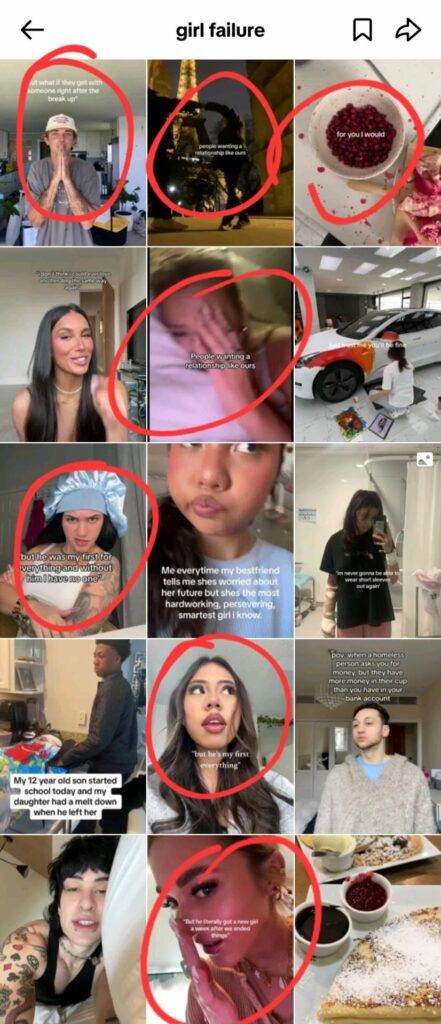
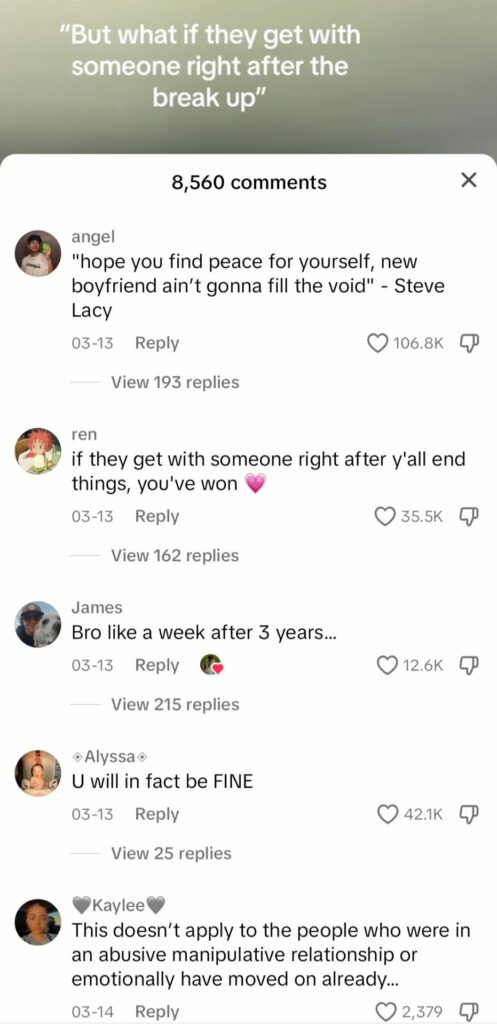
LINK TO THE POST link to the trend page
Defining ‘Bare Minimum’
Despite TikTok’s ability to provide a supportive community and a secure environment for members to discuss their relationships, the communities it has created have some alarming characteristics. As previously stated, being open and expressive about personal relationships on this platform (public display of affection) has elicited some unfavourable reactions from outsider couples who compare their current relationship to others. It was stated that “findings from the study specified that individuals who announced that they are in a romantic relationship on social media also report more jealousy toward their partner than those who kept their relationship private” (Fitzpatrick, 2022). Trends such as receiving enormous flower bouquets, wearing a promise ring, going out on a fancy date, and more are frequently posted on TikTok. This definition of envy hurts partners because it encourages them to conform to the norms of other relationships.
I believe that a segment of this group has created an echo chamber of beliefs that often the male in the relationship should handle the relationship in the same way that other relationships are portrayed online; otherwise, they would be deemed not reaching the standards of the so-called ‘bare minimum’. Not only has this put strain on couples, but it has also made it harder for them to recognize that the outcomes are not determined by the experiences of outsiders. Common searches, as shown in the screenshot below, are assessments made by both genders towards each other in a relationship about what they “should do” to be a good partner.


It has the potential to promote a ‘toxic’ mindset, heighten insecurities because of the misfit implied by online interactions, foster distrust, and possibly trigger more social media problems within the relationship. In addition to this, “34% of 18- to 29-year-olds … say they have felt jealous or unsure in their current relationship because of how their partner interacted with others on social media” (Vogels & Anderson, 2020). This can be caused by a gradual increase in discomfort based on negative biased experiences shared by couples, especially which teens or others admire and compare to, convincing themselves that they will end up in the same scenario.
Conclusion
Based on this overall argumentation, TikTok has undoubtedly established that ‘third space’ for most users to project and communicate their thoughts more freely, as the community grows increasingly to be more connected and expressive. Not only have trends played an important role in allowing people to participate in displaying their relationship to a specific occasion, but they are also able to connect through those trends to find more people with whom they can relate.
Nonetheless, it may contradict the idea of constantly maintaining a ‘safe space’ for the community by normalizing a lack of judgment and understanding towards external relationships that others see. It’s important to recognize that the problems in a relationship may not always be what they seem on the surface. Many people make assumptions about the solutions to these issues without understanding the root cause. In a dating group for teenagers and young adults, an echo chamber has formed where individuals consume and learn from others on social media platforms like TikTok. This could have a lasting impact on their perceptions of romantic relationships, as they may not be getting a complete or accurate understanding of healthy relationships.
Reference List
Contrada, N. [@nicolo.contrada] (n.d.) Posts [TikTok Post]. TikTok. Retrieved March 30, 2024 from https://vt.tiktok.com/ZSFg6WKef/
Doyle, B. 2024. “TikTok Statistics – Updated Jan 2024”. TikTok Statistics – Updated Jan 2024, January 5, 2024. https://wallaroomedia.com/blog/social-media/tiktok-statistics/#:~:text=Average%20Minutes%20Per%20User%20%E2%80%93%20TikTok,app%208%20times%20per%20day.
Fitzpatrick, D. (2022). The Impact of Social Media on Romantic Relationships: A Qualitative Multiple Case Study. https://www.proquest.com/docview/2784392057?pq-origsite=gscholar&fromopenview=true&sourcetype=Dissertations%20&%20Theses
Gogos, E. (2022). Problematic Social Media Use in the Context of Romantic Relationships: Relation to Attachment, Emotion Regulation, and Motivations for Use. https://www.proquest.com/docview/2673580822?pq-origsite=gscholar&fromopenview=true&sourcetype=Dissertations%20&%20Theses
Mendelson, E. (2023). Sensemaking and public intimacy on TikTok: How viral videos influence interpersonal relationships offline. https://journals.sagepub.com/doi/full/10.1177/14614448231163231
Portolan, L. (2022). What is a ‘soft’ or ‘hard’ relationship launch? Explaining the celebrity-led trend. The Conversation. https://theconversation.com/what-is-a-soft-or-hard-relationship-launch-explaining-the-celebrity-led-trend-176531
Şot, İ. (2022). Fostering intimacy on TikTok: a platform that ‘listens’ and ‘creates a safe space’ Volume 44, (Issue 8). https://journals.sagepub.com/doi/full/10.1177/14614448231163231
TikTok. Hell N Back (feat. Summer Walker) [Screenshot of Audio Trend]. Retrieved March 25, 2024, from https://vt.tiktok.com/ZSFg6RBuY/
TikTok. original sound [Screenshot of Audio Trend]. Retrieved March 30, 2024, from
https://vt.tiktok.com/ZSFg6MPrU/
VOGELS, E., & ANDERSON, M. (2020) Dating and Relationships in the Digital Age. From distractions to jealousy, how Americans navigate cellphones and social media in their romantic relationships. Pew Research Center. https://www.pewresearch.org/internet/2020/05/08/dating-and-relationships-in-the-digital-age/#:~:text=About%20four%2Din%2Dten%20adults,their%20relationship%20on%20social%20media.


Leave a Reply
You must be logged in to post a comment.