“Democracy and ignorance mesh together like Mentos and Coca-cola…“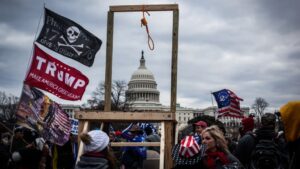 (Credits: Shay Horse/Getty Images)
Abstract:
The internet had always been a paradox between freedom of speech, expression and tolerance pitted against bigotry and misinformation. With the widespread use of social media, this paradox is brought to its peak, a curious (yet unsurprising) phenomenon analyzed through this thesis that focuses on the behaviour of Trump supporters, their roles and misuse of Social media platforms and their open hostility against progressive values online. This thesis defends restrictions on online freedom of speech to preserve tolerance and ethics. The spreading of misinformation on social media, made worse by echo chambers and confirmation bias, is threatening societal cohesion and harsh measures (with accountability) must be enforced to fight the normalization of hatred and ignorance online, a role that should be upheld by society as a whole to create a safer digital landscape for everyone and by everyone because, hey, we don’t want to revert back to the 50s, ain’t we?
“Give every fool a voice and they’ll make sure theirs is louder…“
Introduction/
Democracy. Tolerance. Freedom. Three beautiful ideals that have long ruled the dreams and aspirations of humankind. The dream to see a utopia, a place where everyone would stand as equals, with the right to express themselves in all sorts and forms of manners without fear of ridicule, judgment, or imprisonment. We, humans, have managed to create this place out of our fantasies and simply named it… the internet! Yet this is only a paradox, as for every shiny ideal lies its ugly shadow, forever creeping in its wake. As freedom of expression and democracy are touted as upfront, so too emerge concepts that tolerance itself has always fought: tribalism, ignorance, division, the silencing of minorities, the threat to civic discourse and the rise of right-wing populism. To support my argument, this paper thus delves into the behavior of a closely bonded group akin to a cult: Trump supporters. It examines how their spreading of misinformation and hostility is threatening the democratic ideals intended to thrive on the online utopia that the internet was supposed to be and why social media democracy has to be limited to maintain tolerance and ethics online.
1/ The Freedom to spread misinformation and incite hatred
It would be fair to start this first part with what the word “freedom” means as it is one of the main driving forces of my thesis statement. According to the dictionary, freedom is the “state of being free” (Merriam-Webster 2024), of being allowed -in this context- to have the right to express ourselves. But what if I claimed that too much freedom is the key to destroy freedom? That allowing too much tolerance is the trigger for more intolerance? And the apparent democracy allowed on social media is a tool that extremist forums and groups are completely aware of, as social media platforms are becoming a breeding ground for misinformation and incitement for hatred and direct actions (Zhuravskaya, Petrova, Enikolopov 2020), thanks to their usefulness in communication and public information distribution. And alongside the idea of freedom destroying freedom (this sounds a tad silly but I’ll justify my case), the medium of information spreading that social media are is slowly being corrupted by groups of individuals with counter-intuitive ideals. People have the right to express themselves and should be free to believe in what they want, but the line should be drawn at when these beliefs and thoughts become harmful to everyone’s cohesion or are jeopardizing the ideals of respect and tolerance between different groups online. As stated earlier, social media is becoming a ground for misinformation for allowing the proliferation of nefarious groups disseminating falsehoods and distorting reality.
Now, with that information in mind, echo chambers are aggravating this issue by exposing -often wrongful- informations to users reinforcing their beliefs in a matter they want to feel knowledgeable about. Confirmation bias too? Because a non-negligible size of the population only watches news outlets or websites that will comfort their view (Cinelli et al. 2021), no matter how narrow-minded these positions might be. The notorious cases of QAnon and Alex Jones, viral conspiracy theorists that were proven wrong multiple times, serve as good examples of the dangers of unverified misinformation on social media as -like cancerous cells spreading and multiplying- they generate more and more followers, the latter drinking these theories like milk and honey and leaving aside common sense and critical thinking for superstitions and unproven theories (Enikolopov et al. 2020). Moreover, these echo chambers are creating more mistrust in established institutions, such as the case of Trump supporters refusing to accept Biden’s investiture and calling for fraud while rejecting any form of government that doesn’t go their ways and these type of behaviors can degenerate quickly, such as the example of the January 6th where a crowd of Trump supporters, encouraged by the QAnon tweets among others, tried to take over the Capitol in a bid to replace an old Constitution guaranteeing a people-elected president to assume office for a state coup dictatorship. As we can see, nothing good comes off allowing these types of people access to social media. Furthermore, the normalization of hatred, ignorance and toxicity on social media platforms poses a threat to societal cohesion and well-being (Mathew et al. 2019). Filter bubbles, created by algorithms that are following content to users’ preferences, contribute to the proliferation of hateful discourse by isolating individuals within ideological bubbles, further reducing an already narrow mind (Wolfowicz, Weisburd, Hasisi 2021), so, for instance, a person with extreme political views may find themselves surrounded by like-minded individuals online, leading to the proliferation of hateful rhetoric directed towards opposing ideologies, ultimately worsening societal division and the individual’s radicalization.
This isolation fosters the “otherism” of other groups on the internet (marginalized or not) and promotes anti-woke rhetoric (anti-feminism, rejecting LGBTQ rights or downplaying the achievements of People of color) based on ignorance, fueling division and animosity in online communities. Social media platforms like 4chan or formerly Reddit, where people are free to express themselves without filters, provide fertile ground for the dissemination of hateful ideologies, the widespread usage of slurs, enabling users to spread toxic content with impunity, and echo-chambers with literal neo-Nazi groups to proliferate like mold in a cave (Rieger et al. ND). The unchecked spread of misinformation and the normalization of hatred on social media platforms highlights the urgent need for regulatory measures and increased accountability. Without intervention, the consequences of unchecked misinformation and online toxicity will continue to threaten the foundations of democracy and social cohesion, at the price of unbridled freedom of expression. In the end, policymakers, tech companies, and society as a whole MUST tackle these challenges head-on and work towards creating a safer and more inclusive digital landscape as these kinds of behaviors will also have its stained influence on the next generation (Kordyaka et al. 2023).
2/ The rise of Trump and Right-wing political activism
Moving on to the second part of my thesis, it is important to note that today’s digital age witnessed an emerging of online communities as formidable tools for political activism, particularly among proponents of right-wing populist movements such as Trumpism. Using social media platforms and conservative think tanks, these groups are able to gather support through marketing tactics and advertisements on any social media platforms and propagate their ideologies (Groshek, Koc-Michalska 2016), like PragerU or The Daily Wire, appearing on someone’s feed as simple videos with basic facts any novices to their channels would agree with before plunging into a darker rabbit hole of right-wing ideologies and fallacies (Persily 2017). Through the cultivation of an “us vs. them” mentality, they foster solidarity among their ranks, forging a cohesive collective that stands in opposition to perceived adversaries (Reyes 2020). This tactic of digital cohesion to sow division allows them to shape public opinion and manipulate any narrative to align with their agenda. By harnessing online communities, the Trump crowd (yes, we’re back on them again) effectively exploits the power of social media and news outlets to disseminate propaganda and sway political discourse (Groshek, Koc-Michalska 2016). Furthermore, they capitalize on the anonymity and echo chamber dynamics (stated in my earliest paragraphs) of online platforms to amplify their message and attract new adherents (Groshek, Koc-Michalska). Consequently, they wield an ever-increasing influence over public sentiment, posing a significant threat to democratic principles and institutions by their zeal alone: in 2023, Republican candidates to the White House all lost a debate against an absent nominee: Trump who benefitted -in absentia- from the massive support of his supporters (Blake 2023).
Which leads us to the emergence of Trumpism and right-wing populism online, which had a detrimental impact on democratic values and principles. Through the use of digital activism and social media, Trump supporters spreads false rhetoric and propaganda to manipulate public opinion and advance their political agenda (Groshek, Koc-Michalska). Hashtags like #MAGA (Make America Great Again) serve as rallying cries for their supporters, mobilizing an affective public and amplifying their message across online platforms (Gantt Shafer 2017). Moreover, it would be foolish to ignore the level of organization and cohesion of Trump supporters, taking advantage of social media to organize protests, rallies, boycotts, vandalism, other political events and even state coups, the level of zealotry displayed by the populist wave being nothing else than deep devotion. This organized effort to spread misinformation, disinformation and even outright violence, like when they harassed a campaign bus of another political party, undermines the integrity of democratic processes (Piazza, Van Doren 2022). Furthermore, the rhetoric and policies promoted by the Trump crowd are often reminiscing of a bygone era, perpetuating outdated and discriminatory attitudes reminiscent of the 1950s, no wonder they adopted the MAGA slogan as they still believe in a once great America, that of the post-world war two era and that of the Reagan era (Lucks 2020). By championing regressive ideologies, opposing progressive policies and seeking to roll back progress on issues such as civil rights, the right for abortion and social justice, they threaten to undo decades of progress and set societal mentalities back to a time of division and intolerance (Stempel 2022). As such, the unchecked influence of the Trump crowd draw attention to the need for measures to combat online extremism and protect democratic values in the digital age, like what reddit did in 2020, purging its website off Trump-affiliated subreddits (Rothwell, Diego-Rosell 2016).
Conclusion/
In a nutshell, the spreading of misinformation and the normalization of hatred on social media shows us the need for restrictions and the enforcement of social media authoritarianism against hatred and ignorance to prevent further dangerous actions by zealot individuals. While social media platforms were designed to ease up connectivity and communication as well as giving a voice to every user, they have been taken advantage of by certain groups to sow division and discord among users. The root of the problem doesn’t lie within the platforms themselves, but with the individuals that exploit them for negative purposes. By implementing measures to stop the spread of ignorance and limit the influence of malicious populists on social media, we can reclaim these platforms as tools for positive interaction and see the utopia they were supposed to be turn into reality. It is upon us, as users, to work towards results that maintain democratic values, tolerance and respect on this amazing digital place that is the internet.
By ANDRIANIRINA M. Joel
Reference list/
Blake, Aaron. 2023. “The Winners and Losers of the Third Republican Debate.” Washington Post. November 8, 2023. https://www.washingtonpost.com/politics/2023/11/08/who-won-republican-debate/
Cinelli, Matteo, Gianmarco De Francisci Morales, Alessandro Galeazzi, Walter Quattrociocchi, and Michele Starnini. 2021. The Echo Chamber Effect on social media | proceedings of the National Academy of Sciences. https://www.pnas.org/doi/10.1073/pnas.2023301118.
Gantt Shafer, Jessica. 2017. “Donald Trump’s ‘Political Incorrectness’: Neoliberalism as Frontstage Racism on Social Media – Jessica Gantt Shafer, 2017.” Sage Journals. https://journals.sagepub.com/doi/full/10.1177/2056305117733226.
Groshek, Jacob, and Karolina Koc-Michalska. 2016. “Helping Populism Win? Social Media Use, Filter Bubbles, and Support for Populist Presidential Candidates in the 2016 US Election Campaign: Information, Communication & Society: Vol 20, No 9.” Taylor & Francis Online. https://www.tandfonline.com/doi/abs/10.1080/1369118X.2017.1329334.
Kordyaka, Bastian, Solip Park, Jeanine Krath, and Samuli Laato. 2023. “Exploring the Relationship between Offline Cultural Environments and Toxic Behavior Tendencies in Multiplayer Online Games.” ACM Transactions on Social Computing 6, no. 1–2: 1–20. https://doi.org/10.1145/3580346.
Lucks, Daniel. “Reconsidering Reagan, Racism, Republicans and the Road to Trump.” Google Books, 2020. https://books.google.mu/books?hl=en&lr=&id=YebvDwAAQBAJ&oi=fnd&pg=PA1&dq=trump%2Bsupporters%2Band%2Breagan&ots=UgGezgM6I8&sig=NXV237_UoT758l7NSq51O4NjBBE&redir_esc=y#v=onepage&q=trump%20supporters%20and%20reagan&f=false.
Mathew, Binny, Ritam Dutt, Pawan Goyal, and Animesh Mukherjee. 2019. “Spread of Hate Speech in Online Social Media: Proceedings of the 10th ACM Conference on Web Science.” ACM Conferences. https://dl.acm.org/doi/10.1145/3292522.3326034.
Persily, Nathaniel. 2021. Can Democracy Survive the Internet. HeinOnline. https://heinonline.org/HOL/LandingPage?handle=hein.journals%2Fjnlodmcy28&div=30&id=&page=.
Piazza, James, and Natalia Van Doren. 2022. “Approval of Donald Trump, Racism, Xenophobia and Support …” Sage Journals. https://journals.sagepub.com/doi/abs/10.1177/1532673X221131561.
Reyes, Antonio. 2020. “I, Trump: The Cult of Personality, Anti-Intellectualism and the Post-Truth Era.” Journal of Language and Politics. https://www.jbe-platform.com/content/journals/10.1075/jlp.20002.rey.
Rieger, Diana, Anna Sophie Kümpel, Maximilian Wich, Toni Kiening, and Georg Groh. ND. Assessing the Extent and Types of Hate Speech in Fringe Communities: A Case Study of Alt-Right Communities on 8chan, 4chan, and Reddit. Accessed April 7, 2024. https://doi.org/10.1177/20563051211052906.
Rothwell, Jonathan T., and Pablo Diego-Rosell. 2016. “Explaining Nationalist Political Views: The Case of Donald Trump.” SSRN. https://papers.ssrn.com/sol3/papers.cfm?abstract_id=2822059.
Wolfowicz, Michael, David Weisburd, and Badi Hasisi. 2021. “Examining the Interactive Effects of the Filter Bubble and the Echo Chamber on Radicalization – Journal of Experimental Criminology.” SpringerLink. https://link.springer.com/article/10.1007/s11292-021-09471-0.
Zhuravskaya, Ekaterina, Maria Petrova, and Ruben Enikolopov. 2020. “Political Effects of the Internet and Social Media.” Annual Review of Economics 12, no. 1: 415–38. https://doi.org/10.1146/annurev-economics-081919-050239.


Leave a Reply
You must be logged in to post a comment.