
Facebook Group as Digital Bridge: Building an Online Community for the Social Development of Indonesian and Australian Intercultural Marriage
By: Marliani, D
Curtin University School of Media, Creative Arts and Social Enquiries
Perth, Western Australia
Thesis:
Although this Facebook group primarily assists the Indonesian community in Australia in adjusting their lifestyle, English barrier, culture adaptation, and finding virtual friendships, it also sparks friendships that blossom in real life.
Keywords:
Intercultural Marrieds, Indonesian Community in Australia, Facebook group, Social Networks, Australian-Indonesian Couple, KKC, cultural adaptation, migration, human geography
ABSTRACT
Indonesians who married Australians face challenges in adjusting to their new lifestyle, including language barriers and raising children in an English-speaking environment. Cultural adaptation with their partners can also be challenging. This conference paper will explore the mixed matrimony community between Indonesians and Australians by analysing the virtual activity in a Facebook group. This includes their adjustment to the new lifestyle in Australia, managing their cross-cultural differences, facing their English barrier, and developing friendships. KKC OZ & NZ, an acronym for Komunitas Kawin Campur (Mix Matrimony Community), Australia and New Zealand, serves as a virtual community on Facebook for Indonesians married to Australians and New Zealanders. The platform facilitates the community’s transformation through knowledge and information sharing. By engaging in meaningful interactions and actively participating in the virtual environment, members can foster deeper connections, share experiences, and seek support from a diverse source while also fostering real-life friendships.
INTRODUCTION
Many Indonesians who marry Australians move from Indonesia and struggle to adapt to their new lifestyle; this includes language barriers and raising children in an English-speaking environment. At the same time, cultural adaptation with their partner is another challenge. This issue sometimes results in never-ending arguments and ultimately leads to agreeing to disagree. For these reasons, many are searching for a community that fits their requirements, and social media is the first stop in their search. In order to look for answers and understand the new cultures without erasing Indonesian cultures, this paper will discuss the Facebook group called KKC OZ & NZ (which means mix matrimony community between Indonesians and Australians or New Zealanders). This paper will explore the functions of the group, including its members’ online engagements, their identities, and its ability to unite individuals from diverse backgrounds into a cohesive community. Although this Facebook group primarily assists the Indonesian community in Australia in adjusting their lifestyle, the English barrier, cultural adaptation, and finding virtual friendships, it also sparks friendships that blossom in real life.
FACEBOOK GROUP: INDONESIAN-AUSTRALIAN MIXED COUPLE VIRTUAL COMMUNITY
Facebook established a Facebook Group in 2010 (Pages, 2020) to promote social interactions and facilitate mutual support among its users, following Facebook’s creation in 2004. In his Facebook note from 2021, Facebook CEO Mark Zuckerberg expressed the specific purpose of establishing Facebook groups to give people the power to build a global community. A Facebook group serves as the foundation for constructing a virtual community, where strangers share information and experiences to assist others through online platforms. In this case, Facebook’s slogan, “Connecting People,” means not only reconnecting old classmates or family members who live in different cities or countries but also creating new connections with mutual destiny through a virtual community.
One example of a virtual community is the Australian-Indonesian mixed-marriage Facebook group (KKC OZ-NZ). Formed in 2010, the group aims to share information and exchange experiences based on participatory culture, where members participate to share information and experiences to enlighten other members who post a question. The group covers topics such as processing spouse visas, cultural adaptation, raising children in Australia, and living in a multilingual household. Over time, the group evolved into a cohesive network. The KKC OZ-NZ community consists of individuals who are unfamiliar with each other yet have a shared interest and are typically in similar situations. Members of the KKC OZ-NZ community are welcome to ask any questions, give advice, or share their experiences for others to respond to.
By March 2024, the group had reached 2412 members (KKC OZ-NZ, 2024). This Facebook community for Indonesians with Australian partners has demonstrated itself to be an invaluable platform for exchanging experiences, guidance, and assistance. This Facebook group serves as a digital bridge, connecting members across time zones and distances. As they continued to grow, the administrators and moderators tried to continue to make the virtual community a beacon of positivity and empowerment for all its members.
THE ONLINE ENGAGEMENT
The level of participation from the members of this group has fluctuated since its establishment in 2010. However, they consistently provide responses for each posting. On March 18, 2024, one of the members uploaded a poll addressing the challenges they face in managing relationships with their Australian and New Zealand partners. For example, within 24 hours, the responses of 103 participants revealed that 62% faced challenges related to cultural or ideological adaptation and 23% encountered language barriers, as shown below. Additionally, 13% reported difficulties raising children in a multilingual household.
*Source: KKC OZ & NZ Facebook group March 20, 2024
And Meta’s engagement report for March 2024 below provides an analysis of activity times and days when the majority of members were active, as well as the engagement traffic for reactions and comments.
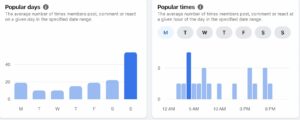
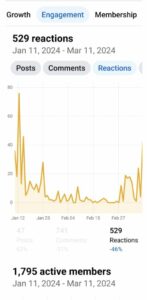
Source: KKC OZ & NZ Facebook group community March 20, 2024
The posts cover a wide range of topics, from asking questions about the restaurant’s recommendations and getting advice to sharing information and updates on immigration laws, as well as family matters. Members who engage in meaningful interactions and actively participate in this virtual environment have the opportunity to foster deeper connections, share insights, and seek support from a diverse and empathetic community, such as assistance with domestic violence, language barriers, further study for mature students, or even looking for anyone to have a coffee with. Although disagreements and quarrels occasionally occur, administrators always act wisely, concluding the discussion by summarising the answers and closing the commenting section before it escalates to online bullying.
Hampton & Wellman (2018) mention in their essay that “failure and strength are inherent in every form of community.” Therefore, despite the KKC OZ-NZ members’ establishment of a supportive and inclusive space where they can connect, learn from each other, and navigate the unique challenges and joys of cross-cultural relationships, the group still experiences drama. As a result, the administrators constantly monitor the group to act as moderators and as needed.
TACKLING THE LANGUAGE BARRIER
Although Australia is Indonesia’s neighbour, many Indonesians are still surprised by Australian English, especially its accents and slang. Generally, the problem does not lie in communicating with their partners, as numerous Australians possess fluency in Bahasa Indonesia or possess the ability to comprehend their partner’s limited English; presumably, some Indonesians grew up learning American English. Nevertheless, the Australian slang is confusing for some, and yet, the process of navigating the Australian bureaucracy to meet the visa criteria for a partner’s English is significantly different from Australian daily slang. For example, in Australian English, tea would mean dinner. Although Indonesia has had an English curriculum in junior high school (year 7) since 1967 (Isadaud et al., 2020), in their article, Isaadaud et al. (2020) explained that many Indonesians do not take English class seriously for some reasons, such as low interest, too hard to learn, complicated pronunciation of the vocabulary, or a lack of a competent English teacher. Since 2013, English has only been a compulsory subject in early education at year one primary school (Azmy, 2020). Therefore, the language barrier for Indonesians, from baby boomers to Gen Z, where most members of the KKC OZ-NZ are, may be a prevalent issue.
Having children in a multilingual household is another major issue. This is especially true when their children are on the verge of developing English reading skills. Teaching their children to read in English will be difficult for Indonesian parents who do not have experience learning English phonetics. In this case, they would ask if any member of the group had any tutor recommendations. In other cases, adults who have language difficulties are typically advised to take an extra English class as part of the Adult Migrant English Programme (AMEP) in TAFE, which is 100% subsidised by the government. Only individuals with firsthand experience are aware of this information, as it remains unpublicised. To conclude, the role of a Facebook group that provides guidance is critical in addressing these difficulties. KKC OZ-NZ members have the opportunity to exchange experiences, advice, and materials pertaining to language learning, cultural understanding, especially with local slang, and overcoming administrative obstacles by getting information from other members.
CONNECTING TO ONLINE IDENTITY AND ADVOCACY
The administrators have designated the group as a private community. To verify their authenticity and avoid engaging in marketing campaigns, fraudulent activity, or misinterpreting the group as a matchmaking community, individuals must answer certain questions when they try to join. Users must use their personal Facebook profile instead of their business account. However, using a pseudonym is allowed. Once they become members, they can post anonymously to protect their true identities as posters, preventing discrimination, humiliation, and bias on social platforms (Thorsen & Sreedharan, 2019). Despite all group members becoming accustomed to encountering identical posts, some individuals may be reluctant to share personal issues with unfamiliar people, particularly when their real photo serves as a profile on their Facebook page. Indonesia is a country with thousands of cultural, religious, and political views. The group has a membership of over two thousand individuals, all of whom share a common feature: they are Indonesian nationals who are married to partners from Australia or New Zealand.
In contrast, some members are proud of their identities and use their profiles to advocate for themselves as domestic violence survivors, single mothers, and partner visas’ advisors. Papacharissi (2016) characterises these online communities as affective, coming together over networks that are discursively constructed from mediated interactions, and they form and dissolve around sentimental relationships. Their participation as a group expert is extremely helpful to the community; by responding to the questions, they are able to provide answers from different perspectives, demonstrating cultural tolerance towards their partners. Some members with higher education and more experience frequently contribute educational resources about Australia’s laws and rights. Such as updating immigration’s regulations, the governments or non-government agencies that assist in domestic violence, the educational path for mature students, how to get the educational equivalency certificate in Australia, etc. Online engagements in the KKC OZ-NZ group community empower members to embrace their identities, cultivate self-acceptance, and advocate for inclusivity and social justice, both within the community and in a larger context. In general, this mixed-marriage Facebook group for Indonesians offers a platform for individuals to engage in the exploration, expression, and commemoration of their identities. Thus, it fosters a sense of community, mutual understanding, and empowerment.
LIFESTYLE ADJUSTMENT
Cultural adaptation is another challenge in a mixed-married household. Despite using the same technology in their respective eras, the upbringing of the Indonesian partners, who grew up in the eighties and nineties, would differ significantly from that of Australia. Jones et al. (2011) stated in their book that “the marriage between countries and regions and ethnic and socio-economic groupings within countries entails significant differences.” These differences appear to impact each family within the community, ranging from minor concerns like cleaning practices to managing financial issues. Most Indonesians who had never resided overseas prior to marrying their Australian partner encountered the unexpected impact of rising living expenses and their partner’s financial management. The group’s responses to these issues stem from mental support, sharing experiences, and education. Intercultural adaptation requires both parties to understand each other’s cultural practices (Holliday, 2021). The comments that come to respond about cultural adaptation issues are essentially identical: they all emphasise that it is important to establish mutual agreement in the household and demonstrate respect for diverse cultures in order to adapt to a new lifestyle while simultaneously embracing and preserving one’s own cultural heritage.
NETWORKING AND FRIENDSHIP
Members may encounter challenges related to economic, social, and cultural changes. This difference prompted the mixed-married couple to make their marriage work. While their Australian partners aim to create a comfortable space for their Indonesian partners to adjust their lifestyles, they may find it more comfortable to receive information from the Indonesian community, who can share their experiences. Although Facebook facilitates the initiation and maintenance of social interactions online and has become entrenched in the way emerging adults communicate today (Khalis & Mikami, 2018), it is undeniable that communication through digital media often lacks the cues inherent in face-to-face interactions (McKenna & Bargh, 2000), including but not limited to facial expressions, gestures, and vocal intonations. Miscommunications usually arise for those reasons. Therefore, members who live in the same region usually organise a meetup and create their own community. This community is a thicker relationship where individuals share private information like their phone number, address, and occupation and introduce their family to each other’s family (Dotson, 2017). Digital communication often lacks face-to-face cues, leading to misunderstandings, and some members need to create their own filter bubble. To address this, members who live in close proximity organise gatherings and create their own local communities where they have more similar interests, which then become friendships in real life.
CONCLUSION
A Facebook group that creates a little virtual community for Indonesians who marry Australian partners has been very helpful to its members in overcoming various multifaceted challenges, including differences in language barriers, children’s upbringing, and education in an English-speaking environment. While communication with partners is often manageable, cultural adaptation can also be challenging. To address these issues, many Indonesians are searching for a community that fits their requirements. The mixed matrimony community between Indonesians, Australians, and New Zealanders, known as KKC OZ and NZ, has proven to be an invaluable platform. By engaging in meaningful interactions and actively participating in the virtual environment, members can foster deeper connections, share experiences, and seek support from a diverse and empathetic community. The KKC OZ&NZ Facebook group, which serves as a digital bridge, connects members across time zones and distances, sparking friendships that blossom in real life.
REFERENCES:
Azmy, K. (2020). Examining the issue of abolishing English tuition in primary school in Indonesia. Language Research Society, 1(1). http://ejournal.president.ac.id/presunivojs/index.php/LARSO/article/view/47-57/577
Dotson, T. (2017). Technically together: Reconsidering community in a networked world.
Facebook Group [KKC OZ&NZ]. (2024, March 20). Facebook insight group activity peak time [Picture attached]. Facebook. https://www.facebook.com/groups/kkc.oz.nz/insights/?section=engagement
Facebook Group [KKC OZ&NZ]. (2024, March 20). Facebook insight group engagement traffic [Picture attached]. Facebook. https://www.facebook.com/groups/kkc.oz.nz/insights/?section=growth
Hampton, K. N. & Wellman, B. (2018). Lost and Saved . . . Again: The Moral Panic about the Loss of Community Takes Hold of Social Media. Contemporary Sociology, 47(6), 643–651. https://www.jstor.org/stable/26585966
Holliday, A. (2021). Intercultural communication: An advanced resource book for students. Routledge. https://doi.org/10.4324/9780367482480
Isadaud, D., Fikri, M. D., Bukhari, M. I. (2022, January 21). The Urgency of English in The Curriculum in Indonesia to Prepare Human Resources for Global Competitiveness. DIAJAR; Jurnal Pendidikan Dan Pembelajaran, 1(1), 51-58. https://doi.org/10.54259/diajar.v1i1.177
Jones, G. W., Leng, C. H., & Mohamad, M. (2009). Preface. In G. W. Jones, C. H. Leng, & M. Mohamad (Eds.), Muslim-Non-Muslim Marriage: Political and Cultural Contestations in Southeast Asia (pp. vii–viii). introduction, ISEAS–Yusof Ishak Institute.
Khalis, A., & Mikami, A. Y. (2018). Talking face-to-Facebook: Associations between online social interactions and offline relationships. Computers in Human Behavior, 89, 88-97. https://doi.org/10.1016/j.chb.2018.07.033
McKenna, K. Y., & Bargh, J. A. (2014). Plan 9 from cyberspace: The implications of the Internet for personality and social psychology. In Personality and social psychology at the interface (pp. 57-75). Psychology Press.
Pages, M. (2020, Mar 7). The History of Facebook Group. Online Group Success. History of Facebook Groups – Online Group Success
Papacharissi, Z. (2016). Affective publics and structures of storytelling: Sentiment, events and mediality. Information, communication & society, 19(3), 307-324.
Thorsen, E., & Sreedharan, C. (2019). #EndMaleGuardianship: Women’s rights, social media, and the Arab public sphere. New Media & Society, 21(5), 1121–1140. https://doi.org/10.1177/1461444818821376
Voss, D. D., [Facebook Group KKC OZ&NZ]. (2024, March 20). Polling: Biggest challenge married to OZ/NZ partners. Facebook. https://www.facebook.com/groups/kkc.oz.nz
Zuckerberg, M. Facebook [Mark Zuckerberg]. (2021, May 5). Building Global Community. Facebook
Conference Paper© 2024 by Des is licenced under CC BY-NC 4.0 


Leave a Reply
You must be logged in to post a comment.