Assignment #1
Title: Conference Paper
| Name: | Stephen Bain |
| Student Number: | 21231564 |
| Unit Name: | NETS2002 Social Media, Communities and Networks |
| Email Address: | stevebainozbass@hotmail.com |
| Date Submitted: | 10 April 2023 |
| Word Count: | 2183 words |
I declare that I have retained a copy of this assignment. I have read and understood Curtin University policies on Plagiarism and Copyright and declare that this assignment complies with these policies. I declare that this assignment is my own work and has not been submitted previously in any form for assessment.
Stephen Bain 10 April 2023
(Date/Signature)
(Typing your name in the space provided is sufficient when
submitting online via FLECS-Blackboard.)
Bain – The Lionfish Invasion on Facebook PDF
ENVIRONMENTAL ADVOCACY IN A WORLD OF COMMUNITIES WITHIN SOCIAL MEDIA
Abstract: This paper is a case-study of the social media interactions around the ‘lionfish invasion’ of the Atlantic Ocean. In examining Facebook groups engaged in studying the lionfish invasion(s), it is discerned that citizen-scientist activation and interactions with resource managers and/or wildlife-managers/scientists utilise the platform’s affordances to create a third-place where a networked-public operates in a public-sphere. This public-sphere discourse enables knowledge-transfer and online-promoting of management activities as well as valuable provable data-collection while countering misinformation. Real-world examples, obtained by online-observation of the network-publics, are used alongside the case-study to highlight scenarios where practical applications are generating positive outcomes for community understanding, involvement and resource management. Definitions determined by literature review of peer-reviewed scholarly texts have been used as benchmarks in order to determine and confirm that the citizen-science/resource-manager interactions can function as a networked-public within social media such as Facebook.
The internet’s social media have changed the way the networked world communicates. This spawned opportunities for public sphere discussion and knowledge exchange between ‘subject-matter-experts’ and engaged citizens which ultimately form networked publics online. These groups also present opportunities for citizen recruitment in support of resource-manager and academic/scientific focused environmental advocacy. This paper reviews the nomenclature used, explores fundamentals of risks associated with social media use, and details a specific-scenario case-study of social media’s use in knowledge-distribution/citizen-data exchange for environmental stewardship. This case-study is based on the ‘lionfish invasion’ of the Atlantic Ocean(s). Facebook is a third-place where wildlife-conservationists/scientists and resource-managers strategise to form a networked public with citizen-scientists to exchange knowledge and data, counter hate-mail and misinformation, advocate environmental endeavours to combat the impacts of invasive lionfish.
While some definitions are not necessarily robust, this paper considers networked publics to be sub-sets within a broader online community (Wellman, 2001). These sub-sets are themed around belonging to a refined common interest and/or geographical location. The community today (Delanty, 2003) is bounded by the regular ‘everyday’ reach, which, in the case of the internet, is global. A networked public is one that bonds together on a specific interest, often for either professional or altruistic intent. In the case of environmental scientists and activated citizens, the community presents as the inter-continental umbrella of those wishing positives for the environment. Nestled within such a community exists issue-specific networks. In this paper the case-study issue-specific network incorporates idealistically networked-selves (Papacharissi, 2010) actively campaigning on Facebook/Meta for the management of lionfish that are impacting outside of their endemic range. This paper leverages off Langlais and Vaux (2022) in identifying Facebook as a third space, rather than home and office, being a social networking site (SNS) that facilitates communities and networked publics. For this paper, Facebook the third place, is a come-and-go-as-you-please where knowledge/data exchange (Hwang & Krackhardt, 2020) takes place between citizens and research-scientists/resource-managers.
Users of social-media/SNS as a networked public, need to proactively manage the online public sphere in order to maintain the intent of the(ir) project(s). Two of the more serious risks/issues associated with social media use, particularly with respect to the use of culling within environmental management, are misinformation and hate-speech. These are best proactively risk-managed to maintain the support of the wider public. In-turn this popularity generally garners grass-roots political support, resulting in increased conservation funding and policy reviews. Misinformation and hate-speech are symptoms of deeper considerations including confirmation bias. This sees people interpretating and then distributing information to support their current/required belief(s) and/or emotions.
Examples are the public-sector reactions to the management of wide-ranging environmental damages by another invasive species, that being cats Felis catus, to the natural environment (Callen et al., 2020; Hayward et al., 2019). This environmental damage is a concern the world over (Legge et al., 2017), with feral cats responsible for increased high-risk threat of extinction in up to a third of non-volant mammals in Australia (Radford et al., 2018). Yet out of necessity, many cat supporters harbour emotion-based beliefs contrary to management projects, often distributing misinformation, even when facts are presented (Wald & Jacobson, 2014). The extremely passionate may resort to law-breaking hate-speech and threats. Unfortunately, this confirmation bias which can lead to counter-measures such as the aforementioned distributing misinformation, can result in the avoidance of some of the tough-topics by environmental managers.
In an extension of bias, the considered use of imagery can have positive outcomes (Huddy & Gunnthorsdottir, 2000). Extrapolating, inclusion of confronting imagery may have a negative effect. This includes images of ‘weapons’ use. Thus, adding risks that some viewers will reject environmentally-beneficial activities purely on the grounds of the methodology being against their beliefs/opinions. An example is killing/culling involving guns/spearguns, where the vocal public is often anti-firearm/weapon. In this case of cognitive and confirmation biases, the activist-public may campaign against the environmental management project for fear that it justifies firearm/weapon ownership. Significantly, imagery can be used to ‘tug-at-the-heart-strings’ in order to quickly get the public onside, even without the use of words (Nicholson-Cole, 2005). Further examples of misinformation generation occur when high-profile personalities post-images on SNS. Images of them interacting with ‘cute’ animals sways public opinion, potentially leading to misunderstandings on how wild animals can be addressed (Bergman et al., 2022). For these reasons, images posted onto social media need to be critically assessed prior to publication. The aim is to not offend susceptible viewers, instead to portray appropriate visual messaging and conduct towards a positive outcome in support of a project’s intent/mission.
Bergman et al. (2022) use a case-study to highlight that citizen-scientist collaboration need not be scientific in nature. In the case-study, scientist-based management organisations successfully magnified benefits by using social media including Facebook and others to share information about and advertise/promote targeted lionfish culling events. Simply by the scientists ‘liking’ and posting approving comments, readers concluded that the activities were acceptable. Large quantities of approvals generate a mimicry/echo chamber effect. Lionfish culling derbies are examples of face-to-face activities where social media posts encourage participants to take part – more on this later. Bergman et al. (2022) purport when managed well, social media can be used to stimulate positive conservation conduct within a site’s networked public. Focusing on presenting and distributing conservation knowledge through social media (e.g., rescue avenues, biology, negative impacts and image-supported education) promotes public sphere recognition on environmental conservation (Wu et al., 2018). The positive outcomes of social media interaction-forming networked publics on high-reach platforms like Facebook are founded on the exchanges of scientists’ knowledge for citizen-contributed-data. Pro-active awareness of negative risks and risk-minimisations to avoid pitfalls, generate force-multiplier effects within communities towards conservation endeavours including affording collaboration on projects and events (Kaplan & Haenlin, 2010). Multiplication of benefit-for-effort can also be generated by linking to co-dependent topics on other sites and platforms. An example is the Garden Bird Survey (GBS) Community of Practice as a Facebook Group in New Zealand; although the GBS runs only 9 days per annum, the GBS community links and contributes to other bird counts, disease observations and Landcare research activities such as depicted on the website www.landcareresearch.co.nz (Liberatore et al., 2018). Another scenario to manage on SNS by maximising education, occurs due to cognitive dissonance, when conflicts of opinion, conduct or beliefs threaten to undermine/factionalise the bonds within the community and its networked public(s). This dissonance can be a result of introduction of controversial concepts and/or changes in approach (Akpan et al., 2018).
The lionfish’s invasion into non-endemic environments, has been well managed on social media, particularly on Facebook. This presents as an ideal case-study into uses of SNS for scientist-citizen interaction with the purpose of education into and addressing of environmental issues. Understanding the methodologies used for both, citizen interaction as well as building of the online networked publics within the communities as a third- place, informs future environmental resource management endeavours.
Image
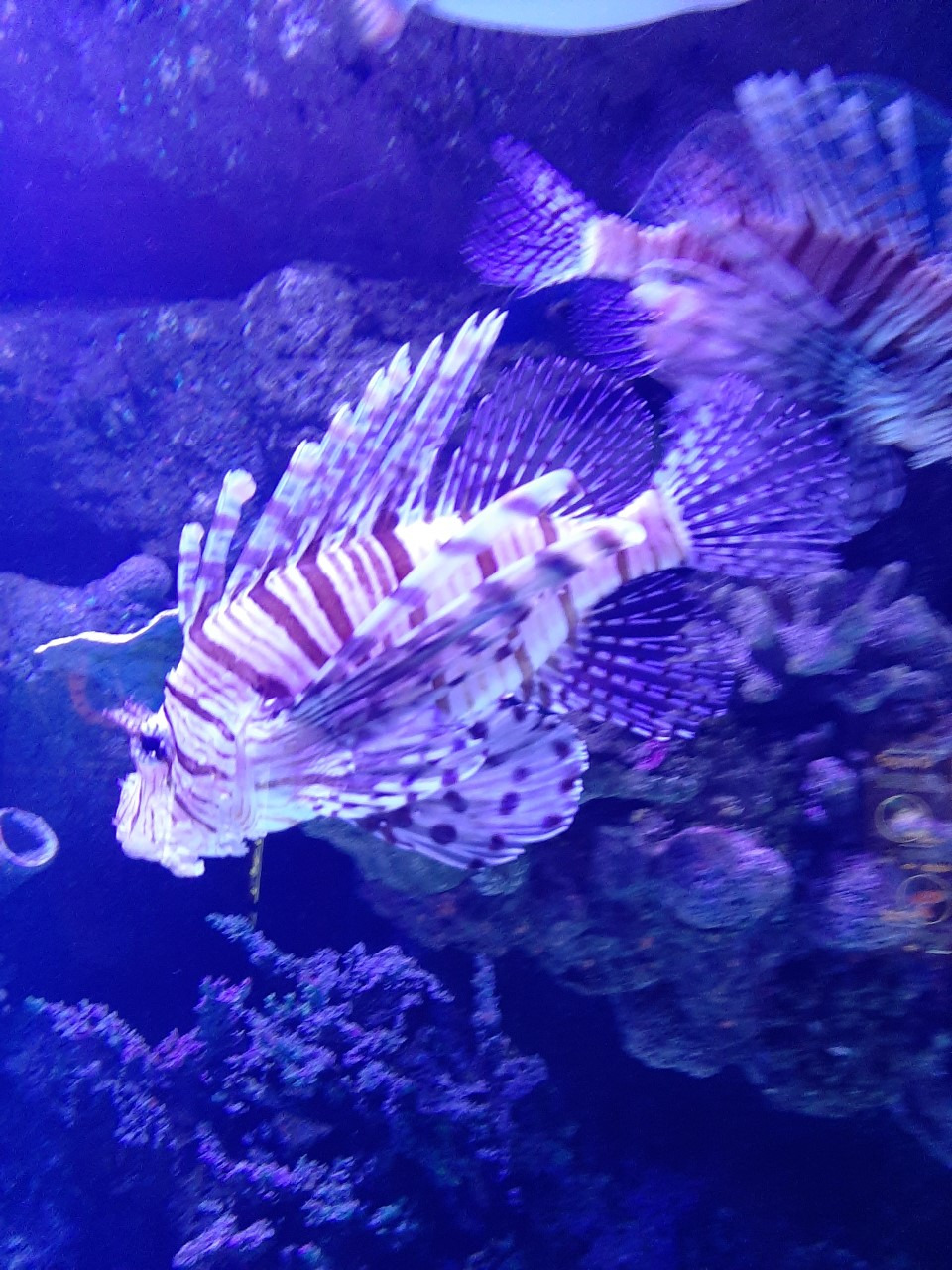
Lionfish (aka, Firefish) Photo Credit: Bain Collection Cairns 2023
An important aspect of the information is observed in the knowledge transfer relating to the question, How did the many sub-species of the venomous-spined lionfish (Wilcox et al., 2017) including Ebosia bleekeri, Dendrochirus zebra, Pterois radiata, Pterois volitans, and Pterois miles (Atlas of Living Australia, 2023a) become “what is likely the most damaging marine fish invasion to date globally” (Hixon et al., 2016, p. 161)? Endemic to Indo-Pacific oceans, including at-least sub-tropical and tropical Australia, lionfish have spread across the Atlantic and into the Mediterranean Sea (Wilcox et al., 2017; Bariche, 2017). Although mostly unconfirmed, various hypotheses exist for their spread, including potential intentional release (National Oceanic and Atmospheric Administration, 2023), accidental aquarium/aquarium-trade release as well as possible transference via ship bilge/ballast waters (The Fisheries Blog, 2013), and/or DNA-analysis supported invasion via Suez Canal (Bariche, 2017). Further what consequences require publication? Once established outside of their endemic range, lionfish have few known predators and local prey have not adapted their defences to this new threat. Hence resource managers highlight that the issue is multi-fold, including lionfish predating on ‘natural’ locals.
Affordances of social media sites facilitate distribution and discoverability of knowledge amongst a networked public. Abidin (2021) describes the characteristics of a networked public as initially being platform-based with scalable engagement utilising the framework and affordances of the platform. In relation to lionfish environmentalism, the affordances include the searchable hashtags, #lionfish, #lionfishhunting and #lionfishbrigade, inter-platform linking/cross-referencing, and website-hyperlinking on/from the platform Facebook such as lionfishcaribbean.com being linked from the Facebook page https://facebook.com/lionfishcaribbean/ (Lionfish Caribbean, 2023). This link takes users to an education/knowledge website with a focus on sustainably using culled lionfish as a food source. Others also promote the use of lionfish as a commercial food source (DeLello, 2021). Educating the public sphere that lionfish fillets are safe to eat, because the toxin comes from the spines not the fish flesh, has informed their use as food source and has addressed many potential negatives that may be touted against their harvesting. The messaging is, from a resource management perspective, based on the criteria of sustainability being that the natural resource is not fished below sustainable levels, these lionfish are a sustainable source of nutrition from the ocean. This is because they are not a natural/endemic resource in the locations where the lionfish is targeted for culling. The promotion of food use on SNS counters possible criticisms from many activists and is likely to result in activists leaving lionfish-culling alone and thus moving on to ‘easier’ targets. Other links take users to government and/or scientific websites. These links are used by scientists and [their] official organisations to ensure that accurate information is readily available in order to minimise/address misinformation. One such site of misguidance is the aquarium focused website Lionfish Lair (Lionfishlair, 2023). On this site pursuing lionfish as pets in locations outside of their endemic range is promoted as a good thing. This site omits to discuss that potentially the spread of lionfish into non-endemic waters has been caused by releases from aquariums by ‘keepers’ who do not wish to kill their pet when it outgrows/outeats its tank. Accordingly, the scientist-citizen networked public have populated warnings on aquarium releases onto social media and via links from social media, including Facebook, to scientist/resource-manager supported knowledge websites. These activities increase discoverability of lionfish knowledge and publicise management activities, for example #lionfishderby and cross-reference to other platforms like @reef-org on Instagram. Reef Guardians British Virgin Islands, a group of citizen environmentalists supported by resource managers, the British Virgin Islands Ministry of Natural Resources, on their Facebook page provide education on lionfish trapping techniques as developed by research scientists. This communication, focusing on social exchanges centred around common-interest science knowledge-transfer demonstrates the working(s) of a networked public as described by Lindgren (2013).
In August 2018, a post on Facebook flagged the identification of a lionfish in waters off Egypt’s Mediterranean Sea coastline. Ensuing social media discussion online created awareness and built a knowledge-hungry network. A valuable citizen-scientist data set was achieved when additional photographically-supported sightings were added to the group, as well as informative commentary on the methods of capture, locations and positive promotion of edibility (Al Mabruk et al., 2020). In a broader ‘all-species’ context, the Atlas of Living Australia’s (ALA), an Australian government supported, non-governmental organization uses Facebook to connect with citizen scientists for their ‘ReefBlitz’ activity (Atlas of Living Australia, 2023b). This activity is linked between the ALA website and Facebook groups and trains citizen-science-contributors and integrates with the iNaturalist App (Atlas of Living Australia, 2022). ALA also tracks lionfish in their endemic ranges. It appears that linking to and/or providing knowledge and education is a fundamental activity to professionals building citizen-professional networked communities on/via SNS. This recording and transfer/accessibility of data/information is described respectively by the terms ‘persistence’ and ‘searchable’ in a networked public (Abidin, 2021). From the examples discussed in this paper, it is clear that citizen-science/resource-manager online-communities operate as a networked public on the Facebook platform.
Citizen-scientists contributions in the public space have become very important to the development of environmentally astute communities and acceptance/uptake of environmental policy change. The importance of citizen scientists is highlighted by Clements et al. (2021) advising that the research and management of non-endemic Indo-Pacific lionfish is beyond the resources of established agencies. Approaches to engagement between formal research/management agencies and citizens to form networked publics/communities, includes convergence of smartphones, software and social media such as Facebook/[Meta] groups. Importantly this facilitates positive outcomes in overcoming limitations of funding and geographic coverage in the collection of data and management (culling/killing) of lionfish and other invasive species. These data sets are used by wildlife-conservation-scientists in their contributions to peer-reviewed scientific publications. Unfortunately, as mentioned earlier, barriers/risks to citizen-scientist collaboration exist, including hate-mail/posts and misinformation. This, at times, leads to scientists opting out of SNS environments, retreating to closed-networks of scientific peers. However, in order to address these negatives in the public sphere, so as to reassure public and political support, re-engagement with social media, including Facebook, is necessary. To re-engage, scientists may contract consultant-advisors in order to avoid downfalls and address issues of negative publicity. After trialling a variety of sites, Facebook’s greater public reach and nature of engagement has proven ideal and superior for online-community citizen/scientist collaboration (Hunter, 2020). The immediacy of inter-scientist and audience education-interaction proves to be a significant benefit to identifying misunderstandings and management of misinformation. Forrester et al. (2021) analysed Facebook posts/interactions and noted that citizen-scientists were collecting valuable data on lionfish distributions, quantities and behaviour responses to culling. In turn wildlife-conservation subject-matter-experts (SME) provided education in the form of and guidance in research procedures and culling methods. Again, this appears to be the successful paradigm employed for the use of SNS in generating positive outcomes for the environment via the use of social media and its networked publics. The benefits continue; culling discourses on social media have resulted in iterative collaborations towards technique refinements as well as informing concentrations of effort, subsequent monitoring and encouraging informed ecotourism. These positive outcomes are achieved by educating knowledge-hungry networked-publics using pro-active educational interactions and promotion of face-to-face activities via social networks.
In conclusion, this paper shows that networked publics on SNS have led to opportunities for public sphere discussion and knowledge exchange between SME and engaged citizens. These groups also present opportunities for citizen recruitment in support of resource-manager and academic/scientific-focused environmental stewardship. Fundamentals of risks associated with generic social media use, were explored and addressed. As well a specific-scenario case-study of Facebook’s use in knowledge-distribution/data-exchange for environmental stewardship regarding combating the ‘lionfish invasion’ was analysed. Ultimately this paper determined that wildlife-conservation SME’s provision of education and guidance in research procedures and culling methods, alongside concurrent risk-management, in exchange for citizen-generated-data, forms a successful paradigm for the use of SNS in generating positive outcomes for environmental advocacy and research advancement.
References
Abidin, C. (2021). From “networked publics” to “refracted publics”: A companion
framework for researching “below the radar” studies. Social Media+ Society, 7(1), https://doi.org/10.1177/2056305120984458
Akpan, J., Beard, L., & Notar, C. (2018). Cognitive Dissonance: The bane of value
systems. International Journal of Social Science and Business, 3(1), 1–5.
http://www.ijssb.com/images/vol3.no.1/1.pdf
Al Mabruk, S., Rizgalla, J., Giovos, I., & Bariche, M. (2020). Social media reveals
the first records of the invasive lionfish Pterois miles (Bennett, 1828) and parrotfish Scarus ghobban (Forsskål, 1775) from Egypt (Mediterranean Sea). BioInvasions Records, 9(3), 574-579. ,
https://doi.org/10.3391/bir.2020.9.3.13
Atlas of Living Australia. (2022, May 31). Networking, discussion and basic
training for World Ocean Day Reef Blitz between 1 and 8 June using
iNaturalist [event notification]. Facebook. https://www.facebook.com/events/490688616140592
Atlas of Living Australia. (2023a). https://bie.ala.org.au/search?q=lionfish
Atlas of Living Australia. (2023b). Australian Citizen Science Project Finder
Project Finder | Australian Citizen Science Project Finder (ala.org.au)
https://biocollect.ala.org.au/acsa#isCitizenScience%3Dtrue%26projectId%3D742%208a0f1-25a9-4faa-8af4-%20e0345a9f2249%26max%3D30%26sort%3DdateCreatedSort
Bariche, M., Kleitou, P., Kalogirou, S., & Bernardi, G. (2017). Genetics reveal the
identity and origin of the lionfish invasion in the Mediterranean Sea.
Scientific reports, 7(1), 1-6. doi: 10.1038/s41598-017-07326-1
Bergman, J., Buxton, R., Lin, H., Lenda, M., Attinello, K., Hajdasz, A., Rivest, S., Tran
Nguyen, T., Cooke, S., Bennett, J., Clements, J. (2022). Evaluating the benefits and risks of social media for wildlife conservation. Canadian Science Publishing Facets, 7(1), 360-397. https://doi.org/10.1139/facets-2021-0112
Callen, A., Hayward, M. W., Klop-Toker, K., Allen, B. L., Ballard, G., Beranek, C. T., …
& Wüster, W. (2020). Envisioning the future with ‘compassionate conservation’: An ominous projection for native wildlife and biodiversity. Biological conservation, 241, https://doi.org/10.1016/j.biocon.2019.108365.
Clements, K. R., Karp, P., Harris, H. E., Ali, F., Candelmo, A., Rodríguez, S. J.,
Balcázar-Escalera, C., Fogg, A. Q., Green, S. J., & Solomon, J. N. (2021). The Role of Citizen Science in the Research and Management of Invasive Lionfish across the Western Atlantic. Diversity, 13(12), 673.
https://doi.org/10.3390/d13120673
Delanty, G. (2003). Community – Virtual community: belonging as communication (3rd
ed.). Routledge. https://doi.org/10.4324/9781315158259
DeLello, S. (2021, October 21). This was test number three in Belize: … of the
Lionfish Purse trap developed by Dr Steve Gittings of NOAA. ReefSave.org is a public charity working to teach and train fishers in the affected areas to profitably harvest the invasive lionfish to sell as food for humans [status update]. Facebook. https:/www.facebook.com/groups/reefguardiansbvi/
Forrester, G., Dzilenski, K., & Gleeson, D. (2021) Use of social-media networking
to facilitate a grass-roots lionfish removal program in the British
Virgin Islands. Management of Biological Invasions, 12(2): 420–440, https://doi.org/10.3391/mbi.2021.12.2.14
Hayward, M. W., Callen, A., Allen, B. L., Ballard, G., Broekhuis, F., Bugir, C., … &
Wüster, W. (2019). Deconstructing compassionate conservation. Conservation Biology, 33(4), 760-768. https://doi.org/10.1111/cobi.13366
Hixon, M., Green, S., Albins, M., Akins, J., & Morris, J. (2016). Lionfish: A major
marine invasion. Marine Ecology Progress Series, 558,
161-165. DOI:10.3354/meps11909
Huddy, L., & Gunnthorsdottir, A. (2000). The persuasive effects of emotive visual
imagery: Superficial manipulation or the product of passionate reason?. Political Psychology, 21(4), 745-778. https://doi.org/10.1111/0162-895X.00215
Hunter, P. (2020). The growth of social media in science: Social media has
evolved from a mere communication channel to an integral tool for discussion and research collaboration. EMBO Rep, 21(5), 1-3.
doi: 10.15252/embr.202050550.
Hwang, E., & Krackhardt, D. (2020). Online Knowledge Communities: Breaking or
Sustaining Knowledge Silos?. Production and operations management, 29 (1), 138-155. https://doi.org/10.1111/poms.13098
Kaplan, A., & Haenlein, M. (2010). Users of the world, unite! The challenges and
opportunities of Social Media. Business horizons, 53(1), 59-68. https://doi.org/10.1016/j.bushor.2009.09.003
Langlais, M., & Vaux, D. (2022). Establishing and Testing a Quantitative Measure for
Evolving Third-Place Characteristics. International Journal of Technology and Human Interaction (IJTHI), 18(1), 1-15. http://doi.org/10.4018/IJTHI.293201
Legge, S., Murphy, B., McGregor, H., Woinarski, J., Augusteyn, J., Ballard, G., Baseler,
M., Buckmaster, T., Dickman, C., Doherty, T., Edwards, G., Eyre, T., Fancourt, B., Ferguson, D., Forsyth, D., Geary, W., Gentle, M., Gillespie, G., Greenwood, L., Hohnen, R., Hume, S., Johnson, C., Maxwell, M., McDonald, P., Morris, K., Moseby, K., Newsome, T., Nimmo, D., Paltridge, R., Ramsey, D., Read, J., Rendall, A., Rich, M., Ritchie, E., Rowland, J., Short, J., Stokeld, D., Sutherland, D., Wayne, A., Woodford, L., Zewe, F. (2017). Enumerating a continental-scale threat: How many feral cats are in Australia?. Biological Conservation, 206, 293-303. https://doi.org/10.1016/j.biocon.2016.11.032
Liberatore, A., Bowkett, E., MacLeod, C.J., Spurr, E. and Longnecker, N. (2018). Social
Media as a Platform for a Citizen Science Community of Practice. Citizen Science: Theory and Practice, 3(1), 1–14, DOI: https://doi.org/10.5334/
Lindgren, S. (2013). SubCulture: Exploring the dynamics of a networked
public. Transformative Works and Cultures, 14(14), 46. https://doi.org/10.3983/twc.2013.0447
Lionfish Caribbean. (2023). www.facebook.com/lionfishcaribbean/
Lionfish Lair. (2023). https://lionfishlair.com/facts-about-lionfish/
National Oceanic and Atmospheric Administration. (2023). Why are lionfish a
threat to Atlantic Ocean fish? (noaa.gov).
https:/oceanservice.noaa.gov/facts/lionfish.html
Nicholson-Cole, S. (2005). Representing climate change futures: a critique on the use of
images for visual communication. Computers, Environment and Urban Systems, 29, 255–273. https://doi.org/10.1016/j.compenvurbsys.2004.05.002
Papacharissi, Z. (2010). A networked self: Identity, community, and culture on social
network sites. Taylor & Francis Group.
https://ebookcentral.proquest.com/lib/curtin/detail.action?docID=574608.
Radford, J., Woinarski J., Legge, S., Baseler, M., Bentley, J., Burbidge, A., Bode, M.,
Copley, P., Dexter, N., Dickman C., Gillespie, G., Hill, B., Johnson, C., Kanowski, J., Latch, P., Letnic, M., Manning, A,, Menkhorst, P., Mitchell, N., Morris, K., Moseby, K., Page, M., Ringma, J. (2018) Degrees of population-level susceptibility of Australian terrestrial non-volant mammal species to predation by the introduced red fox (Vulpes vulpes) and feral cat (Felis catus). CSIRO Wildlife Research 45, 645-657. https://doi.org/10.1071/WR18008
The Fisheries Blog. (2013). The Fate of Released Aquarium Fish.
https://thefisheriesblog.com/2013/08/26/the-fate-of-released-aquarium-fish/
Wald, D., & Jacobson, S. (2014). A multivariate model of stakeholder preference for
lethal cat management. Plos one, 9(4), 1-9.
https://doi.org/10.1371/journal.pone.0093118
Wellman, B. (2001). Physical place and cyber place: The rise of networked
individualism. International journal of urban and regional research, 25(2), 227-252. DOI:10.1111/1468-2427.00309
Wilcox, C., Motomura, H., Matsunuma, M., & Bowen, B. (2017). Phylogeography
of lionfishes (Pterois) indicate taxonomic over splitting and hybrid origin of the invasive Pterois volitans. Journal of Heredity 109, 162–175. https://doi.org/10.1093/jhered/esx056
Wu, Y., Xie, L., Huang, S., Li, P., Yuan, Z., & Liu, W. (2018). Using social media to
strengthen public awareness of wildlife conservation. Ocean and Coastal Management 153, 76–83. https://doi.org/10.1016/j.ocecoaman.2017.12.010


Hi L, The thing is the paper is mainly concentrated on the African continent particularly.If you make an analysis of…