Question – What role has social media played in the development and spread of the body positivity movement for curvy women, from its origins in the streets of New York to the Instagram community?
Theme – Communities and Social Media
Pdf Version – Kangalee_20397737_Conference_Paper
Abstract –
This conference paper will examine why plus-size women are migrating to Instagram. By deconstructing Western beauty standards, the social media platform has been encouraging women to embrace their curves and spread body acceptance. It will concentrate on the social media hashtags #effyourbeautystandards and #BOPO to provide a short history of the body positivity of women with curves and its shift to Instagram. Both hashtags will show how the body positivism shift has maintained its original goals despite globalisation and will spread its message of acceptance on Instagram’s powerful and shared platform with the help of influential individuals who have a beneficial impact on the curvy women’s society and the digital viewers opinions regarding the “fat” community. This paper will examine how Instagram influencers who use hashtag activism to spread encouraging messages about body image utilise stories to document their lives and bring together a diverse online community through shared experiences. Instagram is portrayed in this research as a platform that facilitates the formation of online identities for curvy women through the normalization of the uncommon body type within positive body image societies.
—
Feminine beauty is a culturally established belief that emphasizes women’s attractiveness in appearance as a virtue they should work to cultivate and display. Charles Dana Gibson’s depiction of the “Gibson Girl” as the ideal American lady in 1890 became the dominant definition of beauty in the United States and worldwide (Simon & Mamp, 2020). The fat, the black, the sex-oppressed, and other populations of women were subjected to prejudice, stereotypes, and mistreatment as a result of this doctrine of perfection. The initial acceptance of Fat organization, now known as the ‘‘National Association to Advance Fat Acceptance’’ (NAAFA), was established in the United States in 1969 by Bill Fabrey, whose obese spouse had been the target of prejudice and discrimination. (Cooper, 2016). Through protests in the streets of New York, the fat rights movement, which grew steadily from the 1970s to the 1990s (Stürmer et al., 2003), helped disseminate liberal ideas across the country. In contrast to the current NAAFA movement, which only advocates for overweight and obese people, body positivism emerged in the 2000s as an organization that unites all body types to celebrate body hair, colour discrimination, normalizing scars and physical traits.
Social networking sites like Instagram, which take a method that is more democratic than their rivals, have provided an arena for the body positivism campaign to project the national worldwide movement into globalisation. Instagram allowed for a wide spectrum of beauty than old media such as articles, magazines, or radio by introducing new forms of content created by users such as sharing photos, stories, or videos, stories (Webb et al., 2017). However, an Instagram’s global audience be persuaded to embrace a more curvaceous body type? This paper will argue that Instagram, despite the controversy surrounding the curvy body image, is a powerful tool that favourably affects women’s identity by limiting the pressure women feel to conform to Western society’s beauty ideal, the Gibson Girl. Therefore, Instagram facilitates curvy women’s internet identity formation through the normalization of uncommon silhouettes through its body positivism groups. This is accomplished via the efforts of endorsed advocates and the dissemination of branded hashtags on relevant social networking platforms. Hashtag activism is shaping the future of protests around the world by bringing important economic, political, and social issues to the forefront of the mainstream media. Before, the world of the internet was the primary medium for both the propagation of body shame and the promotion of body positivity. The fat activism community, which had been growing online since the 1990s message boards, has kept doing so through social media. Hashtags are prefixed with the # symbol and used to not only commemorate an occurrence or express an emotion, but also to swiftly and efficiently locate relevant information about current events (Tiggemann & Zinoviev, 2019). Hashtags have gone viral because they help content producers reach a target demographic with an identical interest in a particular topic; they can also be used to quickly indicate a subject, gather and disseminate data regarding that topic; and filter and streamline interactions during the process of searching. Referring to Figure 1 (see Appendix), the two most popular hashtags in favour of the curvaceous women’s movement are #BOPO (1.2 million posts) and #effyourbeautystandards (5 million posts). Images of empowered women posing with the captions #BOPO and #effyourbeautystandards have been shared widely online. These women’s physical size stands out from the norm because they are much bigger than the average woman depicted in the media. Instagram’s hashtags, a tiny but mighty tool that helps a photo stand out from the crowd of others by providing a unique identifier, are rallying curvy women to normalize the display of their curves in a bikini throughout the warmer months like other people and prompting the rest of the audience to be displayed to different body pictures.
The current flurry of body acceptance posts on Instagram has spawned a wave of body acceptance talk, indicating a discernible shift in the ‘Gibson Girl’ ideal in contemporary culture. With the help of brands like Dove, which encourages curvaceous females to personal brand their revolutionary individuality by celebrating their “authentic exquisiteness” and advocating for freedom instead of standardizing and embracing the curvy women movement has drawn attention and built their Instagram circle with the general population and broken down societal body image requirements in the process (Murray, 2013). According to Chamberlain (2017, as cited in Ford, 2021), Instagram has become a hub for the plus-size community, serving as an activism tool for promoting body acceptance that can quicken up engagement and give voice to the marginalized and stereotyped fat women who are looking for internet equity through the power of storytelling. In order to demonstrate, depict, and assess a call to action on Instagram, the ideal blend of storytelling and hashtags was required. Sharing their stories of discrimination and calling for change through campaigns for fairness and amends was what finally pushed the curvy women into action. The body positivity movement uses participatory culture to forge stronger ties to their virtual communities and effect positive societal change (Canella, 2017). Cultural participation was facilitated within the organization by the use of stories. This proves that groups on Instagram engage in a deliberate strategy to influence and normalize the appearance of bodies. The worldwide web audience finds it simple to engage in either passive or active participation in the body positivity campaign because videos and photos that have been assigned a specific tag are assembled with comparable aspects. This led to increased confidence in one’s body and appreciation for oneself among curvaceous and apprehensive women, who view the opinions of others as a validating or approving truth in the construction of their body perception (Webb et al., 2017). Instagram’s openness and global reach make it a great place for people with similar interests and goals to connect and share content related to curvaceous body positivity and related topics. Women’s confidence in discussing and seeking help for issues like body shaming and prejudice, as well as feeling like part of a group, has increased alongside the popularity of genuine curvy content and the process of learning toward embracing one’s own body (Paraskeva at al., 2017).
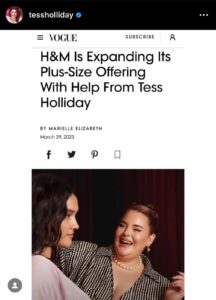
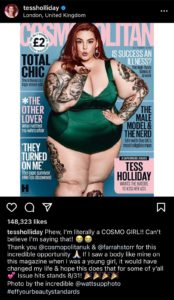
The internet-based curvaceous Influencers established a third place by creating a supportive environment and encouraging others to appreciate and embrace their unique beauty. In the past, Western cultures associated a corpulent physique type with a lack of care and cultivation, both of which were seen as unattractive. (Murray, 2004). But nowadays, influencers on Instagram are encouraging curvaceous women in the bodily image by posting videos and images using newly significant hashtags, such as showcasing their generous curves, donning the most recent plus-sized fashion trend, and advocating positive body image. Tess Holiday, an American model has been the driving force behind the movement to “effyourbeautystandards” since its inception in 2013. She has 2.6 million followers as she is not afraid to show off her curvy figure, which is not considered attractive by Western ideals. Tess called herself a campaigner for body positivity who celebrates her “fatty” physique and promotes self-acceptance for females of all sizes. Holiday’s Instagram profile exemplifies social media hybridization because of its robust and spontaneous community on the internet. She has made use of both more conventional means of contact, like TV and radio interviews, and more modern ones, like instant messaging and video documentation of her day-to-day life. She uses relatable tales from her own life to discuss the challenges that all plus-size women face. This exemplifies how the physique positivist community has strategically positioned a body-positive activist to highlight the reliability of body-positive affirming messages throughout Instagram by highlighting the challenge of being “fat” while continuing to pursue the life of your dreams. Thanks to Instagram, Holiday was able to spread her message that women with curves, who are often stigmatized because of their size, ought to attempt to alter beauty standards by establishing their own terms and making waves in the dynamic fashion sector. (Holiday, 2020). All over the globe, women face injustice and stereotypes. By spreading the testimonies and judgments of curvaceous women, Holiday hopes to offer advice and assistance to these women. Instagram’s accessibility among celebrities and the virtual general population bolstered female connections that created network uniqueness and supported the curvy revolution. Holiday has worked with top brands such as H&M, which is increasing its plus-size offering and has even been featured on the cover of Cosmopolitan magazine (Figure 2). She shattered the general audience and celebrity barriers and normalized viewing the ‘fat’ figure without criticism or discrimination.
When it comes to promoting body positivity, body acceptance, and the acceptance of differences, Instagram influencers are a potent force (Langer & Perez-Moreno, 2020). Everybody, not just curvaceous females, is subjected to a wide variety of body positivity-related goals, and each person can create a presence within the virtual community by interpreting the content in light of their own experiences and perspectives. Therefore, the normalization of criticism from the public when discussing ‘fat’ is a direct result of the curvy trend. It strengthens female bonds and fosters a shared response to addressing bodily dissatisfaction (Britton et al., 2006). For Influencers to build the strength of a group and attract loyal followers, they must develop a strong connection with their target market. However, Influencers who self-objectify make it appear natural while still pursuing body love and spreading uplifting messages on body curve traits, and Instagram functions as an intermediary for gathering all these both beneficial and detrimental interactions. The virtual impact of body positivism can be perceived in everyday life; the body’s act is a very influential tool that recognizes 0 boundaries. As a result of their identification with the influencer community, plus-size women today are more likely to feel comfortable dressing and eating as they please (Bullingham & Vasconcelos, 2013). This is evidence that the network of women who honour their body shapes and work to combat modernized norms and stereotypes has grown to include billions of women worldwide. The curvaceous body advocacy group invests in Influencers to systematically spread knowledge, elevate women, and, most importantly, contribute a role example on the networking sites for ladies to emulate, thereby easing the path to acceptance of one’s body and freedom (Martinez-Lopez et al., 2020). Instagram encourages women of all shapes and sizes to embrace their individuality and develop in a way that doesn’t conform to beauty standards, all while celebrating their natural beauty.
To elucidate, the rise of Instagram as a major media outlet has contributed to a worldwide expansion of messages celebrating women’s curves. The curvaceous society can gain confidence and contribute to normalizing body diversity via the support of Influencers and the use of hashtag advocacy. Concerning what has been said aforementioned, the rise of new globalization and the media caused a shift away from the idealized ‘Gibson girl,’ thereby helping to undermine Western values and free those who are oppressed. Assuming that every plus-size woman is capable of guiding the understated and differentiated groups with bodily-related associated problems toward acceptance of their bodies and a feeling of identity, Instagram enabled the campaign to establish and nurture its identity through both online and offline channels. It’s not Body Positivity if we leave out the overweight people, the people of colour, and those other marginalized individuals who made this movement possible. Although there is a wealth of material available on the body positivity movement, there is still room for an investigation into particular areas, such as activism using hashtags and the impact of influencers. Because most existing research is correlated, this conference report is constrained in its ability to go into greater depth regarding Instagram’s development and the ongoing shift in social interaction that has arisen as a consequence of preconceptions and customer experiences. Therefore, there need to be additional research studies that look at the clear connection between the body acceptance movement and online communities.
Appendix
Figure 1.


Figure 2.
References
Britton, L., Martz, D., Bazzini, D., Curtin, L., & LeaShomb, A. (2006).
Fat talk and self-presentation of body image: Is there a social norm for women to self-degrade?. Body Image, 3(3), 247-254.
Bullingham, L., & Vasconcelos, A. (2013). ‘The presentation of self in the
online world’: Goffman and the study of online identities.
Journal Of Information Science, 39(1), 101-112.
https://doi.org/10.1177/0165551512470051
Canella, G. (2017). Social movement documentary practices:
digital storytelling, social media and organizing. Digital Creativity, 28(1), 24-37.
https://doi.org/10.1080/14626268.2017.1289227
Cooper, C. (2016). Roots of fat activism #7: NAAFA [Blog].
Retrieved 2 April 2021, from http://obesitytimebomb.blogspot.com/.
Ford, D. (2021). Review of Prudence Chamberlain (2017).
The Feminist Fourth Wave: Affective Temporality. Postdigital Science And Education. https://doi.org/10.1007/s42438-021-00224-w
Holliday, J. (2020). “People Appreciate Authenticity”: How Tess Holliday
Changed the Body-Positivity Conversation [Video]. Retrieved 26 March 2020, from https://www.instyle.com/videos/tess-holliday-badass-women
Lange, T., & Pérez-Moreno, L. C. (2020). Architectural Historiography and
Fourth Wave Feminism. Architectural Histories, 8(1), 26.
DOI: http://doi.org/10.5334/ah.563
Martínez-López, F., Anaya-Sánchez, R., Fernández Giordano, M.,
& Lopez-Lopez, D. (2020). Behind influencer marketing: key marketing decisions
and their effects on followers’ responses. Journal Of Marketing Management, 36(7-8), 579-607. https://doi.org/10.1080/0267257x.2020.1738525
Murray, D. (2013). Branding “Real” Social Change in Dove’s Campaign for
Real Beauty. Feminist Media Studies, 13(1), 83-101.
https://doi.org/10.1080/14680777.2011.647963
Murray, S. (2004). Locating Aesthetics: Sexing the Fat Woman.
Social Semiotics, 14(3), 237-247.
https://doi.org/10.1080/10350330408629678
Paraskeva, N., Lewis-Smith, H., & Diedrichs, P. (2016).
Consumer opinion on social policy approaches to promoting positive body image:
Airbrushed media images and disclaimer labels. Journal Of Health Psychology, 22(2), 164-175. http://dx.doi.org/10.1177/1359105315597052
Rothblum, E., & Solovay, S. (Eds.). (2009). The fat studies reader.
ProQuest Ebook Central http://ebookcentral.proquest.com
Simon, J., & Mamp, M. (2020). “Nostalgic Elegance”. Dress, 1-17.
DOI: 10.1080/03612112.2020.1749479
Tiggemann, M., & Zinoviev, K. (2019). The effect of #enhancement-free Instagram
images and hashtags on women’s body image. Body Image, 31, 131-138. https://doi.org/10.1016/j.bodyim.2019.09.004
Stürmer, S., Simon, B., Loewy, M., & Jörger, H. (2003).
The dual-pathway model of social movement participation: The case of the fat acceptance movement*. Social Psychology Quarterly, 66(1), 71-82. doi:http://dx.doi.org.dbgw.lis.curtin.edu.au/10.2307/3090142
Webb, J., Vinoski, E., Bonar, A., Davies, A., & Etzel, L. (2017).
Fat is fashionable and fit: A comparative content analysis of Fatspiration and Health at Every Size ® Instagram images. Body Image, 22, 53-64. https://doi.org/10.1016/j.bodyim.2017.05.003
Pdf Version –


Hi L, The thing is the paper is mainly concentrated on the African continent particularly.If you make an analysis of…