ENVIRONMENTAL ADVOCACY IN A WORLD OF COMMUNITIES WITHIN SOCIAL MEDIA

Posted on

by


Assignment #1


Title:                                  Conference Paper


Name: Stephen Bain
Student Number: 21231564
Unit Name: NETS2002 Social Media, Communities and Networks
Email Address: stevebainozbass@hotmail.com
Date Submitted: 10 April 2023
Word Count: 2183 words


I declare that I have retained a copy of this assignment. I have read and understood Curtin University policies on Plagiarism and Copyright and declare that this assignment complies with these policies. I declare that this assignment is my own work and has not been submitted previously in any form for assessment.


Stephen Bain   10 April 2023

(Date/Signature)

(Typing your name in the space provided is sufficient when
submitting online via FLECS-Blackboard.)


Bain – The Lionfish Invasion on Facebook PDF


ENVIRONMENTAL ADVOCACY IN A WORLD OF COMMUNITIES WITHIN SOCIAL MEDIA


Abstract: This paper is a case-study of the social media interactions around the ‘lionfish invasion’ of the Atlantic Ocean. In examining Facebook groups engaged in studying the lionfish invasion(s), it is discerned that citizen-scientist activation and interactions with resource managers and/or wildlife-managers/scientists utilise the platform’s affordances to create a third-place where a networked-public operates in a public-sphere. This public-sphere discourse enables knowledge-transfer and online-promoting of management activities as well as valuable provable data-collection while countering misinformation. Real-world examples, obtained by online-observation of the network-publics, are used alongside the case-study to highlight scenarios where practical applications are generating positive outcomes for community understanding, involvement and resource management. Definitions determined by literature review of peer-reviewed scholarly texts have been used as benchmarks in order to determine and confirm that the citizen-science/resource-manager interactions can function as a networked-public within social media such as Facebook.  


The internetโ€™s social media have changed the way the networked world communicates. This spawned opportunities for public sphere discussion and knowledge exchange between ‘subject-matter-experts’ and engaged citizens which ultimately form networked publics online. These groups also present opportunities for citizen recruitment in support of resource-manager and academic/scientific focused environmental advocacy. This paper reviews the nomenclature used, explores fundamentals of risks associated with social media use, and details a specific-scenario case-study of social media’s use in knowledge-distribution/citizen-data exchange for environmental stewardship. This case-study is based on the โ€˜lionfish invasionโ€™ of the Atlantic Ocean(s). Facebook is a third-place where wildlife-conservationists/scientists and resource-managers strategise to form a networked public with citizen-scientists to exchange knowledge and data, counter hate-mail and misinformation, advocate environmental endeavours to combat the impacts of invasive lionfish.


While some definitions are not necessarily robust, this paper considers networked publics to be sub-sets within a broader online community (Wellman, 2001). These sub-sets are themed around belonging to a refined common interest and/or geographical location. The community today (Delanty, 2003) is bounded by the regular โ€˜everydayโ€™ reach, which, in the case of the internet, is global. A networked public is one that bonds together on a specific interest, often for either professional or altruistic intent. In the case of environmental scientists and activated citizens, the community presents as the inter-continental umbrella of those wishing positives for the environment. Nestled within such a community exists issue-specific networks. In this paper the case-study issue-specific network incorporates idealistically networked-selves (Papacharissi, 2010) actively campaigning on Facebook/Meta for the management of lionfish that are impacting outside of their endemic range. This paper leverages off Langlais and Vaux (2022) in identifying Facebook as a third space, rather than home and office, being a social networking site (SNS) that facilitates communities and networked publics. For this paper, Facebook the third place, is a come-and-go-as-you-please where knowledge/data exchange (Hwang & Krackhardt, 2020) takes place between citizens and research-scientists/resource-managers.


Users of social-media/SNS as a networked public, need to proactively manage the online public sphere in order to maintain the intent of the(ir) project(s). Two of the more serious risks/issues associated with social media use, particularly with respect to the use of culling within environmental management, are misinformation and hate-speech. These are best proactively risk-managed to maintain the support of the wider public. In-turn this popularity generally garners grass-roots political support, resulting in increased conservation funding and policy reviews. Misinformation and hate-speech are symptoms of deeper considerations including confirmation bias. This sees people interpretating and then distributing information to support their current/required belief(s) and/or emotions.


Examples are the public-sector reactions to the management of wide-ranging environmental damages by another invasive species, that being cats Felis catus, to the natural environment (Callen et al., 2020; Hayward et al., 2019). This environmental damage is a concern the world over (Legge et al., 2017), with feral cats responsible for increased high-risk threat of extinction in up to a third of non-volant mammals in Australia (Radford et al., 2018). Yet out of necessity, many cat supporters harbour emotion-based beliefs contrary to management projects, often distributing misinformation, even when facts are presented (Wald & Jacobson, 2014). The extremely passionate may resort to law-breaking hate-speech and threats. Unfortunately, this confirmation bias which can lead to counter-measures such as the aforementioned distributing misinformation, can result in the avoidance of some of the tough-topics by environmental managers.


In an extension of bias, the considered use of imagery can have positive outcomes (Huddy & Gunnthorsdottir, 2000). Extrapolating, inclusion of confronting imagery may have a negative effect. This includes images of โ€˜weaponsโ€™ use. Thus, adding risks that some viewers will reject environmentally-beneficial activities purely on the grounds of the methodology being against their beliefs/opinions. An example is killing/culling involving guns/spearguns, where the vocal public is often anti-firearm/weapon. In this case of cognitive and confirmation biases, the activist-public may campaign against the environmental management project for fear that it justifies firearm/weapon ownership. Significantly, imagery can be used to โ€˜tug-at-the-heart-stringsโ€™ in order to quickly get the public onside, even without the use of words (Nicholson-Cole, 2005). Further examples of misinformation generation occur when high-profile personalities post-images on SNS. Images of them interacting with โ€˜cuteโ€™ animals sways public opinion, potentially leading to misunderstandings on how wild animals can be addressed (Bergman et al., 2022). For these reasons, images posted onto social media need to be critically assessed prior to publication. The aim is to not offend susceptible viewers, instead to portray appropriate visual messaging and conduct towards a positive outcome in support of a projectโ€™s intent/mission.


Bergman et al. (2022) use a case-study to highlight that citizen-scientist collaboration need not be scientific in nature. In the case-study, scientist-based management organisations successfully magnified benefits by using social media including Facebook and others to share information about and advertise/promote targeted lionfish culling events. Simply by the scientists โ€˜likingโ€™ and posting approving comments, readers concluded that the activities were acceptable. Large quantities of approvals generate a mimicry/echo chamber effect. Lionfish culling derbies are examples of face-to-face activities where social media posts encourage participants to take part โ€“ more on this later. Bergman et al. (2022) purport when managed well, social media can be used to stimulate positive conservation conduct within a siteโ€™s networked public. Focusing on presenting and distributing conservation knowledge through social media (e.g., rescue avenues, biology, negative impacts and image-supported education) promotes public sphere recognition on environmental conservation (Wu et al., 2018). The positive outcomes of social media interaction-forming networked publics on high-reach platforms like Facebook are founded on the exchanges of scientistsโ€™ knowledge for citizen-contributed-data. Pro-active awareness of negative risks and risk-minimisations to avoid pitfalls, generate force-multiplier effects within communities towards conservation endeavours including affording collaboration on projects and events (Kaplan & Haenlin, 2010). Multiplication of benefit-for-effort can also be generated by linking to co-dependent topics on other sites and platforms. An example is the Garden Bird Survey (GBS) Community of Practice as a Facebook Group in New Zealand; although the GBS runs only 9 days per annum, the GBS community links and contributes to other bird counts, disease observations and Landcare research activities such as depicted on the website www.landcareresearch.co.nz (Liberatore et al., 2018). Another scenario to manage on SNS by maximising education, occurs due to cognitive dissonance, when conflicts of opinion, conduct or beliefs threaten to undermine/factionalise the bonds within the community and its networked public(s). This dissonance can be a result of introduction of controversial concepts and/or changes in approach (Akpan et al., 2018).  


The lionfishโ€™s invasion into non-endemic environments, has been well managed on social media, particularly on Facebook. This presents as an ideal case-study into uses of SNS for scientist-citizen interaction with the purpose of education into and addressing of environmental issues. Understanding the methodologies used for both, citizen interaction as well as building of the online networked publics within the communities as a third- place, informs future environmental resource management endeavours.
 

Image

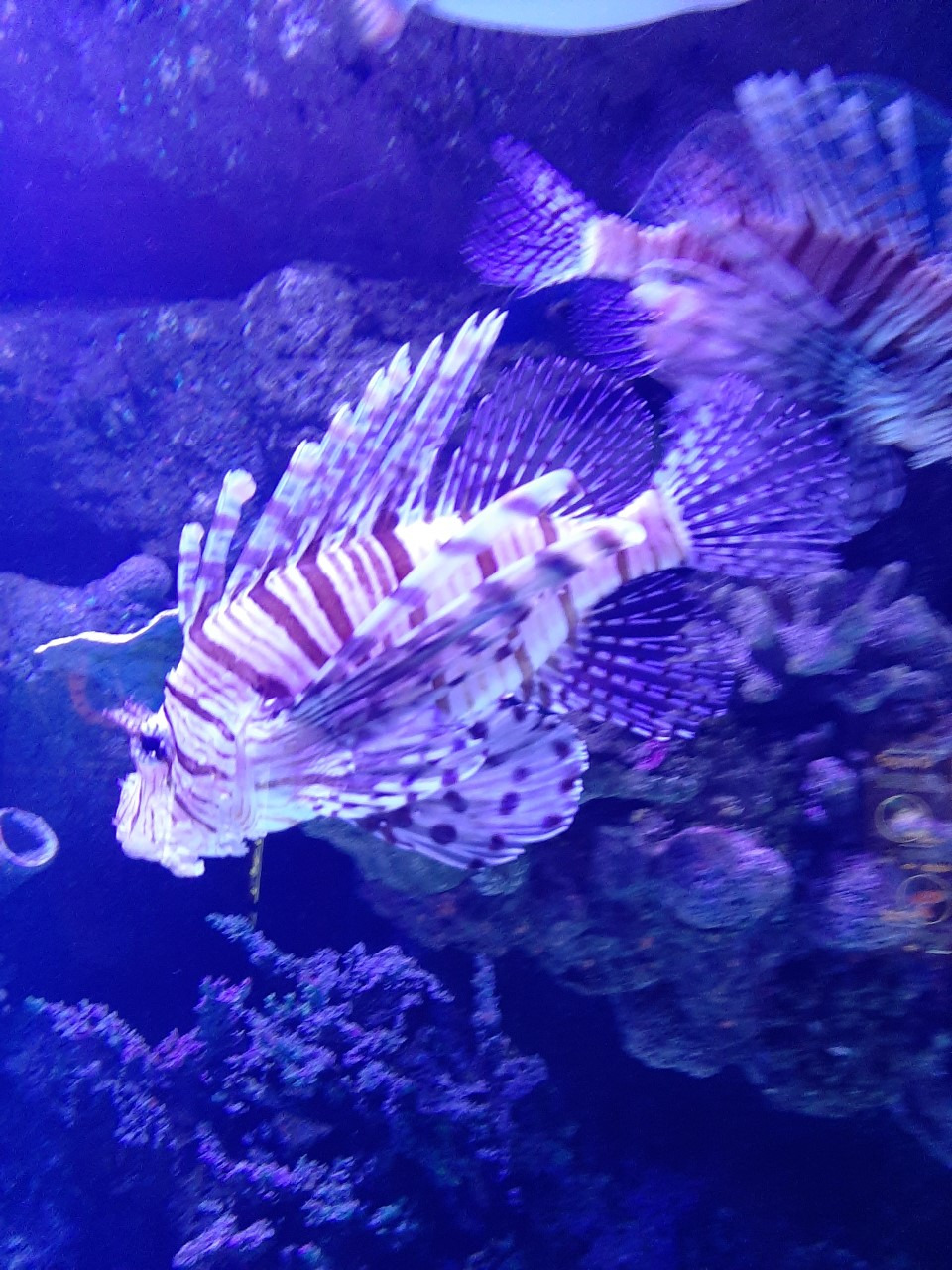
Lionfish  (aka, Firefish)              Photo Credit: Bain Collection Cairns 2023


An important aspect of the information is observed in the knowledge transfer relating to the question, How did the many sub-species of the venomous-spined lionfish (Wilcox et al., 2017) including Ebosia bleekeri, Dendrochirus zebra, Pterois radiata, Pterois volitans, and Pterois miles (Atlas of Living Australia, 2023a) become “what is likely the most damaging marine fish invasion to date globally” (Hixon et al., 2016, p. 161)? Endemic to Indo-Pacific oceans, including at-least sub-tropical and tropical Australia, lionfish have spread across the Atlantic and into the Mediterranean Sea (Wilcox et al., 2017; Bariche, 2017).  Although mostly unconfirmed, various hypotheses exist for their spread, including potential intentional release (National Oceanic and Atmospheric Administration, 2023), accidental aquarium/aquarium-trade release as well as possible transference via ship bilge/ballast waters (The Fisheries Blog, 2013), and/or DNA-analysis supported invasion via Suez Canal (Bariche, 2017). Further what consequences require publication? Once established outside of their endemic range, lionfish have few known predators and local prey have not adapted their defences to this new threat. Hence resource managers highlight that the issue is multi-fold, including lionfish predating on ‘natural’ locals.


Affordances of social media sites facilitate distribution and discoverability of knowledge amongst a networked public. Abidin (2021) describes the characteristics of a networked public as initially being platform-based with scalable engagement utilising the framework and affordances of the platform. In relation to lionfish environmentalism, the affordances include the searchable hashtags, #lionfish, #lionfishhunting and #lionfishbrigade, inter-platform linking/cross-referencing, and website-hyperlinking on/from the platform Facebook such as lionfishcaribbean.com being linked from the Facebook page https://facebook.com/lionfishcaribbean/ (Lionfish Caribbean, 2023). This link takes users to an education/knowledge website with a focus on sustainably using culled lionfish as a food source. Others also promote the use of lionfish as a commercial food source (DeLello, 2021). Educating the public sphere that lionfish fillets are safe to eat, because the toxin comes from the spines not the fish flesh, has informed their use as food source and has addressed many potential negatives that may be touted against their harvesting. The messaging is, from a resource management perspective, based on the criteria of sustainability being that the natural resource is not fished below sustainable levels, these lionfish are a sustainable source of nutrition from the ocean. This is because they are not a natural/endemic resource in the locations where the lionfish is targeted for culling. The promotion of food use on SNS counters possible criticisms from many activists and is likely to result in activists leaving lionfish-culling alone and thus moving on to ‘easier’ targets. Other links take users to government and/or scientific websites. These links are used by scientists and [their] official organisations to ensure that accurate information is readily available in order to minimise/address misinformation. One such site of misguidance is the aquarium focused website Lionfish Lair (Lionfishlair, 2023). On this site pursuing lionfish as pets in locations outside of their endemic range is promoted as a good thing. This site omits to discuss that potentially the spread of lionfish into non-endemic waters has been caused by releases from aquariums by โ€˜keepersโ€™ who do not wish to kill their pet when it outgrows/outeats its tank. Accordingly, the scientist-citizen networked public have populated warnings on aquarium releases onto social media and via links from social media, including Facebook, to scientist/resource-manager supported knowledge websites. These activities increase discoverability of lionfish knowledge and publicise management activities, for example #lionfishderby and cross-reference to other platforms like @reef-org on Instagram. Reef Guardians British Virgin Islands, a group of citizen environmentalists supported by resource managers, the British Virgin Islands Ministry of Natural Resources, on their Facebook page provide education on lionfish trapping techniques as developed by research scientists. This communication, focusing on social exchanges centred around common-interest science knowledge-transfer demonstrates the working(s) of a networked public as described by Lindgren (2013).


In August 2018, a post on Facebook flagged the identification of a lionfish in waters off Egyptโ€™s Mediterranean Sea coastline. Ensuing social media discussion online created awareness and built a knowledge-hungry network. A valuable citizen-scientist data set was achieved when additional photographically-supported sightings were added to the group, as well as informative commentary on the methods of capture, locations and positive promotion of edibility (Al Mabruk et al., 2020). In a broader โ€˜all-speciesโ€™ context, the Atlas of Living Australia’s (ALA), an Australian government supported, non-governmental organization uses Facebook to connect with citizen scientists for their ‘ReefBlitz’ activity (Atlas of Living Australia, 2023b). This activity is linked between the ALA website and Facebook groups and trains citizen-science-contributors and integrates with the iNaturalist App (Atlas of Living Australia, 2022). ALA also tracks lionfish in their endemic ranges. It appears that linking to and/or providing knowledge and education is a fundamental activity to professionals building citizen-professional networked communities on/via SNS. This recording and transfer/accessibility of data/information is described respectively by the terms โ€˜persistenceโ€™ and โ€˜searchableโ€™ in a networked public (Abidin, 2021). From the examples discussed in this paper, it is clear that citizen-science/resource-manager online-communities operate as a networked public on the Facebook platform.


Citizen-scientists contributions in the public space have become very important to the development of environmentally astute communities and acceptance/uptake of environmental policy change. The importance of citizen scientists is highlighted by Clements et al. (2021) advising that the research and management of non-endemic Indo-Pacific lionfish is beyond the resources of established agencies. Approaches to engagement between formal research/management agencies and citizens to form networked publics/communities, includes convergence of smartphones, software and social media such as Facebook/[Meta] groups. Importantly this facilitates positive outcomes in overcoming limitations of funding and geographic coverage in the collection of data and management (culling/killing) of lionfish and other invasive species. These data sets are used by wildlife-conservation-scientists in their contributions to peer-reviewed scientific publications. Unfortunately, as mentioned earlier, barriers/risks to citizen-scientist collaboration exist, including hate-mail/posts and misinformation. This, at times, leads to scientists opting out of SNS environments, retreating to closed-networks of scientific peers. However, in order to address these negatives in the public sphere, so as to reassure public and political support, re-engagement with social media, including Facebook, is necessary. To re-engage, scientists may contract consultant-advisors in order to avoid downfalls and address issues of negative publicity. After trialling a variety of sites, Facebook’s greater public reach and nature of engagement has proven ideal and superior for online-community citizen/scientist collaboration (Hunter, 2020). The immediacy of inter-scientist and audience education-interaction proves to be a significant benefit to identifying misunderstandings and management of misinformation.  Forrester et al. (2021) analysed Facebook posts/interactions and noted that citizen-scientists were collecting valuable data on lionfish distributions, quantities and behaviour responses to culling. In turn wildlife-conservation subject-matter-experts (SME) provided education in the form of and guidance in research procedures and culling methods. Again, this appears to be the successful paradigm employed for the use of SNS in generating positive outcomes for the environment via the use of social media and its networked publics. The benefits continue; culling discourses on social media have resulted in iterative collaborations towards technique refinements as well as informing concentrations of effort, subsequent monitoring and encouraging informed ecotourism. These positive outcomes are achieved by educating knowledge-hungry networked-publics using pro-active educational interactions and promotion of face-to-face activities via social networks.


In conclusion, this paper shows that networked publics on SNS have led to opportunities for public sphere discussion and knowledge exchange between SME and engaged citizens. These groups also present opportunities for citizen recruitment in support of resource-manager and academic/scientific-focused environmental stewardship. Fundamentals of risks associated with generic social media use, were explored and addressed. As well a specific-scenario case-study of Facebookโ€™s use in knowledge-distribution/data-exchange for environmental stewardship regarding combating the โ€˜lionfish invasionโ€™ was analysed. Ultimately this paper determined that wildlife-conservation SMEโ€™s provision of education and guidance in research procedures and culling methods, alongside concurrent risk-management, in exchange for citizen-generated-data, forms a successful paradigm for the use of SNS in generating positive outcomes for environmental advocacy and research advancement.


References


Abidin, C. (2021). From โ€œnetworked publicsโ€ to โ€œrefracted publicsโ€: A companion

framework for researching โ€œbelow the radarโ€ studies. Social Media+ Society, 7(1), https://doi.org/10.1177/2056305120984458


Akpan, J., Beard, L., & Notar, C. (2018). Cognitive Dissonance: The bane of value

systems. International Journal of Social Science and Business, 3(1), 1โ€“5.

http://www.ijssb.com/images/vol3.no.1/1.pdf


Al Mabruk, S., Rizgalla, J., Giovos, I., & Bariche, M. (2020). Social media reveals

the first records of the invasive lionfish Pterois miles (Bennett, 1828) and parrotfish Scarus ghobban (Forsskรฅl, 1775) from Egypt (Mediterranean Sea). BioInvasions Records, 9(3), 574-579. ,

https://doi.org/10.3391/bir.2020.9.3.13


Atlas of Living Australia. (2022, May 31). Networking, discussion and basic

training for World Ocean Day Reef Blitz between 1 and 8 June using

iNaturalist [event notification]. Facebook. https://www.facebook.com/events/490688616140592


Atlas of Living Australia. (2023a). https://bie.ala.org.au/search?q=lionfish   


Atlas of Living Australia. (2023b). Australian Citizen Science Project Finder

Project Finder | Australian Citizen Science Project Finder (ala.org.au) 

https://biocollect.ala.org.au/acsa#isCitizenScience%3Dtrue%26projectId%3D742%208a0f1-25a9-4faa-8af4-%20e0345a9f2249%26max%3D30%26sort%3DdateCreatedSort


Bariche, M., Kleitou, P., Kalogirou, S., & Bernardi, G. (2017). Genetics reveal the

identity and origin of the lionfish invasion in the Mediterranean Sea.

  Scientific reports, 7(1), 1-6. doi: 10.1038/s41598-017-07326-1


Bergman, J., Buxton, R., Lin, H., Lenda, M., Attinello, K., Hajdasz, A., Rivest, S., Tran

Nguyen, T., Cooke, S., Bennett, J., Clements, J. (2022). Evaluating the benefits and risks of social media for wildlife conservation. Canadian Science Publishing Facets, 7(1), 360-397. https://doi.org/10.1139/facets-2021-0112


Callen, A., Hayward, M. W., Klop-Toker, K., Allen, B. L., Ballard, G., Beranek, C. T., …

& Wรผster, W. (2020). Envisioning the future with โ€˜compassionate conservationโ€™: An ominous projection for native wildlife and biodiversity. Biological conservation241, https://doi.org/10.1016/j.biocon.2019.108365.


Clements, K. R., Karp, P., Harris, H. E., Ali, F., Candelmo, A., Rodrรญguez, S. J.,

Balcรกzar-Escalera, C., Fogg, A. Q., Green, S. J., & Solomon, J. N. (2021). The Role of Citizen Science in the Research and Management of Invasive Lionfish across the Western Atlantic. Diversity, 13(12), 673.

  https://doi.org/10.3390/d13120673


Delanty, G. (2003). Community – Virtual community: belonging as communication (3rd

ed.). Routledge. https://doi.org/10.4324/9781315158259


DeLello, S. (2021, October 21). This was test number three in Belize: … of the

Lionfish Purse trap developed by Dr Steve Gittings of NOAA. ReefSave.org is a public charity working to teach and train fishers in the affected areas to profitably harvest the invasive lionfish to sell as food for humans [status update]. Facebook. https:/www.facebook.com/groups/reefguardiansbvi/


Forrester, G., Dzilenski, K., & Gleeson, D. (2021) Use of social-media networking

to facilitate a grass-roots lionfish removal program in the British

Virgin Islands. Management of Biological Invasions, 12(2): 420โ€“440, https://doi.org/10.3391/mbi.2021.12.2.14


Hayward, M. W., Callen, A., Allen, B. L., Ballard, G., Broekhuis, F., Bugir, C., … &

Wรผster, W. (2019). Deconstructing compassionate conservation. Conservation Biology33(4), 760-768. https://doi.org/10.1111/cobi.13366


Hixon, M., Green, S., Albins, M., Akins, J., & Morris, J. (2016). Lionfish: A major

marine invasion. Marine Ecology Progress Series, 558,

161-165. DOI:10.3354/meps11909


Huddy, L., & Gunnthorsdottir, A. (2000). The persuasive effects of emotive visual

imagery: Superficial manipulation or the product of passionate reason?. Political Psychology21(4), 745-778. https://doi.org/10.1111/0162-895X.00215


Hunter, P. (2020). The growth of social media in science: Social media has

evolved from a mere communication channel to an integral tool for discussion and research collaboration. EMBO Rep, 21(5), 1-3.

doi: 10.15252/embr.202050550.


Hwang, E., & Krackhardt, D. (2020). Online Knowledge Communities: Breaking or

Sustaining Knowledge Silos?. Production and operations management, 29 (1), 138-155. https://doi.org/10.1111/poms.13098


Kaplan, A., & Haenlein, M. (2010). Users of the world, unite! The challenges and

opportunities of Social Media. Business horizons53(1), 59-68. https://doi.org/10.1016/j.bushor.2009.09.003


Langlais, M., & Vaux, D. (2022). Establishing and Testing a Quantitative Measure for

Evolving Third-Place Characteristics. International Journal of Technology and Human Interaction (IJTHI), 18(1), 1-15. http://doi.org/10.4018/IJTHI.293201


Legge, S., Murphy, B., McGregor, H., Woinarski, J., Augusteyn, J., Ballard, G., Baseler,

M.,  Buckmaster, T., Dickman, C., Doherty, T., Edwards, G., Eyre, T., Fancourt, B., Ferguson, D., Forsyth, D., Geary, W., Gentle, M., Gillespie, G., Greenwood, L., Hohnen, R., Hume, S., Johnson, C., Maxwell, M., McDonald, P., Morris, K., Moseby, K., Newsome, T., Nimmo, D., Paltridge, R., Ramsey, D., Read, J., Rendall, A., Rich, M., Ritchie, E., Rowland, J., Short, J., Stokeld, D., Sutherland, D., Wayne, A., Woodford, L., Zewe, F. (2017). Enumerating a continental-scale threat: How many feral cats are in Australia?. Biological Conservation, 206, 293-303. https://doi.org/10.1016/j.biocon.2016.11.032


Liberatore, A., Bowkett, E., MacLeod, C.J., Spurr, E. and Longnecker, N. (2018). Social

Media as a Platform for a Citizen Science Community of Practice. Citizen Science: Theory and Practice, 3(1), 1โ€“14, DOI: https://doi.org/10.5334/


Lindgren, S. (2013). SubCulture: Exploring the dynamics of a networked

public. Transformative Works and Cultures, 14(14), 46. https://doi.org/10.3983/twc.2013.0447


Lionfish Caribbean. (2023). www.facebook.com/lionfishcaribbean/


Lionfish Lair. (2023). https://lionfishlair.com/facts-about-lionfish/


National Oceanic and Atmospheric Administration. (2023). Why are lionfish a

threat to Atlantic Ocean fish? (noaa.gov).

https:/oceanservice.noaa.gov/facts/lionfish.html


Nicholson-Cole, S. (2005). Representing climate change futures: a critique on the use of

images for visual communication. Computers, Environment and Urban Systems, 29, 255โ€“273. https://doi.org/10.1016/j.compenvurbsys.2004.05.002


Papacharissi, Z. (2010). A networked self: Identity, community, and culture on social

network sites. Taylor & Francis Group.

https://ebookcentral.proquest.com/lib/curtin/detail.action?docID=574608.


Radford, J., Woinarski J., Legge, S., Baseler, M., Bentley, J., Burbidge, A., Bode, M.,

Copley, P., Dexter, N., Dickman C., Gillespie, G., Hill, B., Johnson, C., Kanowski, J., Latch, P., Letnic, M., Manning, A,, Menkhorst, P., Mitchell, N., Morris, K., Moseby, K., Page, M., Ringma, J. (2018) Degrees of population-level susceptibility of Australian terrestrial non-volant mammal species to predation by the introduced red fox (Vulpes vulpes) and feral cat (Felis catus). CSIRO Wildlife Research 45, 645-657. https://doi.org/10.1071/WR18008


The Fisheries Blog. (2013). The Fate of Released Aquarium Fish.

            https://thefisheriesblog.com/2013/08/26/the-fate-of-released-aquarium-fish/


Wald, D., & Jacobson, S. (2014). A multivariate model of stakeholder preference for

lethal cat management. Plos one, 9(4), 1-9.

https://doi.org/10.1371/journal.pone.0093118


Wellman, B. (2001). Physical place and cyber place: The rise of networked

individualism. International journal of urban and regional research, 25(2), 227-252. DOI:10.1111/1468-2427.00309


Wilcox, C., Motomura, H., Matsunuma, M., & Bowen, B. (2017). Phylogeography

of lionfishes (Pterois) indicate taxonomic over splitting and hybrid origin of the invasive Pterois volitans. Journal of Heredity 109, 162โ€“175. https://doi.org/10.1093/jhered/esx056


Wu, Y., Xie, L., Huang, S., Li, P., Yuan, Z., & Liu, W. (2018). Using social media to

strengthen public awareness of wildlife conservation. Ocean and Coastal Management 153, 76โ€“83. https://doi.org/10.1016/j.ocecoaman.2017.12.010


Search Site

Your Experience

We would love to hear about your experience at our conference this year via our DCN XIV Feedback Form.

Comments

45 responses to “ENVIRONMENTAL ADVOCACY IN A WORLD OF COMMUNITIES WITHIN SOCIAL MEDIA”

  1. Charlotte Phillips Avatar
    Charlotte Phillips

    Hi Steve,

    Youโ€™ve presented a really interesting topic for this conference stream! I actually had no idea lionfish were such an invasive species โ€“ I think this is a great example of the way social media can play a big part in changing peopleโ€™s attitudes toward wildlife. I am certainly guilty of being swayed by โ€œcuteโ€ images of wildlife online! You mention these images need to be critically assessed before publication, how do you think this could be efficiently managed on these networked publics, without losing the extra attention that a more โ€˜offensiveโ€™ image might attract?

    Do you think Facebook itself has some responsibility in managing the misinformation and hate speech that you mention in your paper? If so, what are some ways they could do this? If not, then how do you think it could be effectively minimised or eliminated?

    Congrats on a great paper!

    Charlotte.

    1. Stephen.B.Bain Avatar
      Stephen.B.Bain

      Hi Charlotte, I’m attempting a couple of admin things in this reply …

      firstly to see how it is presented
      and
      secondly, to see if the format is able to be edited.

      I’m about to mash buttons and see what happens ๐Ÿ™‚
      Steve

      1. Stephen.B.Bain Avatar
        Stephen.B.Bain

        okay that almost worked … unfortunately when I ‘mashed’ the update button the above reply went from being immediately under the comment that I was replying to … and stuck itself in here chronologically => I’ll go back to Charlotte’s comment and have another go at having comments/replies stringing in order.

        Update … I didn’t have any success in linking replies directly under the comments. FAIL !

        Update 2 … Apologies for being a bit slow to notice; however this afternoon I worked out that the chronological-comments-conversation can be followed quite easily by simply going into ‘View Post’ for the paper/author and reading the feedback comments under each of the contributions. DUH! … and once in there y’all can reply directly under the comment you wish to discuss.

    2. Stephen.B.Bain Avatar
      Stephen.B.Bain

      Hi Charlotte,

      Hey, what a great question WRT Facebook’s responsibility. A motherhood-statement reply would be to say, “more education of the user; in combination with reviewing the specific subject matter content on Facebook (similar to the management of the anti-Vax campaigning)” … however there’s more to it than flipping it off so lightly … I will do some scholarly research to see if my opinions have any merit/validity and get back to y’all.

      There are also some great papers within this conference that include this as well. I wish to revisit them for inclusivity and linking where appropriate.

      For now I will reiterate my previously posed thought in my comment to Ishan regarding ‘fakes’ as mentioned in the paper (Thanasekaran, 2023), “who is responsible for educating the users about fake-identities, fake-news and fake-claims? And, will be us as the next generation of most-recently schooled โ€˜expertsโ€™, who take on this responsibility”

      More to Follow
      Steve

      ps: I use some terms that are sometimes identified as ‘having fun with it’ … and that is 100% the truth; I do enjoy the lighter side (a ‘bubble-bath’ if I may) … some words/terms and rhyming-slang are because I have a bit of Aussie outback/farmer in my culture, others because I’m ‘elderly’/mature; … I use ‘Hey’ because I’m a Queenslander, and y’all because my grandkids are ‘southern’ (southern USA that is) + and for me y’all is a word that fits where I use it as well y’all is a nod to their culture too.

      Reference:

      Thanasekaran, I. (2023, April 24). “The false sense of trust created by social media fitness influencers in shaping the identity of their audience based on the identity of a character they create” (Paper presentation). Debating Communities and Networks XIV, Perth online. https://networkconference.netstudies.org/2023/csm/1192/the-false-sense-of-trust-created-by-social-media-fitness-influencers-in-shaping-the-identity-of-their-audience-based-on-the-identity-of-a-character-they-create/

      1. Charlotte Phillips Avatar
        Charlotte Phillips

        Hi Steve

        Yes, I think the same question can and does apply to many papers published here! Itโ€™s quite a complex issue, lots to unpack, and there doesnโ€™t seem to be a โ€œrightโ€ answer, so to speak.

        Keen to hear what you found during your further research.

        Charlotte.

        1. Stephen.B.Bain Avatar
          Stephen.B.Bain

          Hi Again Charlotte,

          with respect to “managing images” =>

          This paper, “Framing Possums: War, sport and patriotism in depictions of brushtail possums in New Zealand print media” (McCrow-Young et al., 2015) from my bibliography but not from my cited references, is interesting because to a fair degree it contradicts my paper’s vibe that photographs of ‘cute’ animals in the state of being culled/dead may not be wise as publicity photos.

          To try to bridge the gap between “Framing Possums: War, sport and patriotism in depictions of brushtail possums in New Zealand print media” (McCrow-Young et al., 2015) and my paper; the context is that New Zealand has a pro hunter-gatherer culture, where killing and culling is more accepted than in many other places within the western-world; additionally a concerted campaign across NZ has maligned the possum as public-enemy number one.

          It can be concluded from “Framing Possums: War, sport and patriotism in depictions of brushtail possums in New Zealand print media” (McCrow-Young et al., 2015) that imagery needs to be carefully managed, in this 2015 case the management extreme has shown in that intensive propaganda can even make photos of dead critters okay (within the known circulation limits of print media).

          Notwithstanding the apparent acceptance of dead possum pictures in the context of the 2015 analysis, I wonder what a 2023 update of this article would conclude if, in updating the data, the scope was also widened to include the global social media/networked publics?

          I suspect there wouldn’t be too much difference as the animal rights activists do tend to steer clear of arguments that they’ll likely loose. I sat in on one of their meetings once and I noted that a key-criteria was to role-play and assess the chances of loosing before supporting any activism (hence why they are less likely to campaign for the protection of mosquitos) … apparently a sniff of success = funding!

          I also note that, across the networked publics, there is minimal anti-culling activism with respect to Lionfish.

          I hope this adds a little to the many facets of image management. In this case image-management supported by volumous marketing.

          Ciao
          Steve

          McCrow-Young, A., Linnรฉ, Tobias., & Potts, A., (2015). Framing Possums: War, sport and
          patriotism in depictions of brushtail possums in New Zealand print media. Animal Studies
          Journal, 4(2), 29-54.
          https://ro.uow.edu.au/asj/vol4/iss2/3

    3. Stephen.B.Bain Avatar
      Stephen.B.Bain

      Hi Charlotte,

      Firstly my apologies.

      I have wanted to get back to you and your question about image management. In the examples below (which I have copied and pasted from my reply just now to Gunsa) shows that a practitioner, combined with their lessons learned (and some input from their SNS savvy kids … I ‘interviewed’ family), can set an example of what-to-do to achieve the desired outcome (= more likes). In some ways it can be used to advantage that people have a tendency to follow the leader. Accordingly, by posting quality examples of the best way to present the best images, in-turn it is hoped that future posters will self-critically-assess in order to pursue more ‘likes’. Thus the management of the critical-assessment becomes an example driven new-culture.

      Copied from reply to Gunsa, “My suggestion is to further develop the example(s) provided in my paper; of PR and resource-managers/scientists collaborating to distribute accurate information to citizens and citizen-science communities โ€“ and to implement such endeavours across the existing environmental/extinction issues that we have at our feet.

      Accordingly, as a recommendation as to where I would suggest the next focus should be; we can look to the programs that are culling wild pigs to protect turtle hatchlings. These pigs can be eaten too!

      The comments on the two youtube SNS videos (below) say it all. This, by analysis of the viewer comments, is an example of using imagery in a way that garners support on SNS:

      Saving turtles: One Pig at a Time
      https://www.bing.com/videos/search?q=FVR+culling+pigs+shooting+the+sand&docid=603528971968007612&mid=0D9E84025B11556C21820D9E84025B11556C2182&view=detail&FORM=VIRE

      and another
      https://www.youtube.com/watch?v=G_iFEPg2aDA

      I can feel another paper coming on ๐Ÿ™‚
      Thank you for the discussion and again I welcome feedback.
      SteveB”

      1. Stephen.B.Bain Avatar
        Stephen.B.Bain

        ps: I filmed a great (if I do say so myself), video on my phone of a turtle hatching making his (they are born male if incubated at less than 27.7 Celsius) way down the beach across the coral and rocks to the water.

        Time is not on my side at the moment (lots of unplanned life admin) otherwise, with respected to image management, I would have edited and posted the vid and in doing so provided an example of the option of a ‘cute-cuddly’ PR positive outcome side of culling/pig-culling (if you get my drift?)

  2. Stephen.B.Bain Avatar
    Stephen.B.Bain

    Copied and Pasted (with minor edits) from Comments to Phillips, 2023

    Hi Charlotte,

    Diving right in at the deep end. Your mention of vegans tag-jacking in discussions following your paper (Phillips, 2023), for me links across to your enquiry via my paper about management of imagery with respect to conservation issues (such as the culling of lionfish).

    “You mention these images need to be critically assessed before publication, how do you think this could be efficiently managed on these networked publics…” (Phillips, 2023)

    I think that the efficient management of images relies largely on the proactive application of lessons-learned from past anti-activism (such as the vegan-dairygate) that you mention in discussion on your paper.

    I’ve seen it in other spheres, where there is an unspoken culture that almost silently is activated to address issues … hopefully the environmental-managers and citizen-scientists have such an understanding (I think they do) … the lionfish case-study presents as a golden-egg laying goose, where spearfishos can be hunters who are the good-guys => it’s a space that they don’t wish to be damaged from the inside!

    I accept that this comment is a bit cliche-esque; however it’s really where it’s at when role-playing campaigns in-order to second-guess the opposition and implement risk-mitigation.

    Ciao
    SteveB

    ps: I don’t have an issue with vegans, … however some of them may have a problem with me (or rather they have problems/issues with the management techniques that I endorse)

    Reference

    Phillips, C (2023, April 22). REFRACTED PUBLICS ON TWITTER: ANTI-VAXXERSโ€™ ROLE IN INCREASING GLOBAL VACCINE HESITANCY
    [Conference Paper]. Debating Communities and Networks XIV. Online Perth.
    https://networkconference.netstudies.org/2023/csm/427/refracted-publics-on-twitter-anti-vaxxers-role-in-increasing-global-
    vaccine-hesitancy/#comment-202

  3. Avinash Assonne Avatar
    Avinash Assonne

    Hey Stephen,

    First of all, I really like the format of your post. You even included a detailed “coversheet” at the beginning, I have not seen many doing that on here. Actually myself, I didn’t think about including all those details at the top until I came on to check out your post just right now. I hope you don’t mind if I include the same infos in regards to the coversheet at the top. I’m just going to copy paste it and then change the details (name, email address, ID, word counts etc.) I think it’s important to include all those details even on here on this site and not only in the doc. Your post reminded me of that, thank you! I edited a few more things just now when I copy pasted on mine, this one is Assignment #2 and I changed the title to “Conference participation reflection”. I like the italicized Abstract part too on yours.

    In regards to your paper itself, it was a very interesting read. As Charlotte mentioned, I didn’t know as well that lionfish were such an invasive species. You are correct about the fact that scientists should work interchangeably with consultant advisors as this will be beneficial for them. Do you think that if they work with professionals in public relations this might help the situation too? The fight againstย biodiversity loss is anย “awful” problem that is challenging to resolve sinceย it frequently involves complicated issues that call for multidisciplinary, collaborative solutions. Culling seems like a very effective method to solve the lionfish’s issue.

    Your paper did a very good at explaining how SNS offer a special framework in the quickly evolving world of today that, if used effectively, may unite our voices and provide a chance to catalyze social change for the conservation of biodiversity worldwide. Although mine is a little bit more simplistic, it would be cool to get your opinion and perspective on my paper which talks about digital identity and how social media can have a negative impact or effect on one’s self-representation online.

    Regards,
    Avinash

    1. Stephen.B.Bain Avatar
      Stephen.B.Bain

      Hi Avinash,

      Hey thank you for the comments on my paper’s formatting, there are a few things I’d like to improve (it’s a work in progress). Additionally, I open-mindedly agree with your suggestion that Assignment 2 / Conference is appropriate for the coversheet.

      Your comment re PR is spot on … I feel that purist practitioners such as engineers and scientists often overlook the emotive and/or public-relations angle(s) … the facts are where it all is at and nothing else matters ๐Ÿ™‚ … it is horrifying to many engineers to sacrifice the inclusion of more facts in order to insert a marketing pitch. My research for this paper found comments where scientists had retreated from SNS-life because of the chasm between science and everyday; however I also found that more recently some scientists have engaged with PR specialists in order to re-engage with public SNS. I believe that the Lionfish is a good example of this.
      Accordingly, this is why I’m studying Web-Media & Marketing online in the B.Communications

      There’s a little bit more on the reality to public interface (and retreating into third-spaces) in my discussions with Finch. Finch’s paper is worth a read too.

      Thank you for the invite to dive deeply into your paper, I’ll have a look at your paper tomorrow.

      Kind Regards & Thanks Again
      Steve

      1. Avinash Assonne Avatar
        Avinash Assonne

        Hi Steve,

        You are welcome! Thank you for the detailed response and getting more in-depth specially regarding how scientists have actually started to work with PRs specialists to re-engage with public SNS. I’ll check out Finch’s paper and the discussions you had with him. I’m studying Web Media and Marketing Communications as well ๐Ÿ™‚ See you around!

        Kind regards,
        Avinash

        1. Stephen.B.Bain Avatar
          Stephen.B.Bain

          Hi Avinash,

          The whole “PR4Science” is a tempting thought for a business idea … alas PR isn’t taught online.

          Steve

  4. Stephen.B.Bain Avatar
    Stephen.B.Bain

    An example of an article regarding lionfish on a scuba diving website

    https://scubadiverlife.com/lionfish-culling-cayman-islands/

    Maybe 20 years ago divers IMO would have been anti-culling … I recall having stand-offs and physical aggression (I know companies where the ‘divers’ and ‘cullers/fisheaters’ had to be treated as different markets – to be kept separated)

  5. Stephen.B.Bain Avatar
    Stephen.B.Bain

    A URL to a well-made knowledge-transfer video of the culling activity

    https://www.youtube.com/watch?v=AAFvWlkQ9oU

  6. Yiyun.Wang Avatar
    Yiyun.Wang

    Hi Stephen,

    Thank you for your interesting and insightful paper! I was impressed by your example of using Lionfish and the importance of proper social media outreach for proper knowledge dissemination.
    I find that it is now becoming easier to share knowledge on the internet which allows a lot of wrong knowledge to be spread more frequently. I also think that older people seem to be more vulnerable to false knowledge dissemination. For example, my grandparents often use social media platforms and share false science popularizing articles to me. Although I tell them it is wrong, they keep sending me new article. This really bothers me.

    Cheers!
    Yiyun

  7. Stephen.B.Bain Avatar
    Stephen.B.Bain

    Hi Yiyun,

    Thank you for your positive and encouraging feedback. Like yourself, I agree that the spread of incorrect information is worrying. As a grandparent myself, I find that my grandkids keep me on my toes …. I reckon that’s their job ๐Ÿ™‚

    On behalf of all grandparents, Yiyun, “Keep Up the Good Effort”.

    Thank you
    SteveB

  8. Milkias.Gunsa Avatar
    Milkias.Gunsa

    Hi Stephen!

    I really liked your point about how Facebook and other platforms can serve as a hub for knowledge exchange between professionals and citizens. The lionfish spotting in Egypt and the follow-up data collection you talked about was a cool real-world example of this.

    Your point about how social media helps promote lionfish as a food source was a unique angle I hadn’t thought about. The Atlas of Living Australia’s use of Facebook and the iNaturalist App to connect with citizen scientists was also a great highlight.

    However, I think the paper could touch more on the downsides of using social media for knowledge exchange. You mention hate posts and misinformation, but maybe dive deeper into how to tackle those issues? Also, what about the echo chamber effect on social media – how might that impact the public’s understanding of the lionfish issue?

    Anyway, awesome work!!

    Cheers

    1. Stephen.B.Bain Avatar
      Stephen.B.Bain

      Hi Again Milkias,

      Thank you again for your interest in my paper and your questions.

      Moving on to your last question, “how might that [echo chambers] impact the publicโ€™s understanding of the lionfish issue?”

      Based on what we have seen with regard to the feral cats and feral horses issues; an analysis of these case-studies and applying/overlay to the lionfish scenario; it is conceivable that negative echo chambers resulting from misinformation, could see a political knee-jerk reaction (as seen by feral horses and even the live export trade ban) which would cease the culling/management activities.

      However, political inference ‘overruling’ science, has not occurred with the lionfish management projects, hence I can postulate that, so far, the lionfish management project shines as a best-practice example for the management of SNS negativity, misinformation and echo chambers.

      Cheers
      Steve

  9. Stephen.B.Bain Avatar
    Stephen.B.Bain

    Hi ‘Gunsa’,

    Hey thanks for your discussion-promoting feedback. Your question has given me the opportunity to expand beyond the introductory word-count-limited context of my paper. Hang-on for a few more case-studies.

    I enjoyed your comment about lionfish as an edible food source; for me this is a tangent that I had to hold myself back from (my wife is a food writer with a bent towards cooking-the-culled). I underline your point and, that in my opinion, promoting sustainable food resources adds another feather in the cap of any โ€˜management by cullingโ€™ control plan for invasive species.

    In part I chose lionfish as my case-study hub because of the positive messaging around the food aspect … while I have eaten culled horse meat (cheval), in my opinion it would have been less acceptable to tout the culling of horse and eating the meat, within my broad audience paper themed towards social media as I felt the issue of what to eat may have become the discussion point rather that the use of SNS to educate with respect to what can/may be eaten.

    I hear you with the negatives/haters/misinformation issue(s); this in my opinion is where the echo-chambers really become a self-licking ice-cream. At times the echos of false information can bring a project undone and/or force it underground. In summary, one online-poster/commentor makes an outlandish claim due to a hidden agenda and the โ€œoh yeah what they saidโ€ echos reverberate. Iโ€™ve observed these behaviours as a lurker and note that the outcomes can include; punters getting โ€˜sucked-inโ€™ by the misinformation/rhetoric all the way to comments being shut down which effectively locks-out both the knowledge-transfer and the citizen-science exchange. Via this last example of comments being turned off, the “antis” can achieve their goal of silencing good science via their strategy of simply creating a ‘ruckus’.

    One of the best examples of this, is the backlash against culling horses in Kosciusko National Park (KNP) => the misinformation includes some people being convinced that these horses are native to Australia and therefore they (the horses) belong in the National Parks. This spreads onto SNS and the commentary gets shut down (or as in this case, has swayed politicians to at times adopt policy(ies) that are informed by the misinformation).

    here are some links

    a site that misinforms readers that feral horses are NATIVE:
    => 10 Native Australian Horse Breeds (Facts, History & Pictures)
    https://horseyhooves.com/australian-horse-breeds/

    a site that highlights the plethora number of myths peddled around:
    => ‘Myths vs facts – Reclaim Kosci’
    https://reclaimkosci.org.au/myths-v-facts/
    QUOTE: โ€œIn June 2018 the NSW parliament passed a law that protects feral horses in Kosciuszko National Parkโ€

    Read here for coverage of the death threats towards humans by horse-supporters:
    => The battle over Australia’s brumbies intensifies in a clash of culture, colonialism and conservation – ABC News
    https://www.abc.net.au/news/2022-02-22/kosciuszko-brumby-battle-turns-feral-mountain-culture-war/100830536

    This next, more academic piece, includes the topic that one in five people believe the misinformation i.e. that
    feral horses are native!
    => When introduced species are cute, culling them becomes tricky – The University of Sydney
    https://www.sydney.edu.au/news-opinion/news/2020/02/11/when-introduced-species-are-cute-cuddly-culling-them-
    becomes-tricky.html
    Reference: https://www.sciencedirect.com/science/article/abs/pii/S0006320719300357?dgcid=author
    “Diverse public perceptions of species’ status and management align with conflicting conservation frameworks”

    Incidentally the most recent ABC news report on the feral horses in KNP (this year) had its comments section closed very
    promptly because the comments from horse supporters became very racist very quickly.

    The ABC recently ran this story about old-school media impacting government policy with respect to culling
    https://www.abc.net.au/news/2022-10-27/feral-animal-cull-halt-nsw-national-parks/101583396

    Similar exists with feral cats โ€ฆ the concept of trap-neuter-release/return (TNR) is promoted by so-called compassionate-conservationists who oppose culling cute felines โ€ฆ via THR cats are trapped, de-sexed and returned to the bushland (it is overlooked that that end-result is that the cats, which are returned to the bush, therefore continue to eat/prey and accelerate the wiping-out of native species) โ€ฆ in many cases the โ€œecho-chamberโ€ agrees that T-N-R is better than culling/removal.
    The basic fundamental biological point that the supporters of TNR overlook, is that the cats are not having sex with our native quolls, bettongs, etc; they are eating them to extinction!
    to counter pro-TNR here is a link to an anti-TNR paper (it is interesting that this paper connects increases in feral cats to the outcomes and by-products of TNR programs … including cat-dumping of pets where the dumper thinks the(ir) cat will be trapped and desexed and then is free to roam in an environmentally friendly way). Astute readers my connect that ‘dumping’ is alleged to also be one of the key-causes of the lionfish invasion.
    https://bioone.org/journals/wildlife-biology/volume-2021/issue-1/wlb.00799/Free-ranging-domestic-cat-abundance-and- sterilization-percentage-following-five/10.2981/wlb.00799.full

    The facebook group https://www.facebook.com/groups/526440420805408/ markets itself as helping TNR

    This reddit site https://www.reddit.com/r/veterinaryprofession/comments/jkfesp/what_is_your_view_on_tnr_trap_neuter_release/
    shows the peddling of (mis)information. Here we see that the predation by cats on native wildlife, i.e. the primary reason in my opinion for management of cats, is hardly mentioned at all! … In parts the convo becomes one of how to build warm cosy shelters for the cats (i.e. so they can go on killing local fauna) …. this is a good example of an echo-chamber, it is not the simplistic version of ‘agreement/liking’; this is more complex context where the perceived problem becomes the new discussion and acts as a catalyst for discussion about how to solve it (yet the real debate is … “should it be solved at all?”). This is an example of the ‘hijacking’ that is a risk on SNS.

    As an example of the cat issue, the following is from Wikipedia (the link is to an example of a ‘pet’ cat(s) killing/eating the last known examples of a bird species)
    https://en.m.wikipedia.org/wiki/Lyall%27s_wren

    Sooo, as I believe I have shown in this commentary, the existence of the misinformation issue and the outcomes (such as protected feral horses and promotion of housing for cats) is established.

    The question becomes, what to do about it?

    My suggestion is to further develop the example(s) provided in my paper; of PR and resource-managers/scientists collaborating to distribute accurate information to citizens and citizen-science communities – and to implement such endeavours across the existing environmental/extinction issues that we have at our feet.

    Accordingly, as a recommendation as to where I would suggest the next focus should be; we can look to the programs that are culling wild pigs to protect turtle hatchlings. These pigs can be eaten too!

    The comments on the two youtube SNS videos (below) say it all. This, by analysis of the viewer comments, is an example of using imagery in a way that garners support on SNS:

    Saving turtles: One Pig at a Time
    https://www.bing.com/videos/search?q=FVR+culling+pigs+shooting+the+sand&docid=603528971968007612&mid=0D9E84025B11556C21820D9E84025B11556C2182&view=detail&FORM=VIRE

    and another
    https://www.youtube.com/watch?v=G_iFEPg2aDA

    I can feel another paper coming on ๐Ÿ™‚
    Thank you for the discussion and again I welcome feedback.
    SteveB

    1. Milkias.Gunsa Avatar
      Milkias.Gunsa

      Thanks for your comprehensive and thought-provoking response. The complexity of these issues is truly staggering!

      You’ve highlighted some incredibly important issues, particularly around misinformation and echo chambers. The situation with the feral horses in Kosciusko National Park is a clear example of how misinformation can lead to harmful outcomes. Something I never even knew about to be honest! The case of wild pig culling to protect turtle hatchlings is super interesting! It’s a great example of how a compelling narrative can make a significant difference in public perception.

      I also strongly agree with the notion to to amplify collaboration between PR and resource-managers/scientists to disseminate accurate information and engage citizen-scientists more effectively. This would be a very good way to reduce misinformation.

      The links you’ve shared provide a wealth of information and I appreciate the time you took to compile them ๐Ÿ™‚

      1. Stephen.B.Bain Avatar
        Stephen.B.Bain

        Hi Milkias,

        Thank you for your rousing feedback.

        The positive feedback that I have received across-the-board for this topic during this conference has been very motivational.

        To finish with a positive … it seems that the opportunity to market conservation by culling is empowered by social media as SNS/platforms are providing an avenue to spread accurate science.

        Pre-SNS mis-information used to be spread by word-of-mouth, often out of the earshot of the subject matter experts. Now that we have SNS, misinformation can be hunted-down and targeted (if you’ll pardon the analogy). Concurrently, the facts can be distributed, often remaining available and accessible ‘forever’.

        Used to advantage, SNS just might be a good thing!

        Ciao
        SteveB

  10. H.Lochee Avatar
    H.Lochee

    Hi Steve!

    Thanks for your detailed and thoroughly researched paper! Just like many others, even I was unaware of the invasive nature of Lion fish.

    It is interesting to see how scientists an experts in the field are using social media to raise awareness and rectify public biased notions on wildlife.
    I tend to be a very empathetic person so whenever the killing of animals are involved, I feel sorry for them and guilty that I cannot do more that just sign a digital petition. However your paper has showed me the other side of the story.

    Do you think more stringent regulations should be introduced in the first place to stop mis-information to be dispersed online?
    On another note I often signed PETA online petitions against animal cruelty and mistreatment, do you think such organizations, despite their good-will, may have wrong information especially if they are not taking into consideration the bigger picture of global biodiveristy impacts?

    Yaj

  11. Steve Avatar
    Steve

    Hi Yaj,

    Thank you for a very pertinant but in some ways ‘tough’ question about peta/activist type organisations.

    There are positives and negatives that can be attributed to these organisations (just like social media/SNS) … as educated people we should look past the emotive image(s) , ask a few questions (like “what happens if farms are shut down”) and my suggestion is to apply focused activism (on an issue that you’ve researched) rather than blanket support of an organisation (whose supporters may redirect your support towards negatives such as bullying and hate-mail = all the things we are trying to address on SNS).

    My personal approach, following risk analysis and lived-experience, is to not apply blind-faith support to organisations … and because I am able to; I’ll physically support ‘just’ causes (such as sustainable seafood, in season produce, low food miles = issues that ‘everyday’ people can support everyday at every shop).

    Yaj, thank you for a great discussion point.

    All the best
    SteveB

  12. Stephen.B.Bain Avatar
    Stephen.B.Bain

    Hi Yaj,

    Yes, I’m of the opinion that “more stringent regulations should be introduced in the first place to stop mis-information [being] dispersed online”.

    However this wishful thinking is probably, ‘easier-said-than-done’. In the meantime we live the battle for good and good-information by knowledge spreading the deeper/researched truth(s), rather than emotive-activism that’s designed (and gets) knee jerk ‘cancel’/ban responses from governments/politicians.

    Kind regards
    Steve

  13. Stephen.B.Bain Avatar
    Stephen.B.Bain

    All,

    An interesting pre-SNS example of the misinformation scenario (and therefore showing that its not just the fault/cause of SNS) is the red fox situation in Australia.

    There used to be a financially self-staining fox culling industry in Australia. However when the activist movement from the UK (anti-fox hunt, which had pretty much nothing to do with Australia) spilled onto our shores (via shopping-centre pop-up petitions signed by bypassers) the backlash against fox furs as a fashion item in Australia’s big cities resulted in bullying and aggression against anyone involved, from hunters to consumers, and the financial basis for the fox culling industry was destroyed over-night.

    And this issue’s activism is enshrined as an example that even today makes policy makers shy of addressing the situation (and why they knee jerk on KNP feral horses etc).

    So now foxes are free to munch on native Australian wildlife.

    (TIC) Wear fox-furs and save a bilby!

    In relation to SNS … because the tactics were successful 30 to 40 years ago, we still see them surface from time to time as ‘factual’ on SNS; where the ‘factual’ relates to a belief that the information used was accurate and therefore the myth(s) continue.

    With regard to management of online/SNS dialogue and images, it helps to be aware of this history and to role-play it when mitigating risk.

    Cheers
    SteveB

  14. P.Itnac Avatar
    P.Itnac

    Hi Stephen!

    You introduced a very interesting topic and I enjoyed reading your article. Personally, I didn’t know lionfish were such an invasive species like most of us. Seeing your work made me want to read more on Lionfish.
    Do you think there could be ways for how can scientists and educators effectively communicate accurate information about lionfish to the public? How can we tackle the misinformation issues and hate comment on social media?
    How can we balance the need for accessibility of information with ensuring accuracy, particularly in social media?

    Cheers!
    Pratikshabye.

  15. Stephen.B.Bain Avatar
    Stephen.B.Bain

    Hi Pratikshabye,

    Thank you for your feedback on your enjoyment of the article. That is certainly something that I tried to achieve by using a case study.

    (I have a little bit going on at the moment so I will address your three questions individually … so that I can jump in and out).

    With regard to your first question, “Do you think there could be ways for how can scientists and educators effectively communicate accurate information about lionfish to the public?”

    To provide accurate information to the public, I lean towards the use of endorsed websites as centres-of-knowledge; with SNS posts linking-to/referencing the government/scientist endorsed websites. There is probably a need for PR/Marketing/Web savvy and science aware persons to provide the human link(s) between the technical data word and the online user/consumer/readers; this could possibly a new career option for graduates from this course.

    Thanks again for your positive feedback
    SteveB

  16. Stephen.B.Bain Avatar
    Stephen.B.Bain

    Hi Pratikshabye,

    I’m back again (an opportunity for a quick turnaround has presented itself).

    In relation to “How can we tackle the misinformation issues and hate comment on social media?”

    I just read a great paper on here at this conference that increased my awareness of Twitter’s efforts in regard the misinformation battle (including using human fact-checkers). If all platforms embraced and implemented such strategies, and exchanged lessons learned, together with education via our school systems (and local libraries), I reckon that the spread of fake-news/mis-information would be severely impacted – Yeehaa!

    SteveB

    ps: this is the conference paper that I referred to, it is worth a read:
    https://networkconference.netstudies.org/2023/onsc/655/the-power-of-twitter-exploring-the-networked-self-and-advocating-for-social-and-political-change/
    by hj.papadopoulos

    and from that paper’s discussions
    ” Twitter, for instance, employs fact-checkers to validate the accuracy of information and classify the content as misleading if found to be false. You may find a comprehensive explanation of Twitterโ€™s measures to address misleading information by following this link: https://help.twitter.com/en/resources/addressing-misleading-info

  17. Stephen.B.Bain Avatar
    Stephen.B.Bain

    “How can we balance the need for accessibility of information with ensuring accuracy, particularly in social media?”

    Great question Pratikshabye!

    I’d like to think my recommendation of ‘URL’ linking from social media to endorsed sites is the answer to accuracy of information.

    Such linking encourages (forces?) any poster to read the ‘expert’ material first (just as we do when writing our papers and responding to comments). If the public were schooled-in and used, citing/referencing as a guide/measure of credibility (rather some conspiracy theory wacko “said-so”) then misinformation could possibly be identified pretty darn quickly in many cases, simply by the absence of credible references.

    In relation to the ‘accessibility’ component of your enquiry … I see a need (hope/wish) for academic papers to be able to all.

    I’m keen on your feedback on this one.
    Cheers
    SteveB

    1. P.Itnac Avatar
      P.Itnac

      Hi Stephen,

      I appreciate you spending the necessary time and effort to address all of my questions. Honestly, I got more responses that I was expected. but I am glad. By the way, excellent response.

      Thank you very much.
      Best regards,
      Pratikshabye.

  18. Stephen.B.Bain Avatar
    Stephen.B.Bain

    Hi,

    As examples of the resources that can be referenced/linked by social media/SNS consumers:

    I also wanted to mention the book
    “Cane Toad Wars”
    https://researchers.mq.edu.au/en/publications/cane-toad-wars
    by Rick Shine
    https://en.wikipedia.org/wiki/Richard_Shine

    For those interested, the book details the journeys of a well-respected award-winning scientist in his and his team’s studies towards combating the cane toad invasion of Australia … there are good examples provided in the book for those wishing to understand and role play the limitations and constraints that impact the study and addressing of this invasion.
    and from the book’s abstract => “this book makes an effective case for the value of long-term natural history research in informing conservation practice”

    On the web/internet, Professor Shine has a website https://www.canetoadsinoz.com/
    which can be used as a reference link by users of social media.

    This link
    https://www.facebook.com/stopthetoad/
    is an example of the cane-toad-invasion issue on Facebook
    => unfortunately it seems to have had very little traffic and may have fallen into disuse; and therefore was not suitable for use as a case-study … it possibly also highlights a factor to consider; that is, ongoing maintaining of knowledge sites.

    https://www.facebook.com/events/australia/the-great-cane-toad-bust-2023/882032526308387/?paipv=0&eav=AfZCFU7zOZawqsIEAguUAjKPMYvPXwhLuT9kliMQOOFmXqQbm5V-pMDFufJIrmRWReE&_rdr
    => shows active use of SNS to promote a cane-toad ‘culling’ event

    I hope this example helps further awareness of the use of SNS for environmental issues.
    SteveB

    ps: Incidentally, the Cane Toad issue was one of the options I had for a case-study; unfortunately 1/ most of the information/commentary/recent-examples that I found, about cane toads and social media, were on pay-to-view news sites & 2/ the aforementioned consideration of contemporary examples being difficult to locate.

  19. Stephen.B.Bain Avatar
    Stephen.B.Bain

    All,

    As our conference for 2023 draws to a close, I’d like to thank you all for participating in a fun and friendly manner. I reflect that this has been a great environment in which to learn. I’ve certainly absorbed many new skills and knowledges, as well I’ve been introduced to all manner of nuances in relation to social media.

    Thanks again team!

    Kind regards
    SteveB

  20. Thomas.M.Lewis Avatar
    Thomas.M.Lewis

    Hello Steve,

    Hopefully you have time for one last question,great paper, do you feel Facebook within reflection of your case study is a standard of these forms of interaction,

    if so is there any that resemble or can allow similar cooperation within a networked public founded upon social platforms?

    if not then within a given platform of social media what you say is the best case example of knowledge transfer and or management activity formed online?

    Regards Tom(OUA).

    1. Stephen.B.Bain Avatar
      Stephen.B.Bain

      Hi Tom,

      I’m going with Facebook because of its ‘groups’. However, Facebook becomes even stronger when users and the themes are linked across all platforms in order to maximise the use of affordances.

      I also believe, that for now, Facebook’s demographic age group is [logically] most comfortable in the Facebook sphere; and that this age group are keen on fostering scientifically supported conservation. Not that other age groups are not keen … just that the need to include Facebook’s ‘older users’ makes Facebook [always] part of the deal.

      Thanks Tom, All the Best.
      SteveB

  21. Despina Karatzias Avatar

    Hi Stephen,

    Thank you for an excellent and thought-provoking paper, to which I have also enjoyed reading the comments and your extended research and discussions. I was not aware of the ‘lionfish invasion’ and social networking sites social media have certainly become powerful educational tools to raise awareness, share information, and organise grassroots movements and events around environmental issues.

    However, as you point out this also comes with challenges, such as dealing with misinformation and not to mention navigating social media algorithms.

    I am curious about your background and the catalyst that led you to focus specifically on the lionfish invasion.

    Thank you again for a most enjoyable read.

    Warmest,

    Despina

  22. Stephen.B.Bain Avatar
    Stephen.B.Bain

    Hi Despina,

    Thank you for your question, now to answer it:

    In my later years, as I head towards semi-retirement I’d love to give a little back to our planet. I have a passion for self-sustainability (including hunter-gathering) and added to this I have a wonderful granddaughter who constantly asks me questions about the environment and conservation.

    During COVID I undertook a Diploma in Conservation and Land Management and I also have completed a Diploma of Conservation and Ecosystem Management (along with ‘humane destruction’, trapping and monitoring skillsets).

    I then became aware that no matter how correct the research, “if you can’t sell it, then it is all for naught!”

    So here I am, madly trying to learn about this thing called Web2.0 and it’s affordances.

    Thank you for a great conference
    SteveB

    1. Despina Karatzias Avatar

      Thank YOU and all you have contributed throughout this conference.

      Congratulations on your achievements in pursuing your passion for sustainability and how fortunate we have been that this conference has afforded us the opportunity to openly explore and discuss topics that matter to us like environmental advocacy in a world of communities within social media.

      Working in tourism, there is much work to be done around sustainability and transitioning to delivering eco-friendly Australian experiences, accommodation offerings and destinations. It is no longer nice to have and like yourself, I think before we try to advocate for business to change, it must start with us as individuals first.

      Thank you again for your participation and engagement throughout.

      Warmest,

      Despina

      1. Stephen.B.Bain Avatar
        Stephen.B.Bain

        Hi Despina,

        Tourism hey!

        Would you believe I have Diplomas in Tourism, Travel, Hospitality and also Event Management.

        I’d love to get an environmental, citizen-science, ecotourism thing happening with some of our more more endangered species.

        Cheers
        Steve

        1. Stephen.B.Bain Avatar
          Stephen.B.Bain

          Hi Despina,

          As an extra, Googling “Cape York Ecotourism Feasibility Study” hopefully should get you to the pdf of this study; there’s some good ideas in the pdf (and some great ‘lessons learned’ too).

          SB

  23. Finch.Assadoullaev Avatar
    Finch.Assadoullaev

    Hi Steve,
    Really well-done and thorough paper. I appreciate the clear elaboration of terms which further permitted comprehension of your topic and paper as a whole.

    Confirmation bias in online spaces is truly one of the biggest downfalls of online participation. As you mention, either people will ignore important information to suit their needs or entirely misinterpret! This is why people online are often called “trigger-happy” – exhibiting destructive, impulsive behaviours & reactions. I believe that many online experiences would be vastly improved without these instances; however, is there a way to police that? How can we ensure that someone’s reaction and behaviours online are coming from a well-informed basis? What do you think?
    Oftentimes, I believe most people’s reactions come from, what they believe is, a positive place and I can’t imagine a solution. Negative commenters are often as quick as they are reactive, leaving little time to educate or change minds.

    By my understanding, it seems that globally, everyone has come to an understanding that lionfish are an invasive and net-negative species. What do you think it is about the lionfish informational campaign that made it so successful?

    Finally, you mention that scientists tend to retreat into themselves due to negative experiences with the public. I know we’ve discussed the prospect of adopting an anonymous persona, but would it be possible to use these experiences as opportunities for education? I’m not sure to what extent it occurs for this demographic, but I’ve witnessed on multiple platforms and within varieties of communities (queer, black, indigenous, etc.), they will often use the hate or ignorance as a springboard to open up a venue for communication, discussion, and education.

    Thanks for your input and for all your hard work throughout the conference.
    Cheers,
    Finch

    1. Stephen.B.Bain Avatar
      Stephen.B.Bain

      Hello there Finch,

      It has been great to exchange ideas with you throughout the full three weeks of this conference as well as during the lead-up. You’ve certainly been a much valued member of the team and the teamwork on here has been awesome.

      Onto your questions:

      I think that the lionfish campaign has been successful for two reasons, 1/ spearfishos love the environment, but/yet they also love to spear things … with the lionfish they get to do both, 2/ lionfish taste darn good!
      For this reason, I think, as I’ve promoted previously, that feral pigs should be on our agenda in Australia; not only for food but to also reduce carbon emissions.
      https://www.abc.net.au/news/2021-07-20/feral-pigs-and-carbon-emissions/100299774

      Yes confirmation bias is an interesting phenomena; I’m as guilty as anyone … I can read a document and interpret it that way I want … however I try to return to the document and read it with a counter-view to my bias … it is very interesting how much I learn doing this. I’m not goody-two-shoes though, sometimes I shock myself with my misinterpretations! … which I find very embarrassing.
      Alas I do not think that the “trigger-happy” keyboard-warriors suffer that conscience affliction.
      I think the only way to address the issue is to make topical issues ‘common-knowledge’ so that the inappropriate knee-jerk is minimised … having said that there are some absolute numpties who by virtue of the accessibility for all of SNS, get to have a say online; we may not ever get through to them. As you suggest, many of the quick reactions come from a belief; ‘we’ have to educate that belief so that it is factual.

      This then leads to the point you raise about scientists; certainly the development of tactics to test strategies (including anonymously), in conjunction with PR experts, is an idea from yourself that I will take away from the conference.
      I’m thinking that there might be a small hurdle for scientists to address in order to turn any aggression around; most scientists I’m thinking could be viewed by the numpties as having enjoyed some privileges (such as education), and this might be used against the scientists by the rabble-rousers. Notwithstanding this small consideration, it is time to get onto the front-foot with the facts (using every angle that we can).

      Thanks again.
      It’s 1am here … getting sleepy!
      SteveB

  24. NhacLinh.Vo Avatar
    NhacLinh.Vo

    Hey Steve

    You are so good at this. Thank you for sharing your outstanding paper.

    According to your paper “In the case-study, scientist-based management organisations successfully magnified benefits by using social media including Facebook and others to share information about and advertise/promote targeted lionfish culling events.”
    Do you think this statement is a result of social behavior?

    1. Stephen.B.Bain Avatar
      Stephen.B.Bain

      Hi NhacLinh.Vo,

      Thank you for your question. Straight to the point.

      In short yes! Our social behaviours do create a leader & followers scenario which can be used to magnify effort … if the marketing strategy convinces the leaders, then (hopefully) the masses will get on board too, not necessarily because they too are convinced, but often because they are ‘socially’ going with the flow.

      Kind regards
      Steve

      1. Stephen.B.Bain Avatar
        Stephen.B.Bain

        Hi NhacLinh.Vo,

        With respect to my earlier reply, and upon reflection …. there is also the voter to politician/policy-maker scenario to consider … that is, convince the masses and the ‘leaders’ will hopefully follow.

        This probably requires a different strategy, but worth considering in the tactical-plan nonetheless.

        Kind regards
        Steve

Skip to content